

Today’s investors face an important question: how do you keep your investment portfolio balanced when the stock market keeps reaching new highs? While it might seem smart to only invest in companies that have done well lately, building wealth over time means thinking about both growth potential and managing risk.
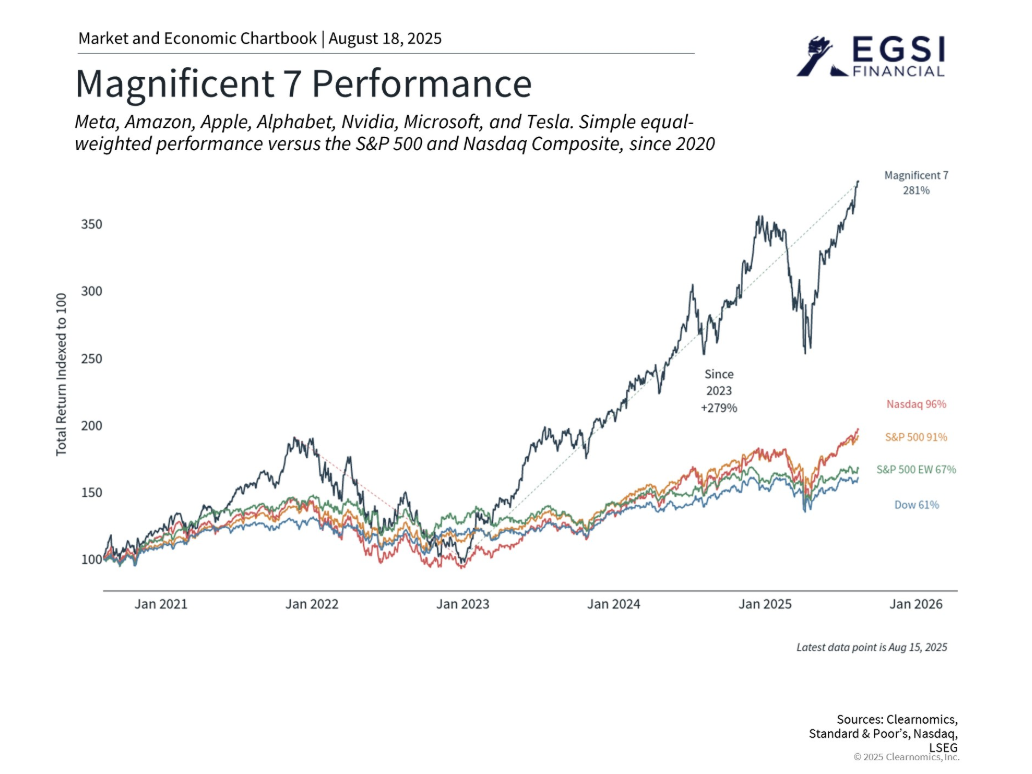
Large technology companies, especially those gaining from AI (artificial intelligence) growth, are often called the “Magnificent 7.” These seven companies – Apple, Microsoft, Nvidia, Amazon, Alphabet, Meta, and Tesla – make up about 35% of the S&P 500 stock index and are seven of the eight biggest companies by value. Some are also called “hyperscalers” because they spend huge amounts of money on computer systems to handle the growing needs of AI programs.
When just a small group of stocks drives most of the market’s gains, it becomes extra important to look at past market patterns, current stock prices, and how your investments are spread out. Learning how similar situations played out before can help investors make smarter choices for their long-term money goals.
New technology has always driven markets over time
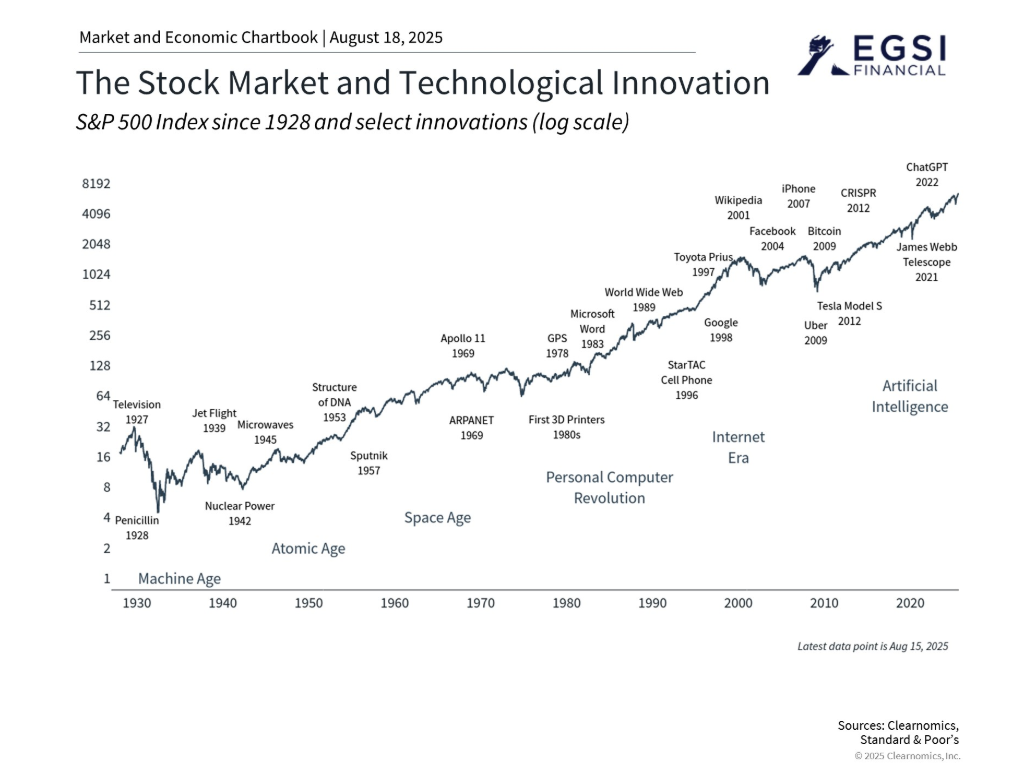
AI and railroads might seem completely different, but history shows that game-changing technologies often follow similar paths. Back in the 1860s, railroad companies controlled American stock markets just like tech companies do now. The Pennsylvania Railroad was actually the biggest company in the world at one point, and railroad stocks made up a huge part of the overall market. This created excitement and high stock prices that would sound very familiar to today’s investors.
This same pattern has happened many times throughout history. The dot-com boom of the 1990s, when investors focused almost entirely on internet companies, gives us a clear recent example. But going back to the 1800s, technologies like the telegraph, electric power, and telephones changed how cities worked and created many new businesses. In the 1900s, electronics and computers changed every part of life and business, even before the internet was invented.
Each wave of new technology followed similar steps: doubt at first, quick adoption, market excitement, and finally becoming a normal part of the economy. Railroads didn’t disappear – they became a standard part of how we move goods and people, helping the whole economy. While many dot-com companies failed in the late 1990s and early 2000s, many others became today’s technology leaders.
For long-term investing, it’s important to think not just about individual companies, but about how new technologies affect the whole market and economy. The real benefit of innovation is that it makes all businesses more productive and efficient. The key difference is that while individual company stock prices can go up and down quickly, it takes much longer for the full economic benefits to show up.
History shows that stock prices matter as much as growth
Today, the question isn’t whether AI will be important, but whether current stock prices make sense. The S&P 500 is trading at a price-to-earnings ratio (a measure of how expensive stocks are) of 22.5 times earnings, which is close to the all-time high of 24.5 times. This means investors are paying high prices based on the assumption that these trends will keep going at the same speed.
What’s causing high prices for the Magnificent 7? First, recent estimates show that U.S. private AI investment hit $109 billion in 2024, with hundreds of billions more planned this year. This is more than the entire economic output of many countries and much more than similar investments elsewhere. In recent months, investors have reacted positively when companies announce even higher AI spending. This is a big change from less than a year ago when investors worried about whether these big company investments would actually pay off.
Second, many companies and regular people have quickly started using AI tools, creating more and more demand for computing power. This explains why “hyperscalers” like Microsoft and NVIDIA have seen their company values soar, with both reaching valuations over $4 trillion. This is also why demand for new data centers (buildings full of computers), and the electricity needed to run them, are major concerns for investors.
These companies are seen as building the foundation that lets other businesses use AI technologies, much like railroad companies built the transportation systems that helped all businesses in the 1800s. While this creates huge long-term value, it’s hard to predict when investors will see returns.
The problem is that markets often overestimate how quickly new technologies will make money, even when the long-term potential might be real. The 1990s provide a warning example. During that time, some investors believed that traditional ways of valuing internet companies no longer applied. When reality didn’t meet expectations, the Nasdaq stock index fell 78% from its peak, and many companies failed or were bought out. Yet the internet did transform the economy, just not in the timeframe or way that high stock prices suggested.
Balancing opportunities with the risk of too much concentration
Just as the Magnificent 7 companies have led the market higher, they have also led it lower. For example, in 2022 when interest rates rose quickly due to inflation, these stocks dropped about 50% on average.
Since the Magnificent 7 now makes up such a large part of major stock market indexes, almost all investors have these stocks in their portfolios. For those who have focused on technology stocks, their portfolio allocations might be larger than they intended.
Having too much of your portfolio in just a few investments is called “concentration risk,” which is the opposite of diversification (spreading your money across many different investments). On one side, these companies have shown growth and profits. On the other side, having a large part of your portfolio dependent on a small group of companies, no matter how successful they are, can create ups and downs as trends change. Even great companies can go through periods of poor performance.
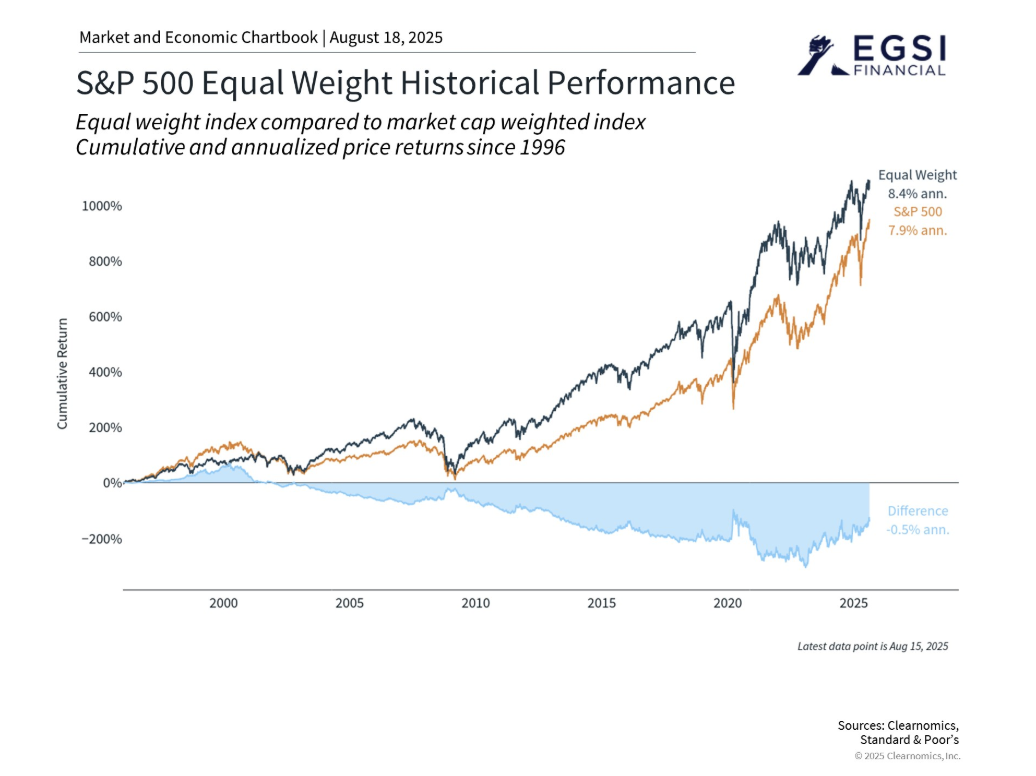
For comparison, consider the equal-weighted S&P 500 shown in the chart above, which gives the same importance to each company regardless of size. This approach has historically provided different return patterns than the standard market-capitalization weighted index (which gives bigger companies more influence), sometimes performing better when large companies struggle.
Since mega cap tech companies have done well recently, some investors might be surprised that an equal weighted index has still performed better over the past 30 years. This shows the importance of not just focusing on what has driven markets recently and what’s currently in the news.
This doesn’t mean investors should avoid technology stocks completely. Rather, it suggests the importance of keeping balance and having an appropriate mix of different investments.
The bottom line? Current AI trends offer both opportunities and risks to investors. Financial success isn’t about picking winning stocks, but keeping an appropriate portfolio balance that matches your long-term goals.
We are an independent financial services firm helping individuals create retirement strategies using a variety of investment and insurance products to custom suit their needs and objectives.
Advisory services offered through EGSI Investment Management, Inc., a Registered Investment Advisor with the State of Ohio. Insurance services offered through EGSI Financial, Inc.
Investing involves risk, including the potential loss of principal. No investment strategy can guarantee a profit or protect against loss in periods of declining values. None of the information contained on this website shall constitute an offer to sell or solicit any offer to buy a security or any insurance product.
Any references to protection benefits, safety, security, or steady and lifetime income streams on this website refer only to fixed insurance products. They do not refer, in any way, to securities or investment advisory products. Annuity guarantees are backed by the financial strength and claimspaying ability of the issuing insurance company. Annuities are insurance products that may be subject to fees, surrender charges and holding periods which vary by insurance company. Annuities are not FDIC insured.
The information and opinions contained in any of the material requested from this website are provided by third parties and have been obtained from sources believed to be reliable, but accuracy and completeness cannot be guaranteed. They are given for informational purposes only and are not a solicitation to buy or sell any of the products mentioned. The information is not intended to be used as the sole basis for financial decisions, nor should it be construed as advice designed to meet the particular needs of an individual’s situation.
Investing involves risk, including the potential loss of principal. No investment strategy can guarantee a profit or protect against loss in periods of declining values. None of the information contained on this website shall constitute an offer to sell or solicit any offer to buy a security or any insurance product.
Any references to protection benefits or steady and reliable income streams on this website refer only to fixed insurance products. They do not refer, in any way, to securities or investment advisory products. Annuity guarantees are backed by the financial strength and claims-paying ability of the issuing insurance company. Annuities are insurance products that may be subject to fees, surrender charges and holding periods which vary by insurance company. Annuities are not FDIC insured.
The information and opinions contained in any of the material requested from this website are provided by third parties and have been obtained from sources believed to be reliable, but accuracy and completeness cannot be guaranteed. They are given for informational purposes only and are not a solicitation to buy or sell any of the products mentioned.