

A well-known quote from Warren Buffett says that “someone’s sitting in the shade today because someone planted a tree a long time ago.” For many parents and guardians, saving and planning ahead is about making sure their family is financially secure.
Raising children comes with many day-to-day costs, but parents also need to prepare for bigger expenses like childcare, healthcare, and education. They also need to make sure their children are protected if something unexpected happens. With good planning, parents can manage these costs and also help set their children up for financial success by taking advantage of different savings options.
The options available for saving on behalf of children have grown with the introduction of 530A accounts, created by last year’s One Big Beautiful Bill Act. These are commonly known as “Trump Accounts.” These accounts give families more ways to grow wealth over time, but it is important to think carefully about how they fit into an overall financial plan.
Trump Accounts are the newest planning tool for children
The purpose of these accounts is to give children a head start on saving for retirement in a tax-efficient way, along with a contribution funded by the government. Think of them as a retirement savings account, similar to an individual retirement account (IRA), but designed for children. According to the Treasury Department, six million children are already signed up for Trump Accounts, with 1.4 million eligible for the $1,000 pilot program contribution.1 As with any new savings option, it helps to understand the rules before deciding how to use it for a child’s benefit.
Here are some key features of 530A accounts to keep in mind:
• If a child qualifies, the initial seed-grant of $1,000 provides a motivating reason to start saving early. Currently, children qualify if they are born between January 1, 2025 and December 31, 2028, are U.S. citizens, and have a valid Social Security Number.
• There are no earned income requirements to make contributions for a child. This makes them a useful option for long-term savings that are not set aside specifically for education.
• Investment choices are kept simple and currently include a set of low-cost funds that track U.S. stock market indexes. Any changes to these investment options would require new legislation.
• The money cannot be taken out until the child turns 18, so it cannot be used for K-12 education costs.
• Withdrawals after age 18 follow general IRA rules, including a 10% penalty for early withdrawals that do not meet a qualifying reason.
• Contributions from individuals and employers are allowed up to a combined total of $5,000 per year. Employers can contribute up to $2,500 per year without that amount being counted as taxable income for the employee.
It is helpful to think of 530A accounts as tools that work alongside other savings options rather than replacing them. After all, the most effective financial strategy is rarely built around just one type of account.
Key savings tools when planning for children
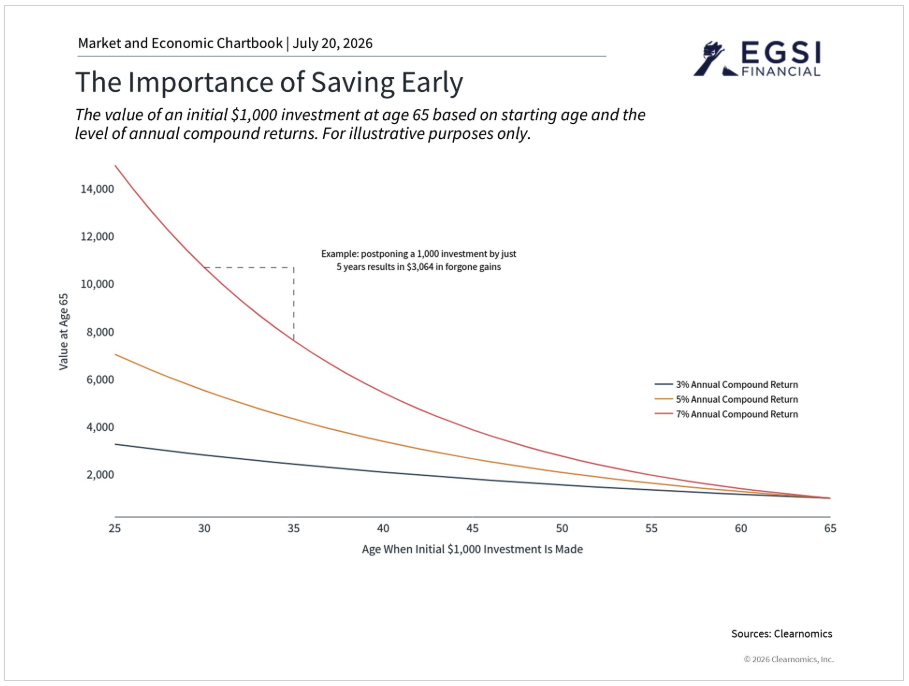
Savings accounts for children have become an important part of many financial plans. According to data from Congress, the number of children with savings accounts rose from 1.2 million in 2021 to 5.8 million in 2023.2 The chart above shows the benefit of starting to save even just a few years earlier.3
There are several ways to save for a child’s future, and the best choice depends on each family’s situation, goals, and how quickly they may need access to the money. Some of the most widely used accounts are 529 plans, custodial Roth IRAs, and Uniform Gifts to Minors Act (UGMA) or Uniform Transfers to Minors Act (UTMA) accounts. Each of these has different rules around contributions, withdrawals, and taxes. Here are some important features:
• 529 Plans: Usually opened by a parent or grandparent, these accounts are designed to help save for future education expenses. Contributions are made with money that has already been taxed, and withdrawals are free from federal taxes when used for qualified education expenses. There is no cap on how much can be contributed, but contributions are subject to annual gifting limits.
• Custodial Roth IRA: These accounts are held in the child’s name and are focused on saving for retirement. Contributions are made with money already taxed, and withdrawals are tax-free if certain conditions are met. One key difference compared to Trump Accounts is that the child must have earned income to contribute, and the annual limit is $7,500 in 2026.
• UGMA/UTMA accounts: These accounts are also owned by the child but are managed by an adult until the child reaches legal age. They are mainly used for gifting and inheritance purposes. No earned income is required, contributions are made with money already taxed, and they are subject to annual gifting limits.
Strategies for making the most of children’s savings
Families can use several strategies to save as much as possible while keeping taxes and contribution limits in mind. One approach takes advantage of a tax rule that allows donors to contribute several years’ worth of annual gift tax exclusions into a 529 education savings account all at once. This is commonly called “superfunding.”
For example, a person can contribute a lump sum of up to $95,000 per beneficiary to a child’s 529 account in a single year without triggering a gift tax. This works because the contribution is treated as if it were spread evenly over five years. As a result, no additional gifts can be made to that beneficiary from the same donor during that period without potential gift tax implications. It is also worth noting that 529 accounts owned by parents are not counted as student assets when calculating financial aid eligibility.
Another approach involves using UTMA accounts to transfer investments that have gone up significantly in value, known as highly appreciated securities. Depending on the parents’ income level, carefully gifting these investments and selling them as long-term gains inside a UTMA account may help reduce or avoid capital gains taxes. One important consideration is that these accounts are counted as student assets and are weighed more heavily when calculating federal student aid eligibility.
One pitfall to watch out for is the “kiddie tax,” which applies to income a child earns from investments rather than from working. Up to a certain amount, this income is taxed at the child’s lower tax rate. Anything above that threshold is taxed at the parents’ higher rate. This rule applies to earnings from a UTMA account or distributions from Trump Accounts.
Why starting early and letting money grow matters

Historically, even a small amount of money invested at birth can grow significantly over a long period of time, thanks to compound growth. Compound growth means that investment returns are reinvested, so over time the money grows on top of itself. This is why one of the most important principles of investing is to start as early as possible and give money time to grow. The chart above shows how $1 invested in stocks and bonds has grown over a long period of time thanks to this effect.
Teaching children about the value of saving and investing early can help them make smarter financial decisions as they grow up. By contributing to savings and investment accounts early as part of a broader financial plan, parents can help their children take full advantage of long-term growth over time.
Bottom line? By planning ahead, parents can build a strong financial foundation for their children’s futures by utilizing savings strategies and appropriate vehicles.
References
1. https://home.treasury.gov/news/press-releases/sb0552
2. https://www.congress.gov/crs-product/R48554
3. Clearnomics research based on historical market returns.
Index Descriptions
S&P 500
The Standard & Poor’s 500 Index is a capitalization-weighted index of 500 stocks designed to measure performance of the broad domestic economy through changes in the aggregate market value of 500 stocks representing all major industries. The modern design of the S&P 500 stock index was first launched in 1957. Performance prior to 1957 incorporates the performance of the predecessor index, the S&P 90.
We are an independent financial services firm helping individuals create retirement strategies using a variety of investment and insurance products to custom suit their needs and objectives.
Advisory services offered through EGSI Investment Management, Inc., a Registered Investment Advisor with the State of Ohio. Insurance services offered through EGSI Financial, Inc.
Investing involves risk, including the potential loss of principal. No investment strategy can guarantee a profit or protect against loss in periods of declining values. None of the information contained on this website shall constitute an offer to sell or solicit any offer to buy a security or any insurance product.
Any references to protection benefits, safety, security, or steady and lifetime income streams on this website refer only to fixed insurance products. They do not refer, in any way, to securities or investment advisory products. Annuity guarantees are backed by the financial strength and claims-paying ability of the issuing insurance company. Annuities are insurance products that may be subject to fees, surrender charges and holding periods which vary by insurance company. Annuities are not FDIC insured.
The information and opinions contained in any of the material requested from this website are provided by third parties and have been obtained from sources believed to be reliable, but accuracy and completeness cannot be guaranteed. They are given for informational purposes only and are not a solicitation to buy or sell any of the products mentioned. The information is not intended to be used as the sole basis for financial decisions, nor should it be construed as advice designed to meet the particular needs of an individual’s situation.
Investing involves risk, including the potential loss of principal. No investment strategy can guarantee a profit or protect against loss in periods of declining values. None of the information contained on this website shall constitute an offer to sell or solicit any offer to buy a security or any insurance product.
Any references to protection benefits or steady and reliable income streams on this website refer only to fixed insurance products. They do not refer, in any way, to securities or investment advisory products. Annuity guarantees are backed by the financial strength and claims-paying ability of the issuing insurance company. Annuities are insurance products that may be subject to fees, surrender charges and holding periods which vary by insurance company. Annuities are not FDIC insured.
The information and opinions contained in any of the material requested from this website are provided by third parties and have been obtained from sources believed to be reliable, but accuracy and completeness cannot be guaranteed. They are given for informational purposes only and are not a solicitation to buy or sell any of the products mentioned. The information is not intended to be used as the sole basis for financial decisions, nor should it be construed as advice designed to meet the particular needs of an individual’s situation.