

In July, the S&P 500 stock index reached ten new record highs. This happened because companies reported good earnings (profits), economic data looked strong, and new trade agreements were made before important tariff deadlines. The S&P 500 had six straight days of record closing prices in the second half of July. For the year so far, this main stock index is up 7.8%.
But at the end of July, markets became uncertain again. On July 31, the government announced new tariff rates (fees on imported goods), which worried people about higher prices for everyday items. Also, the July jobs report showed that the job market had been much weaker in recent months than people thought.
In times like these, it’s important for investors to stay calm as markets react to new trade news and economic information. The past few months show us that things can change quickly, so keeping a long-term view is still the best way to reach your financial goals.
Important Market and Economic Information
- The S&P 500 went up 2.2% in July, the Dow Jones Industrial Average rose 0.1%, and the Nasdaq increased 3.7%. For the whole year so far, the S&P 500 is up 7.8%, the Dow is up 3.7%, and the Nasdaq is up 9.4%.
- The Bloomberg U.S. Aggregate Bond Index (which tracks bonds) fell 0.3% in July. The 10-year Treasury bond yield (interest rate) rose slightly to end the month at 4.38%.
- International stocks had mixed results. Developed market stocks (MSCI EAFE index) fell 1.5% while emerging market stocks (MSCI EM index) gained 1.7%.
- The economy (GDP) grew at a 3.0% annual rate in the second quarter, mainly because businesses started investing more and importing more due to tariffs.
- The U.S. dollar got stronger, rising from 96.88 at the end of June to 99.97 at the end of July. But it’s still down a lot this year.
- Bitcoin hit a record high of $120,198 in the middle of the month but ended July at $116,491.
- Gold prices stayed strong but are below recent peaks, ending the month at $3,293.
- Copper prices jumped to record levels because of targeted tariffs, but then had its biggest single-day drop of 22%.
- The Consumer Price Index (which measures inflation or rising prices) increased 2.7% compared to a year ago in June, matching what economists expected.
- Only 73,000 new jobs were added in July. Big downward changes to May and June job numbers mean the economy was much weaker than first reported. The unemployment rate stayed low at 4.2%.
Stock markets hit new record highs
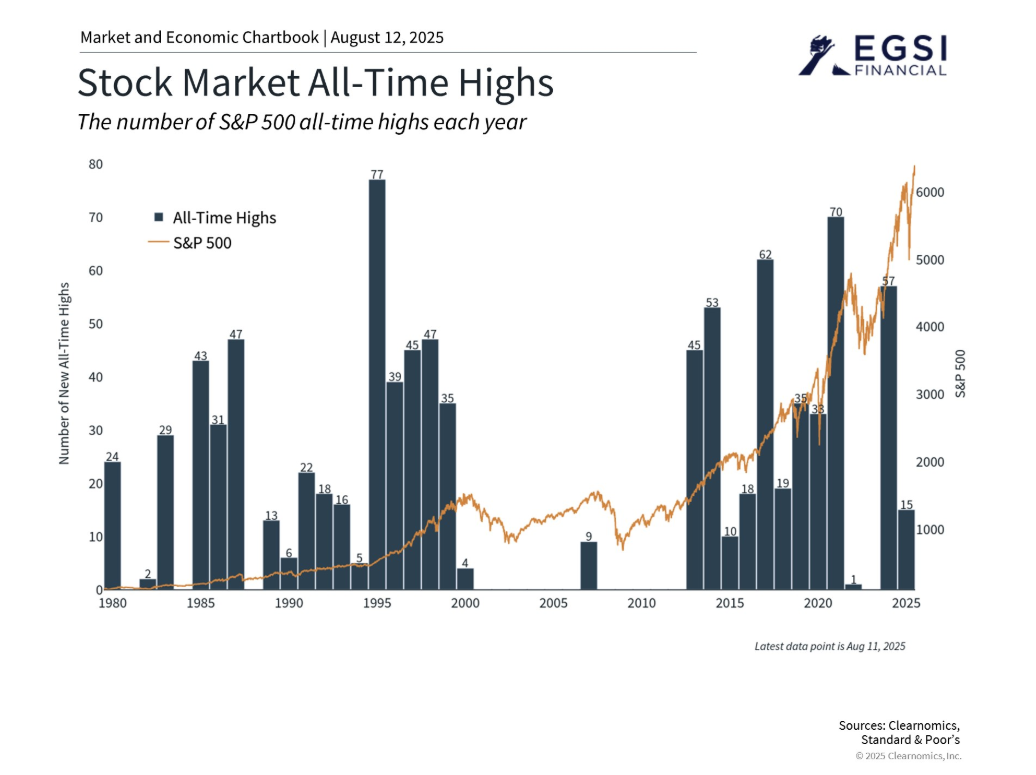
Companies continued to report better-than-expected earnings (profits) in July, which pushed stock prices higher. While many companies said tariffs affected them, the impacts weren’t always bad. More than a third of S&P 500 companies have reported their results, and 80% beat earnings expectations. Overall earnings growth is now 6.4% per year, which is lower than recent quarters but better than Wall Street analysts predicted.1
Excitement about artificial intelligence helped several Magnificent 7 stocks (the biggest tech companies). Both Microsoft and Meta reported better earnings than expected while making big investments in AI technology. Because of this, Microsoft became the second company ever to be worth more than $4 trillion. However, Tesla reported disappointing results for the second quarter, causing its stock price to fall.
While tech stocks have had ups and downs in 2025, the Information Technology sector is up over 13% this year. Only the Industrials sector has done better, returning over 15% so far in 2025. Meanwhile, Health Care and Consumer Discretionary stocks have performed poorly and are down for the year.
For bonds, it was a quiet month with bond prices falling slightly overall. The Federal Reserve (the Fed) kept interest rates the same at 4.25% to 4.50% for the fifth meeting in a row. They’re trying to balance worries about inflation from tariffs with economic growth. But for the first time since 1993, two Fed governors disagreed with this decision and wanted to cut rates by a quarter point. This comes as President Trump and Fed Chair Powell continue to have public disagreements, with the White House pushing the Fed to lower interest rates.
New data after the meeting showed that hiring got weaker in July, with only 73,000 jobs added. Previous job reports were revised down, meaning there were actually 258,000 fewer jobs added in May and June than first reported. The three-month average is now only 35,000 new jobs per month, much lower than normal. This suggests the Fed may need to focus more on employment, increasing the chance of rate cuts possibly starting in September.
Investors wait for new trade deals and tariff announcements
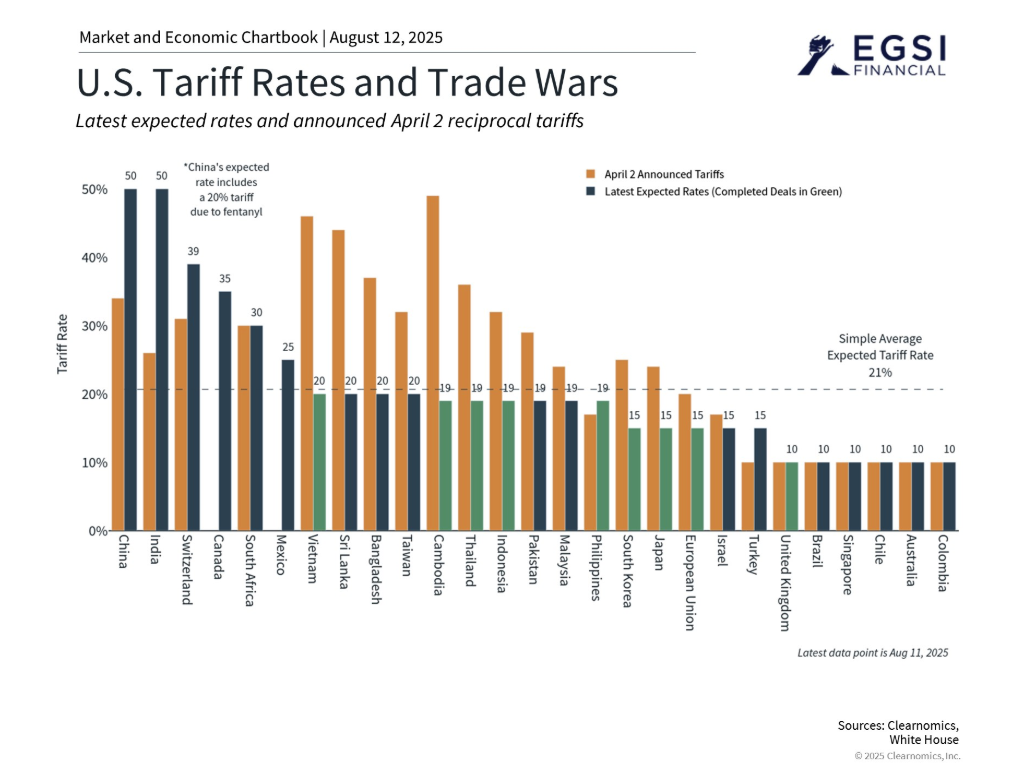
Throughout July, the White House announced several new trade deals with the European Union, Japan, and South Korea. Trade talks with China are still happening. These deals avoided the worst-case situation that many investors worried about in April, but many other countries still face potentially higher tariff rates as negotiation deadlines pass. On July 31, President Trump signed an executive order setting new tariff rates for many trading partners, to start on August 7 (the previous deadline was August 1), as shown in the chart above.
As of July 23, the Yale Budget Lab estimates that consumers face an overall effective tariff rate of 20.2%, the highest since 1911. So far, companies seem to have absorbed much of this extra cost instead of passing it on to consumers through higher prices. Whether this continues depends on where tariffs end up and how well companies can adapt.
The government passed major laws on taxes and digital currencies
Bitcoin reached new highs in July as Congress considered new laws to regulate cryptocurrencies (digital currencies like Bitcoin). The government’s friendly approach toward wider use of cryptocurrencies has helped Bitcoin gains in 2025. Separately, the GENIUS Act, which is now law, focuses on stablecoins (cryptocurrencies that are tied to the U.S. dollar value).
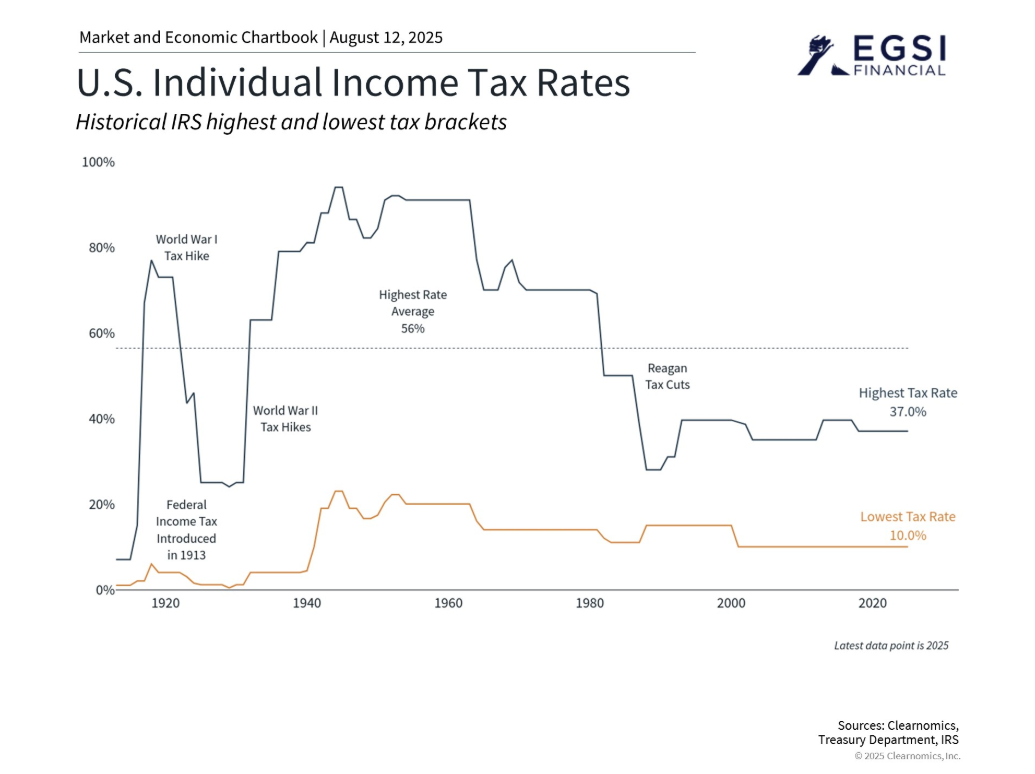
On July 4, President Trump signed a major tax and spending bill that made many parts of the Tax Cuts and Jobs Act permanent, including current tax rates and tax brackets. The bill gives investors more certainty by keeping the current low-tax environment, but also raises concerns about the growing national debt being sustainable.
The Congressional Budget Office estimates the bill will add over $3 trillion to the national debt over the next ten years. While the bill included spending cuts to major programs, these were more than offset by reductions in tax revenue.
Making many of these tax changes permanent removes uncertainty that affected long-term financial planning, since many provisions from the TCJA were supposed to expire this year. This could help support business investment and consumer spending in the near term.
The bottom line? The stock market reached many new highs during a busy month of tariff changes, a new tax bill, and company earnings reports. As we move into August, trade deals and earnings will likely remain key focuses for investors.
1.https://advantage.factset.com/hubfs/Website/Resources%20Section/Research%20Desk/Earnings%20Insight/EarningsInsight_072525.pdf
We are an independent financial services firm helping individuals create retirement strategies using a variety of investment and insurance products to custom suit their needs and objectives.
Advisory services offered through EGSI Investment Management, Inc., a Registered Investment Advisor with the State of Ohio. Insurance services offered through EGSI Financial, Inc.
Investing involves risk, including the potential loss of principal. No investment strategy can guarantee a profit or protect against loss in periods of declining values. None of the information contained on this website shall constitute an offer to sell or solicit any offer to buy a security or any insurance product.
Any references to protection benefits, safety, security, or steady and lifetime income streams on this website refer only to fixed insurance products. They do not refer, in any way, to securities or investment advisory products. Annuity guarantees are backed by the financial strength and claimspaying ability of the issuing insurance company. Annuities are insurance products that may be subject to fees, surrender charges and holding periods which vary by insurance company. Annuities are not FDIC insured.
The information and opinions contained in any of the material requested from this website are provided by third parties and have been obtained from sources believed to be reliable, but accuracy and completeness cannot be guaranteed. They are given for informational purposes only and are not a solicitation to buy or sell any of the products mentioned. The information is not intended to be used as the sole basis for financial decisions, nor should it be construed as advice designed to meet the particular needs of an individual’s situation.
Investing involves risk, including the potential loss of principal. No investment strategy can guarantee a profit or protect against loss in periods of declining values. None of the information contained on this website shall constitute an offer to sell or solicit any offer to buy a security or any insurance product.
Any references to protection benefits or steady and reliable income streams on this website refer only to fixed insurance products. They do not refer, in any way, to securities or investment advisory products. Annuity guarantees are backed by the financial strength and claims-paying ability of the issuing insurance company. Annuities are insurance products that may be subject to fees, surrender charges and holding periods which vary by insurance company. Annuities are not FDIC insured.
The information and opinions contained in any of the material requested from this website are provided by third parties and have been obtained from sources believed to be reliable, but accuracy and completeness cannot be guaranteed. They are given for informational purposes only and are not a solicitation to buy or sell any of the products mentioned.