
Federal Reserve Chair Jerome Powell recently spoke at an important meeting called the Jackson Hole conference. His speech suggested that the Fed will likely lower interest rates in September. Powell explained that while there are concerns about tariffs and rising prices, the Fed also needs to help keep people employed. Stock markets have been reaching record highs lately, which shows that investors feel good about the Fed’s plans and trust in the economy’s strength. What could a rate cut mean for people who invest for the long term?
Why investor trust in the Fed is important
The connection between Fed trustworthiness and investor confidence is often ignored, but it’s very important for how the Fed’s decisions actually work. Financial markets act like a “reality check” for the central bank. While the Fed controls short-term rates, longer-term interest rates that affect home loans and business borrowing are set by markets. This means the Fed’s policies only work when investors believe the Fed can reach its goals through rate changes and communication.
The 1970s show what happens when people don’t trust the Fed. When the Fed lost credibility by letting prices rise too much, bond market investors basically raised interest rates themselves by demanding higher returns to protect against inflation risk. On the other hand, the period after 2008 showed how Fed credibility helped keep long-term inflation expectations steady. Even when the Fed was perhaps slow to fight inflation after the pandemic, their quick rate increases and strong statements helped restore confidence about future inflation.
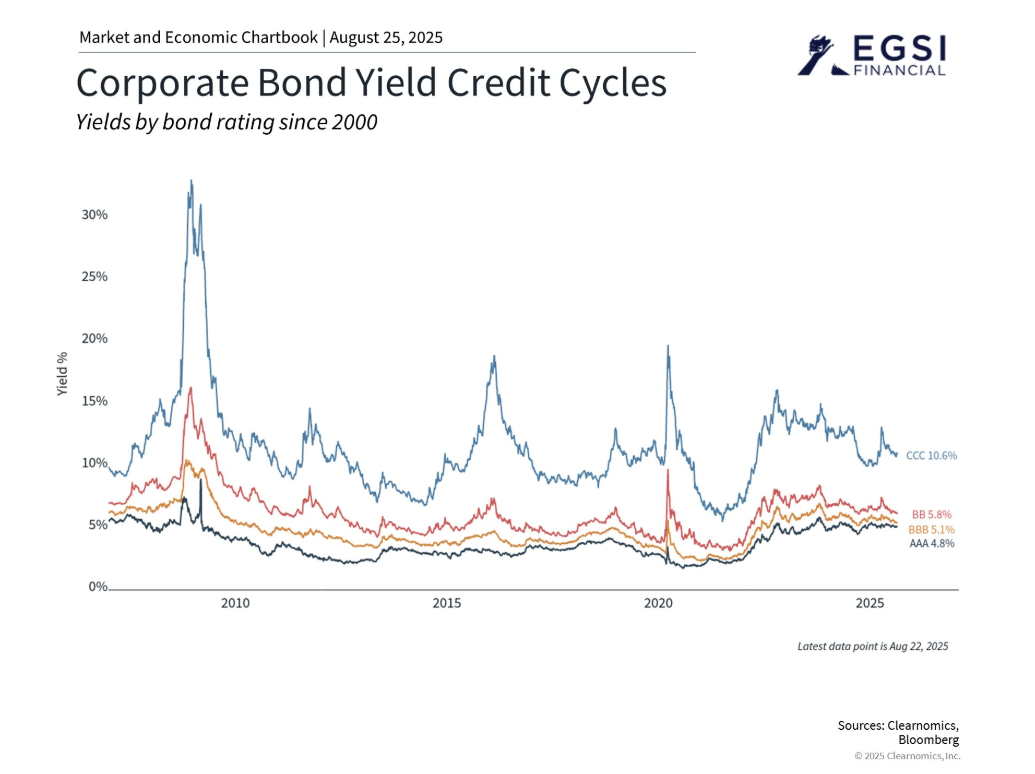
One way to measure confidence in both the Fed and the economy is through corporate bond yields. Yields show how much extra return investors want to lend money to companies based on risk. These yields usually drop when the economy is doing well and company profits are growing, and they rise when there are financial and economic worries. Similarly, corporate credit spreads show us how much extra yield investors want above safe government bonds.
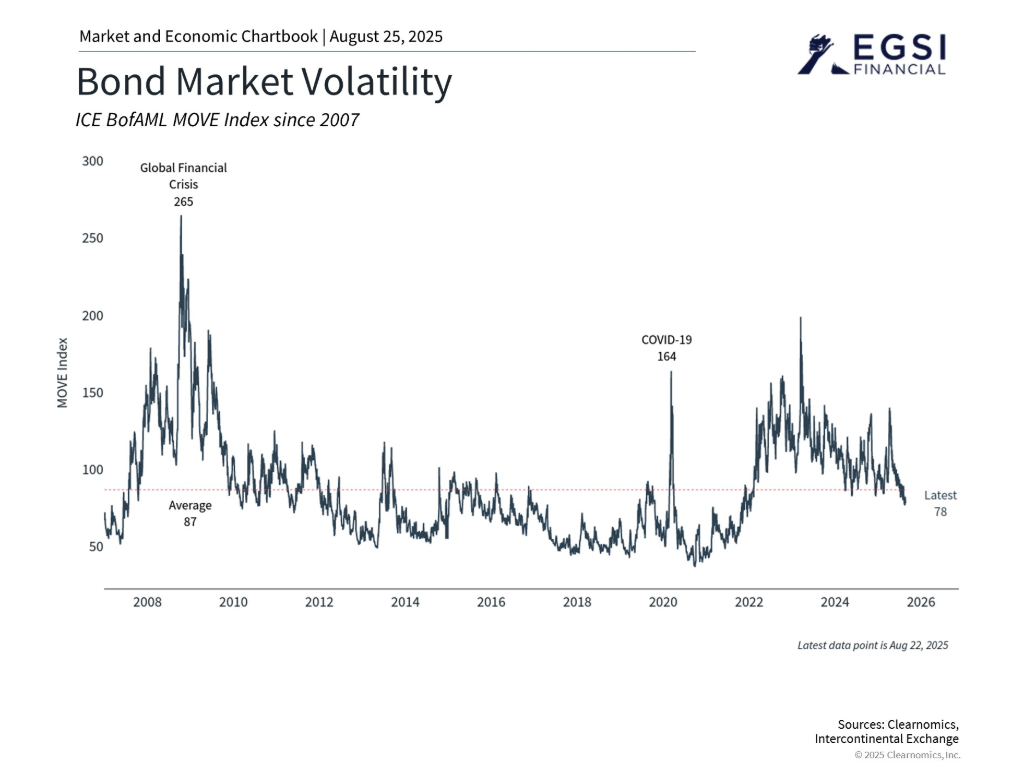
Today’s market conditions suggest this confidence stays strong. One of the clearest signs of market confidence comes from corporate bond markets, where credit yields and spreads have hit their lowest points in years, as the chart above shows. High-yield spreads have also gotten tighter, showing that investors feel comfortable taking on corporate credit risk. This matches with major stock market indexes hitting new record highs because of investor confidence.
The Fed is hinting at rate cuts
Powell’s Jackson Hole speech recognized the careful balance the Fed must maintain between controlling rising prices and supporting jobs. While the Fed chair noted that “risks to inflation are tilted to the upside” because of tariff effects, he also stressed “significant risks to employment to the downside.” This double focus shows the Fed’s job to promote both stable prices and employment.
Recent economic numbers show this challenge. The Fed’s favorite inflation measure, called the Personal Consumption Expenditures Price Index, has gone up 2.6% over the past year, while core PCE increased 2.8%. These levels stay above the Fed’s 2% goal, and along with the Consumer Price Index and Producer Price Index, show signs that companies are starting to pass higher costs to consumers.
However, job market data has shown unexpected weakening. July’s jobs report showed that only 73,000 new jobs were added, much lower than the historical average and what experts expected. Downward changes to previous months suggested that the job market has been cooling more than first thought. Unemployment has stayed steady between 4.0% and 4.2%, but this stability partly comes from fewer people looking for work and changes in immigration policy affecting labor supply.
The Fed’s challenge is figuring out whether tariff-related price increases are a temporary change or a sign of getting worse inflation pressures. So, right now, the Fed appears to be getting ready for careful rate cuts.
Rate cuts create chances across bond types
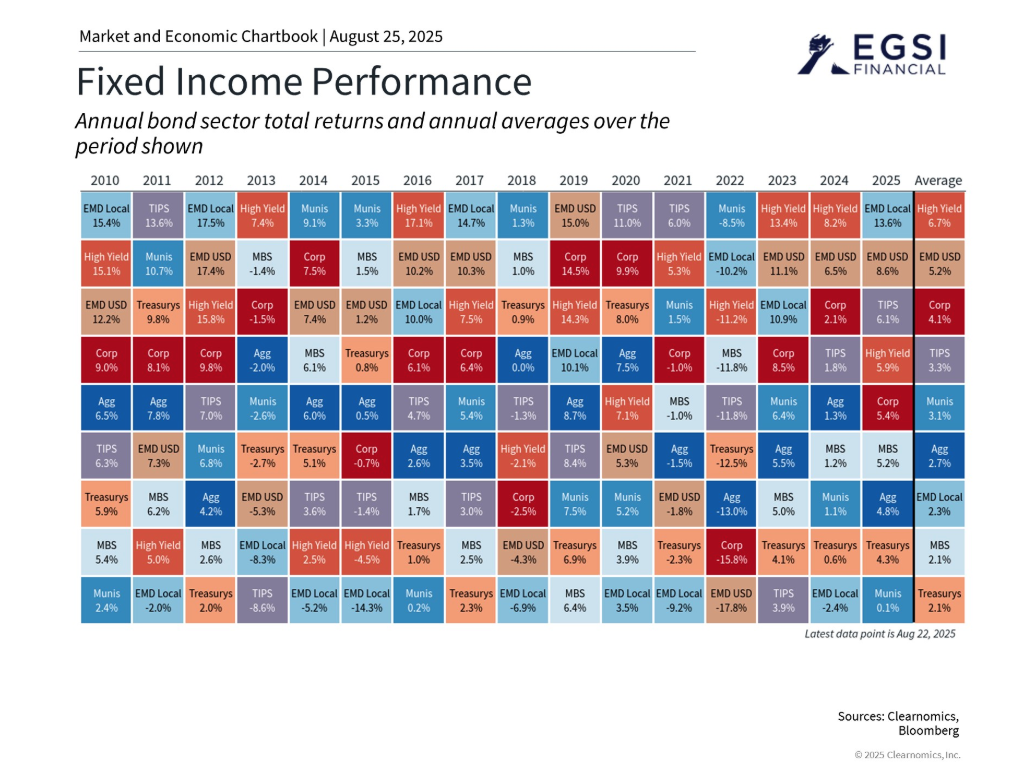
The possibility of Fed rate cuts has important effects for all investors. Historically, falling policy rates help bond prices, since existing bonds with higher yields become more valuable. Also, changing rates and market ups and downs have helped support diversified bond holdings. All of these factors have helped the U.S. Aggregate Bond Index generate a total return of 4.8% this year.
Whether long-term rates come down or not, bond yields are quite attractive. For example, the average yield for Treasurys is currently 4.0%, 4.9% for investment grade corporate bonds, and 6.9% for high yield debt. To help investors create portfolio income, these yields are still much higher than the average levels since 2008.
For stock investors, lower rates typically reduce borrowing costs for companies, which can increase growth rates. This can support higher valuations since future cash flows can be worth more today when interest rates are lower. The market’s recent record highs suggest investors are already positioning for this supportive environment.
Of course, when credit spreads are tight and market valuations are high, it’s important to stay disciplined. When spreads are compressed, corporate bonds may offer limited additional return potential and could face challenges if conditions get worse. Similarly, high valuations can also mean that long-run expected returns may be lower.
This doesn’t mean avoiding stocks or bonds entirely, or trying to time the market, but instead highlights the importance of holding an appropriate asset mix to balance these risks. A well-built portfolio can benefit from a stable economic environment and expected rate cuts, while keeping protection against unexpected developments.
The bottom line? Market confidence in Fed policy direction, combined with strong corporate fundamentals, creates opportunities for long-term investors. Holding an appropriate portfolio is still the best way to navigate long run risk and returns.
We are an independent financial services firm helping individuals create retirement strategies using a variety of investment and insurance products to custom suit their needs and objectives.
Advisory services offered through EGSI Investment Management, Inc., a Registered Investment Advisor with the State of Ohio. Insurance services offered through EGSI Financial, Inc.
Investing involves risk, including the potential loss of principal. No investment strategy can guarantee a profit or protect against loss in periods of declining values. None of the information contained on this website shall constitute an offer to sell or solicit any offer to buy a security or any insurance product.
Any references to protection benefits, safety, security, or steady and lifetime income streams on this website refer only to fixed insurance products. They do not refer, in any way, to securities or investment advisory products. Annuity guarantees are backed by the financial strength and claimspaying ability of the issuing insurance company. Annuities are insurance products that may be subject to fees, surrender charges and holding periods which vary by insurance company. Annuities are not FDIC insured.
The information and opinions contained in any of the material requested from this website are provided by third parties and have been obtained from sources believed to be reliable, but accuracy and completeness cannot be guaranteed. They are given for informational purposes only and are not a solicitation to buy or sell any of the products mentioned. The information is not intended to be used as the sole basis for financial decisions, nor should it be construed as advice designed to meet the particular needs of an individual’s situation.
Investing involves risk, including the potential loss of principal. No investment strategy can guarantee a profit or protect against loss in periods of declining values. None of the information contained on this website shall constitute an offer to sell or solicit any offer to buy a security or any insurance product.
Any references to protection benefits or steady and reliable income streams on this website refer only to fixed insurance products. They do not refer, in any way, to securities or investment advisory products. Annuity guarantees are backed by the financial strength and claims-paying ability of the issuing insurance company. Annuities are insurance products that may be subject to fees, surrender charges and holding periods which vary by insurance company. Annuities are not FDIC insured.
The information and opinions contained in any of the material requested from this website are provided by third parties and have been obtained from sources believed to be reliable, but accuracy and completeness cannot be guaranteed. They are given for informational purposes only and are not a solicitation to buy or sell any of the products mentioned.