
In recent weeks, stock market swings have been largely driven by rising oil prices and ongoing geopolitical conflict. Brent crude oil — a global benchmark for oil prices — has climbed back above $100 per barrel. This raises concerns that higher energy costs could slow economic growth while also pushing prices higher for consumers, a situation known as inflation. These concerns add to other existing worries, such as how artificial intelligence is affecting businesses, overall stock market valuations, private credit (loans made by non-bank lenders), and what the Federal Reserve (the U.S. central bank) may do with interest rates. All of this can naturally lead investors to wonder whether their portfolios are in good shape.
The author Alfred A. Montapert once wrote “do not confuse motion and progress.” When markets move up and down every day because of global headlines, it can be tempting to think that portfolios and financial plans need frequent changes. However, a key principle of good financial planning is that the hard work should already be done before uncertainty arrives. A well-built portfolio holds the right mix of different types of investments that work well together and are aligned with your financial goals. This kind of portfolio is designed to handle different market conditions without needing constant adjustments.
That said, markets without a clear direction can feel unsettling. During times like these, keeping a calm and level-headed perspective is especially important when there is so much negative news. It is more important than ever to keep long-term goals in focus, because saving and investing wisely are still the best ways to build wealth over time. So, what should investors keep in mind as uncertainty continues?
Market pullbacks are an unavoidable part of investing
The stock market has been bumpy this year. As of mid-March, the S&P 500 — a widely followed measure of U.S. stock performance — was sitting about 5% below its all-time high, which was reached back in January. While recent market moves may feel uncomfortable, declines of this size are completely normal. In fact, in a typical year, the market experiences several drops of 5% or more over the course of weeks or months before bouncing back. In 2025, for example, there were six such pullbacks for the S&P 500, driven mainly by tariffs, yet the market still generated a total return of 18% for the year.
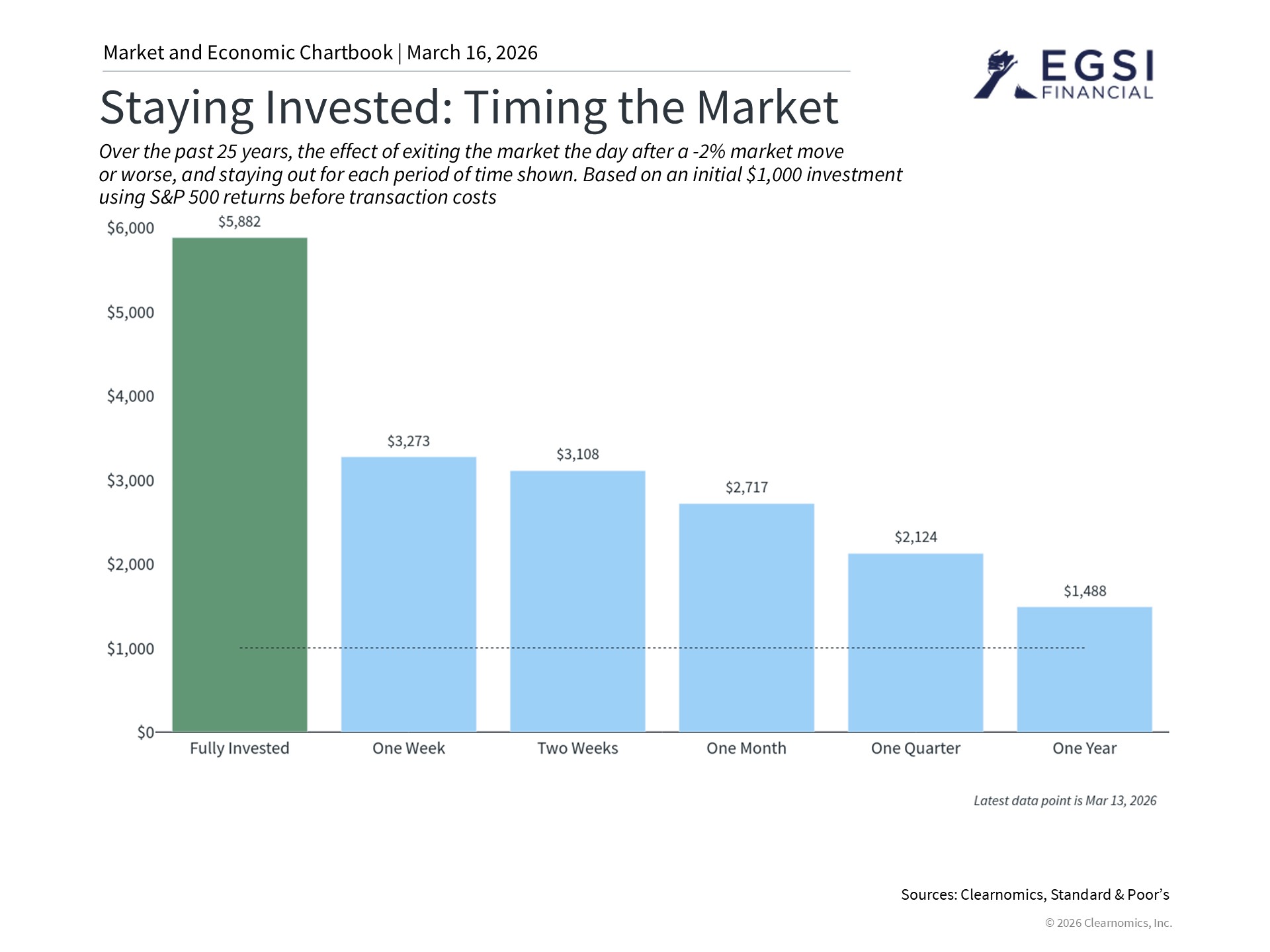
This is the foundation of why staying invested has historically been the best approach for long-term investors. Some investors may be tempted to try to time the market — meaning they sell when things look bad and buy back in when things improve. But the challenge is not just knowing when to get out; it is also knowing when to get back in. The accompanying chart shows that even missing just one week after a period of heavy market swings has historically hurt investment results. While there are no guarantees, this is historically because the market’s best days have tended to follow closely after its worst days. Investors who moved to the sidelines often missed the very recoveries they were waiting for.
This is not to say that market pullbacks do not matter, or that markets always bounce back quickly. Rather, the point is that they are a recurring feature of investing that should be planned for, not reacted to.
Bond yields are attractive amid recent volatility
While stocks tend to grab most of the headlines, the bond market is equally important. Bonds are essentially loans that investors make to governments or companies in exchange for regular interest payments. One of the key factors affecting bonds is inflation, and the rise in oil prices has raised new questions in recent weeks. Adding to the uncertainty is an upcoming change in leadership at the Federal Reserve in May, along with questions about whether the central bank might adjust its plans for interest rates. Currently, market expectations point to only one rate cut by the end of this year.
Bonds are a core investment holding that often help balance out stock market swings. However, the geopolitical conflict in the Middle East has also affected bonds, with a broad measure of the U.S. bond market — the Bloomberg U.S. Aggregate Bond Index — roughly flat so far this year. The 10-year U.S. Treasury yield, which moves in the opposite direction of bond prices, has risen back above 4.2% after falling as low as 3.9% when the conflict in Iran began.
Some perspective is helpful here. After a historic drop in 2022, when inflation and interest rates rose quickly and hurt bond values, bonds have since contributed positively. From 2023 to 2025, bonds generated strong returns. Since the low point in October 2022, the broad bond market has returned roughly 20% in total, with some specific areas of the bond market performing even better.
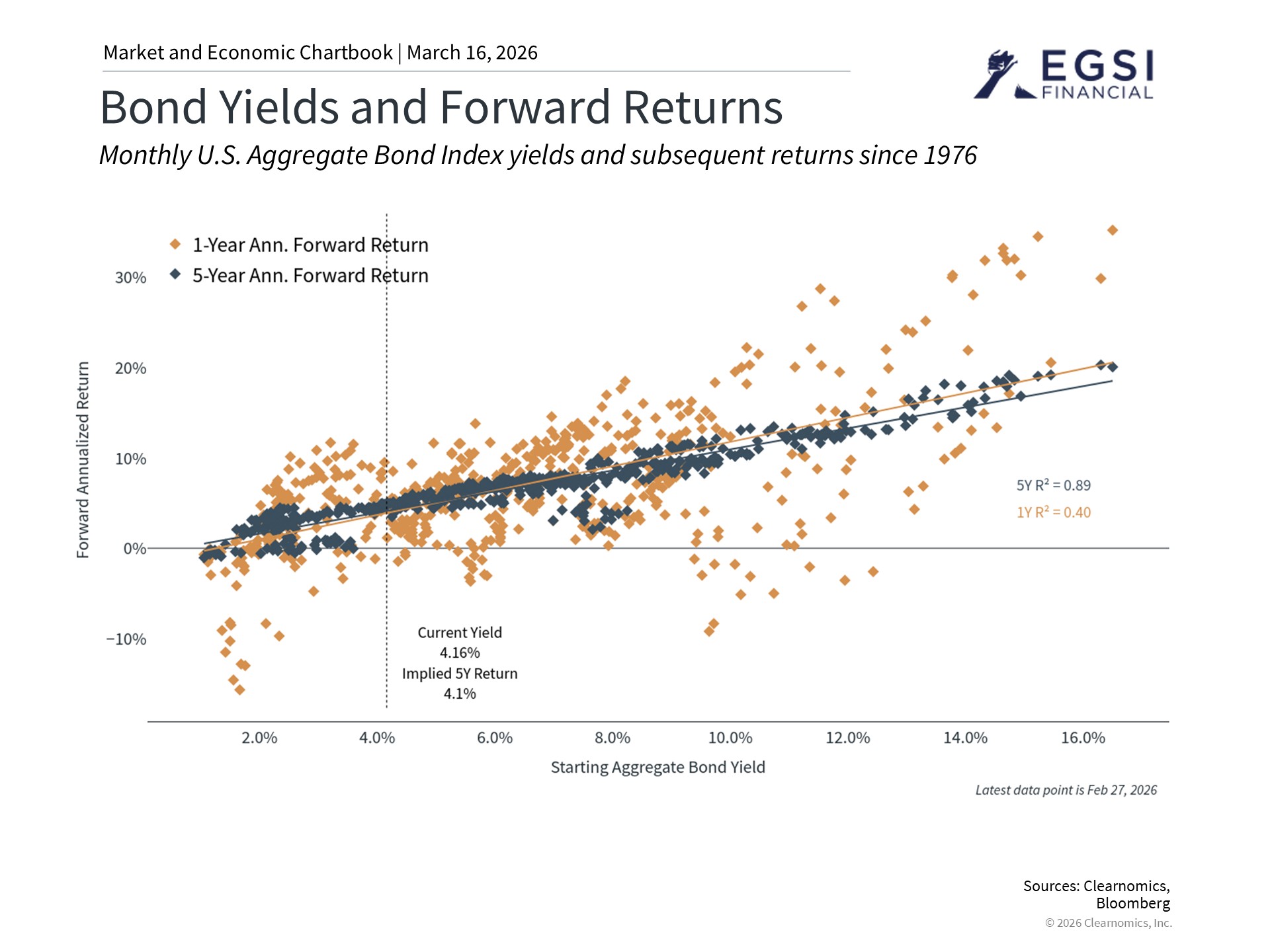
For long-term investors, bond yields — the interest income a bond pays relative to its price — remain attractive compared to the previous decade. Today’s bond yields offer meaningful income potential that simply was not available for much of the past ten years. Specifically, the yield on the U.S. Aggregate Bond Index is 4.5%, well above the 2.9% average since 2009. Investing in bonds when yields are higher has also historically been linked to stronger total returns over time, as shown in the accompanying chart.
This is especially relevant when compared to holding cash. Cash yields are still negative in real terms — meaning after accounting for inflation, you are actually losing purchasing power. On average, $10,000 invested in certificates of deposit (a type of savings account that pays a fixed interest rate) yields about $155 a year, which is still well below the current inflation rate of between 2.5% to 3%. For those who are retired or close to retirement, inflation may feel even higher due to rising medical expenses and insurance costs. So, while cash may feel like the safe choice, a proper allocation to bonds remains the better way to generate income and support long-term growth.
It is also worth noting that there is growing concern around private credit — an asset class made up of loans to companies that are made by non-bank lenders rather than through public markets. Reports of rising redemption requests (meaning investors are asking to take their money out) and some larger funds limiting withdrawals have raised eyebrows. The sector has grown significantly in recent years and is connected to areas of market uncertainty such as technology and energy. Unlike publicly traded bonds, private credit is structured to be a long-term investment, precisely because it comes with this type of uncertainty. Like any other investment, what matters most is whether private credit is appropriate for a given portfolio and how it fits alongside other holdings.
Having a portfolio perspective continues to benefit investors
While each type of investment brings its own considerations, the past few weeks highlight the value of a well-constructed portfolio. Holding a variety of different investments — whether across asset classes, specific sectors, or different parts of the world — helps smooth out the ups and downs of portfolio performance during volatile periods. This reduces the temptation to make sudden changes that can get in the way of long-term financial plans.
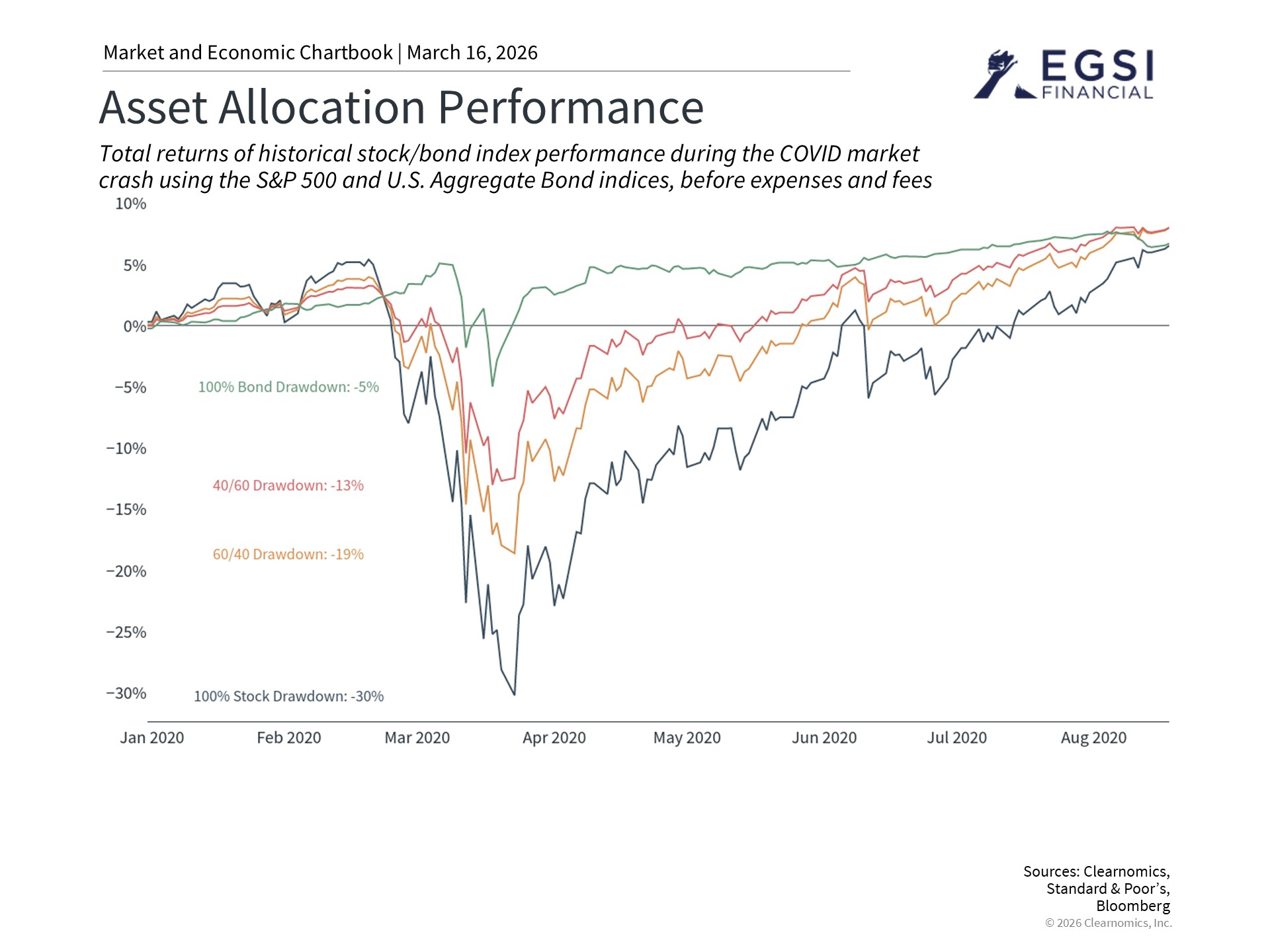
The accompanying chart highlights one of the most volatile periods in recent history: the pandemic in 2020. Different mixes of investments behaved in very different ways during that time. Portfolios that were more balanced across asset classes experienced smaller swings in value. While these portfolios all ended up at roughly the same level after that period, the real question is whether investors would have panicked and sold when stocks were down 20% or 30%.
Today, assets like commodities — physical goods such as oil and precious metals — are leading the way in performance due to rising energy and metals prices. However, the goal is not to guess which investment type will perform best next and concentrate a portfolio there. Instead, it is about benefiting from the full range of market movements. When one part of a portfolio struggles, another may help provide balance. Over time, this approach has allowed investors to participate in growth while managing risk — which is ultimately what achieving long-term financial goals requires.
The bottom line? Market volatility driven by oil prices and geopolitical uncertainty is uncomfortable but not unusual. Staying invested with a diversified portfolio remains the best way to turn short-term swings into long-term progress.
We are an independent financial services firm helping individuals create retirement strategies using a variety of investment and insurance products to custom suit their needs and objectives.
Advisory services offered through EGSI Investment Management, Inc., a Registered Investment Advisor with the State of Ohio. Insurance services offered through EGSI Financial, Inc.
Investing involves risk, including the potential loss of principal. No investment strategy can guarantee a profit or protect against loss in periods of declining values. None of the information contained on this website shall constitute an offer to sell or solicit any offer to buy a security or any insurance product.
Any references to protection benefits, safety, security, or steady and lifetime income streams on this website refer only to fixed insurance products. They do not refer, in any way, to securities or investment advisory products. Annuity guarantees are backed by the financial strength and claimspaying ability of the issuing insurance company. Annuities are insurance products that may be subject to fees, surrender charges and holding periods which vary by insurance company. Annuities are not FDIC insured.
The information and opinions contained in any of the material requested from this website are provided by third parties and have been obtained from sources believed to be reliable, but accuracy and completeness cannot be guaranteed. They are given for informational purposes only and are not a solicitation to buy or sell any of the products mentioned. The information is not intended to be used as the sole basis for financial decisions, nor should it be construed as advice designed to meet the particular needs of an individual’s situation.