

When people think about investing in the stock market, they usually start by looking at well-known market benchmarks, like the S&P 500 or the Dow Jones Industrial Average. These are broad measures of how the market is doing overall. But it can also be useful to look at the different sectors — or industry groups — that make up these benchmarks. For example, the S&P 500 is divided into 11 sectors, each with its own unique characteristics. These sectors can behave very differently from one another depending on what is happening in the economy or around the world. Understanding how sectors work is an important part of building a balanced portfolio and planning for the long term.
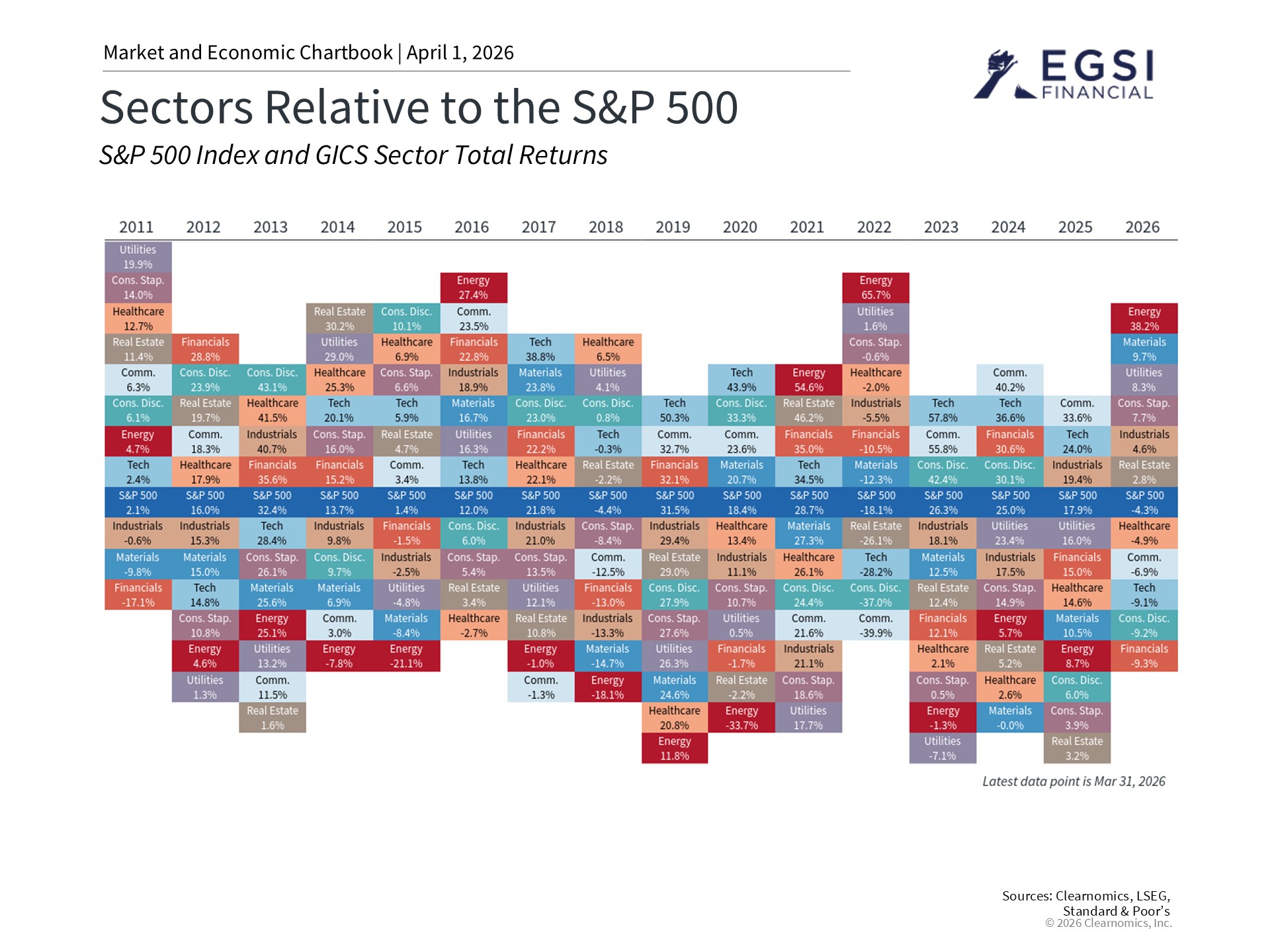
Right now, the gap between the best and worst performing sectors has grown to more than 40 percentage points this year. This wide gap has been shaped by ongoing conflict in the Middle East, changing oil prices, and new developments in artificial intelligence (AI). At the same time, the S&P 500 recently dropped more than 5% from its all-time high, even though 6 of the 11 sectors are still up for the year. This can happen because not all sectors carry the same weight in the index. For instance, Technology currently makes up nearly one-third of the S&P 500, while Energy and Utilities represent just 3.5% and 2.5%, respectively. History shows that market conditions can change quickly, and recoveries often happen when people least expect them — though past performance does not guarantee future results.
While recent market movements have been notable, it is worth remembering that sector-level differences happen every year. Taking a longer-term view, many sectors have performed well over the past few years, often in surprising ways. This is a reminder that spreading investments across sectors — not just across different types of assets — is an important strategy. So, what should investors know about the recent shift in sector performance and the market pullback?
The energy sector has surged amid geopolitical uncertainty

Energy stocks have climbed as global tensions push oil prices higher
The energy sector — which includes companies that produce and sell oil, gas, and other fuels — has been one of the top performers so far in 2026, gaining around 30% year-to-date. This strong performance has been driven by a sharp rise in oil prices, with Brent crude (a widely used benchmark for global oil prices) hovering above $100 per barrel due to rising tensions in the Middle East. These developments are still unfolding and could continue to cause market swings. History shows that energy stocks have often risen during periods of global conflict and uncertainty.
For example, in 2022, when Russia invaded Ukraine, the energy sector gained 65.7% for the full year, even as the broader S&P 500 fell 18%. The year before that, energy returned 54.6% as the economy recovered from the pandemic. While the overall market has historically recovered from these major events, they show how energy stocks can act as a buffer — or counterweight — when other parts of the market are struggling.
This year, oil prices initially rose because of the blockage of the Strait of Hormuz, a key shipping route for oil, which forced many Middle Eastern countries to cut back on production. More recently, attacks have targeted energy production facilities directly. When oil prices rise, energy companies benefit because they earn more money from selling oil and gas, which also encourages them to invest in finding and producing more.
However, higher oil prices can be a challenge for the broader economy in the short term. They raise costs for consumers filling up their cars, for businesses that rely on transportation, and for many industries that use energy as an input. This is why the same event that helps energy stocks can hurt other sectors, such as transportation, retail, and manufacturing.
That said, there are reasons for long-term optimism. Between 2011 and 2014, oil prices stayed near $100 per barrel, yet the economy continued to grow and the stock market kept rising. Economists often describe these kinds of disruptions as “supply-side shocks” — meaning they are caused by a temporary reduction in supply rather than a fundamental change in the economy. Over time, production tends to be restored and other suppliers step in to fill the gap.
The United States, for instance, has been the world’s largest oil producer for six consecutive years, with output now exceeding 13.7 million barrels per day. The U.S. is often referred to as a “swing producer” because it can increase production to help offset shortages elsewhere in the world. This ability to ramp up supply helps keep prices from rising too much and reduces the economy’s dependence on foreign oil sources.
AI has raised new questions about technology companies

The AI boom has led to new questions about the future of tech stocks
Over the past several years, companies tied to artificial intelligence (AI) have been among the biggest drivers of stock market gains. Sectors like Information Technology, Communication Services, and Consumer Discretionary all benefited. A group of the largest and most influential AI-related companies, often called the Magnificent 7, played a major role in pushing markets higher. However, this concentration also made the overall market more sensitive to the performance of just a small number of companies.
More recently, the picture has changed. While many of these companies are still reporting strong financial results, other sectors have started to outperform, including Energy, Industrials, Utilities, Materials, and Consumer Staples. Some of these groups are considered more “defensive” — meaning they tend to hold up better when markets get rocky — and they have benefited in this year’s environment.
Part of the changing story around tech stocks comes from growing concerns about how AI could disrupt existing software business models. Some have called this the “SaaS-pocalypse” — the idea that AI tools might replace or reduce the need for traditional software-as-a-service (SaaS) products, which are software programs that businesses subscribe to and access online. Whether or not these concerns turn out to be justified, they have already caused investors to take a closer look at how much they are willing to pay for technology stocks.
This shift does not mean technology stocks are no longer valuable or important. It simply shows how quickly market leadership can change. This is a key reason why investors should be careful not to put too much of their portfolio into any one sector, even when that sector seems to be on an unstoppable growth path. A portfolio’s goal is not to chase the best performing sector at any given moment, but to produce steady, healthy returns over time that support long-term financial goals.
Defensive sectors and broader diversification have supported portfolios
Spreading investments across sectors helps manage risk in uncertain times
As uncertainty has grown in recent months, investors have turned to what are called “defensive sectors” — parts of the market that tend to be more stable during turbulent times. These include Utilities (companies that provide electricity and water), Consumer Staples (companies that make everyday products like food and household goods), and to a lesser extent Health Care. This shift toward defensive sectors had already been underway before the latest Middle East escalation, suggesting that investors were already becoming more cautious due to concerns about AI and the technology sector.
Defensive sectors tend to do well when uncertainty and market volatility — or the amount of up-and-down movement in the market — increase. This is not because these companies are suddenly growing faster, but because their earnings and cash flows are generally more predictable. Utilities still collect payments from customers, people still buy groceries, and healthcare remains a necessity regardless of what is happening in the world. These sectors also tend to pay higher dividends — regular cash payments made to shareholders. This stability and income make them more appealing when investors are worried about economic growth or rising prices.
A related concept that has gained attention is “heavy assets, low obsolescence,” or HALO. This refers to companies that own physical assets or rely on manufacturing processes that are not easily replaced or disrupted by new technologies like AI. These companies are often considered defensive in nature.
Just as it is very difficult to predict which asset class will perform best in any given year, it is equally hard to predict which sector will lead or lag. The top-performing sector one year often ends up near the bottom the next. Technology’s recent struggles are a good example — they come after years of strong leadership. This unpredictability is exactly why holding a broad mix of sectors is so important.
A well-diversified portfolio — one that includes a mix of cyclical sectors like energy (which tend to do well when the economy is growing), growth-oriented sectors like technology, and defensive sectors like utilities and consumer staples — is better prepared to handle different market environments. Instead of trying to predict which sector will be next to rise or fall, investors are generally better served by maintaining a balanced mix that can participate in gains across many parts of the economy while also managing risk.
The bottom line? The S&P 500’s performance this year is a reminder that maintaining balance across sectors is a key principle of long-term investing. Having exposure to many parts of the market is the best way to keep portfolios aligned with financial goals.
We are an independent financial services firm helping individuals create retirement strategies using a variety of investment and insurance products to custom suit their needs and objectives.
Advisory services offered through EGSI Investment Management, Inc., a Registered Investment Advisor with the State of Ohio. Insurance services offered through EGSI Financial, Inc.
Investing involves risk, including the potential loss of principal. No investment strategy can guarantee a profit or protect against loss in periods of declining values. None of the information contained on this website shall constitute an offer to sell or solicit any offer to buy a security or any insurance product.
Any references to protection benefits, safety, security, or steady and lifetime income streams on this website refer only to fixed insurance products. They do not refer, in any way, to securities or investment advisory products. Annuity guarantees are backed by the financial strength and claimspaying ability of the issuing insurance company. Annuities are insurance products that may be subject to fees, surrender charges and holding periods which vary by insurance company. Annuities are not FDIC insured.
The information and opinions contained in any of the material requested from this website are provided by third parties and have been obtained from sources believed to be reliable, but accuracy and completeness cannot be guaranteed. They are given for informational purposes only and are not a solicitation to buy or sell any of the products mentioned. The information is not intended to be used as the sole basis for financial decisions, nor should it be construed as advice designed to meet the particular needs of an individual’s situation.