
April’s market performance is a helpful reminder that markets can bounce back strongly even when investors are worried. Despite an ongoing conflict in the Middle East, major stock market indexes reached new all-time highs during the month. The S&P 500 — a widely followed measure of U.S. stock performance — gained 10.4% in April alone, one of its best monthly results ever recorded. This is somewhat similar to the tariff-driven market swings and recovery seen in early 2025.
That said, this does not mean markets will be smooth sailing from here. Ongoing tensions in global politics, a change in leadership at the Federal Reserve (the U.S. central bank), and rising energy prices will likely continue to generate news in the months ahead. The key takeaway is that regardless of how difficult things may seem, keeping a well-built, diversified portfolio that matches your long-term financial goals remains the wisest approach.
Key Market and Economic Highlights for April
• The S&P 500 and Nasdaq (a stock index focused on technology companies) gained 10.4% and 15.3% for the month, both finishing at new all-time highs, while the Dow Jones Industrial Average — another major U.S. stock index — rose 7.1%.
• Market volatility (how much prices swing up and down) declined over the month, as measured by the CBOE VIX index, falling from 25.3 to 16.9 alongside improving market conditions.
• International developed markets returned 7.0% based on the MSCI EAFE Index in U.S. dollar terms, while emerging markets (faster-growing economies like those in Asia and Latin America) returned 14.5% based on the MSCI EM Index.
• U.S. small cap stocks (shares of smaller companies) jumped 12.2% based on the Russell 2000 and mid-cap stocks (medium-sized companies) gained 7.8% based on the S&P MidCap 400.
• The 10-year Treasury yield (the interest rate on U.S. government bonds maturing in 10 years) ended the month with little change at 4.37%. The Bloomberg U.S. Aggregate Bond Index, which tracks a broad range of U.S. bonds, was essentially flat with only a 0.1% increase during the month.
• Brent crude oil ended April at $114 per barrel, with swings from as low as $92 to as high as $121. WTI closed the month at $105, as the Strait of Hormuz remained closed to shipping.
• Gold ended the month at $4,610 per ounce, a slight decline over the month. The U.S. Dollar Index stood at 98.1, down from 99.96 the previous month.
The stock market rebound
April’s strong market performance might come as a surprise given the backdrop of geopolitical tensions and policy uncertainty. However, history shows that some of the strongest market months have taken place during times when investors were most concerned. This pattern has appeared across many market cycles, including after the pandemic shock of 2020, the inflation-driven downturn of 2022, and the tariff-related pullback of early 2025. While these kinds of rebounds are never guaranteed, they tend to happen when people least expect them.
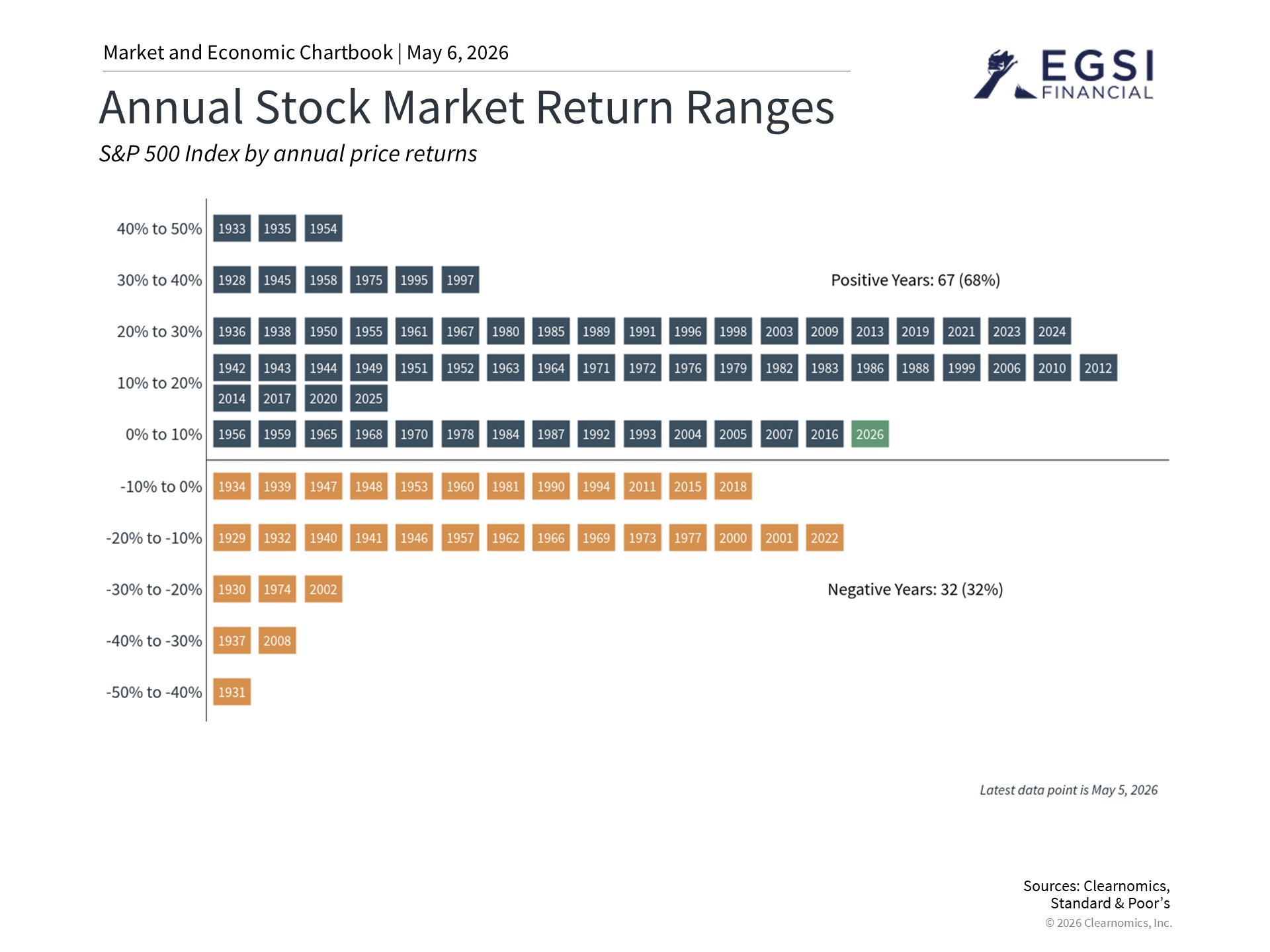
After combining April’s gains with the negative returns from the first quarter, the S&P 500 is now up 5.3% for the year. The accompanying chart shows how the S&P 500 has performed each year going back through history. Since 1928, the market has ended the year with a gain in roughly two out of every three years. While negative years do happen and should be expected from time to time, there have been far more positive years over the long run. Since 1980, that share rises to about three out of every four years being positive.
This is not to suggest that markets always recover quickly, but it does highlight how difficult it is to try to “time” the market — that is, moving in and out of investments to avoid losses. Recent years offer important lessons for investors to keep in mind the next time markets get rocky.
Jerome Powell’s final Federal Reserve meeting as Chair
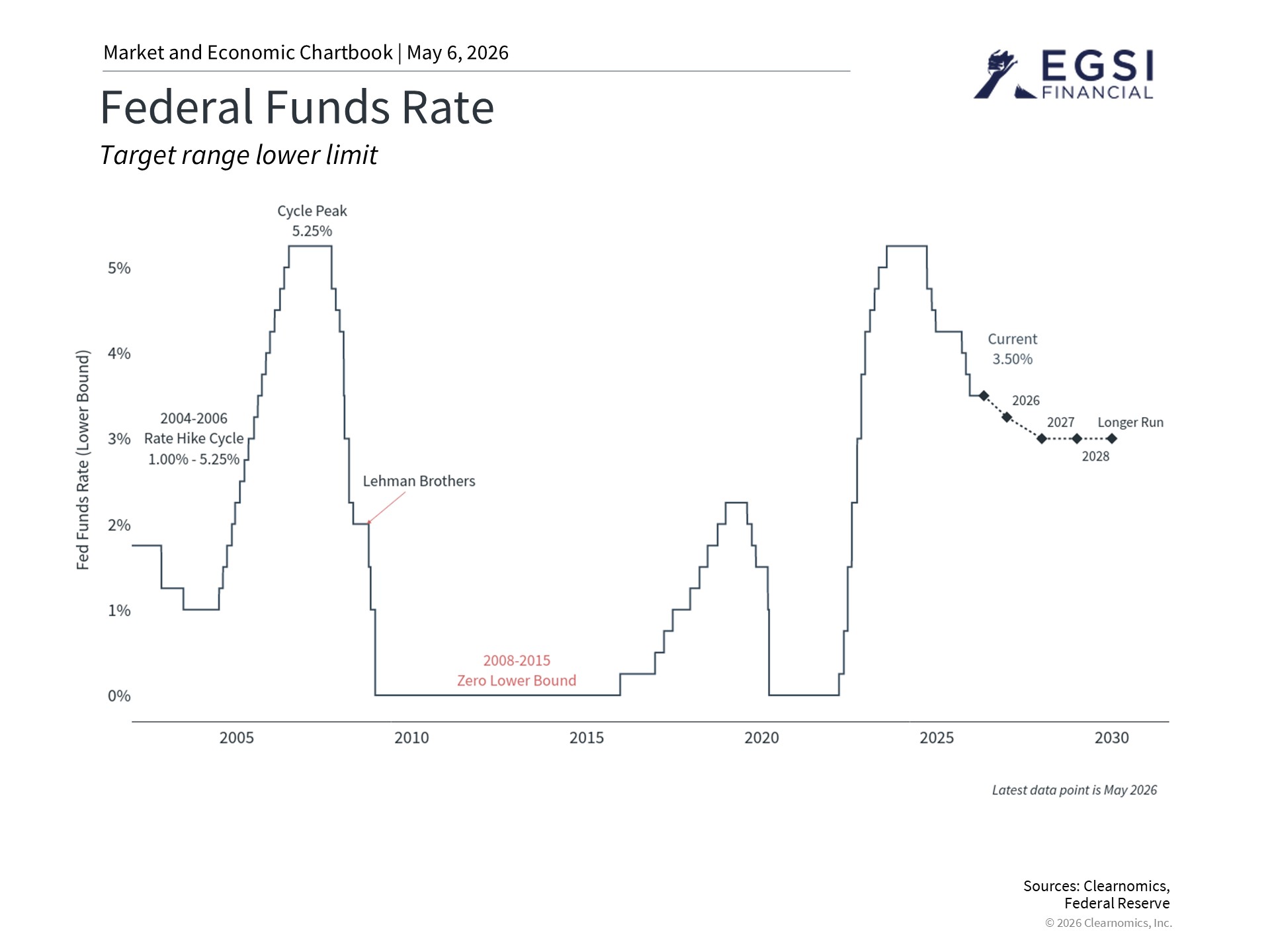
The Federal Reserve — the U.S. central bank responsible for managing interest rates — kept its key policy rate unchanged at its April meeting, holding it in a range of 3.50% to 3.75%. While this decision was widely expected, there was notable disagreement among committee members: four of the twelve voting members dissented, meaning they formally disagreed with the decision. This was the most dissents since 1992. Three officials agreed with the rate decision but objected to language in the official statement that hinted at future rate cuts, while one governor pushed for an immediate cut — a position that member has taken at every meeting they have attended.
This division reflects both a leadership transition at the Fed and two competing economic challenges. On one hand, the job market has been showing signs of weakness, with job openings falling below the number of unemployed workers for the first time in years. On the other hand, the ongoing conflict involving Iran and the disruption around the Strait of Hormuz have pushed oil prices higher, which in turn is driving up gasoline prices and overall inflation (the rate at which prices rise).
Supporting the job market would typically call for lower interest rates, while fighting inflation would call for higher rates. As a result, market expectations for the Fed’s next move now reflect roughly even odds of either a rate cut or a rate hike later this year.
This was also Jerome Powell’s final press conference as Fed Chair. He has led the Fed since taking over from Janet Yellen in 2018, and has been on the Board of Governors since 2012. Kevin Warsh is expected to be the next Fed Chair, with his nomination already approved by the Senate Banking Committee. Powell noted at the press conference that he will remain on the Fed’s Board of Governors until ongoing legal matters from the Justice Department are resolved, and that he intends to serve in a way that is respectful of the incoming Chair.
While a change in Fed leadership does add some uncertainty about future policy direction, it is worth noting that both markets and the broader economy have performed well across many different Fed Chairs and interest rate environments over the years. Ultimately, a well-diversified portfolio — one that spreads investments across many different types of assets — is built to handle this kind of uncertainty.
Oil prices and the impact of the Strait of Hormuz closure
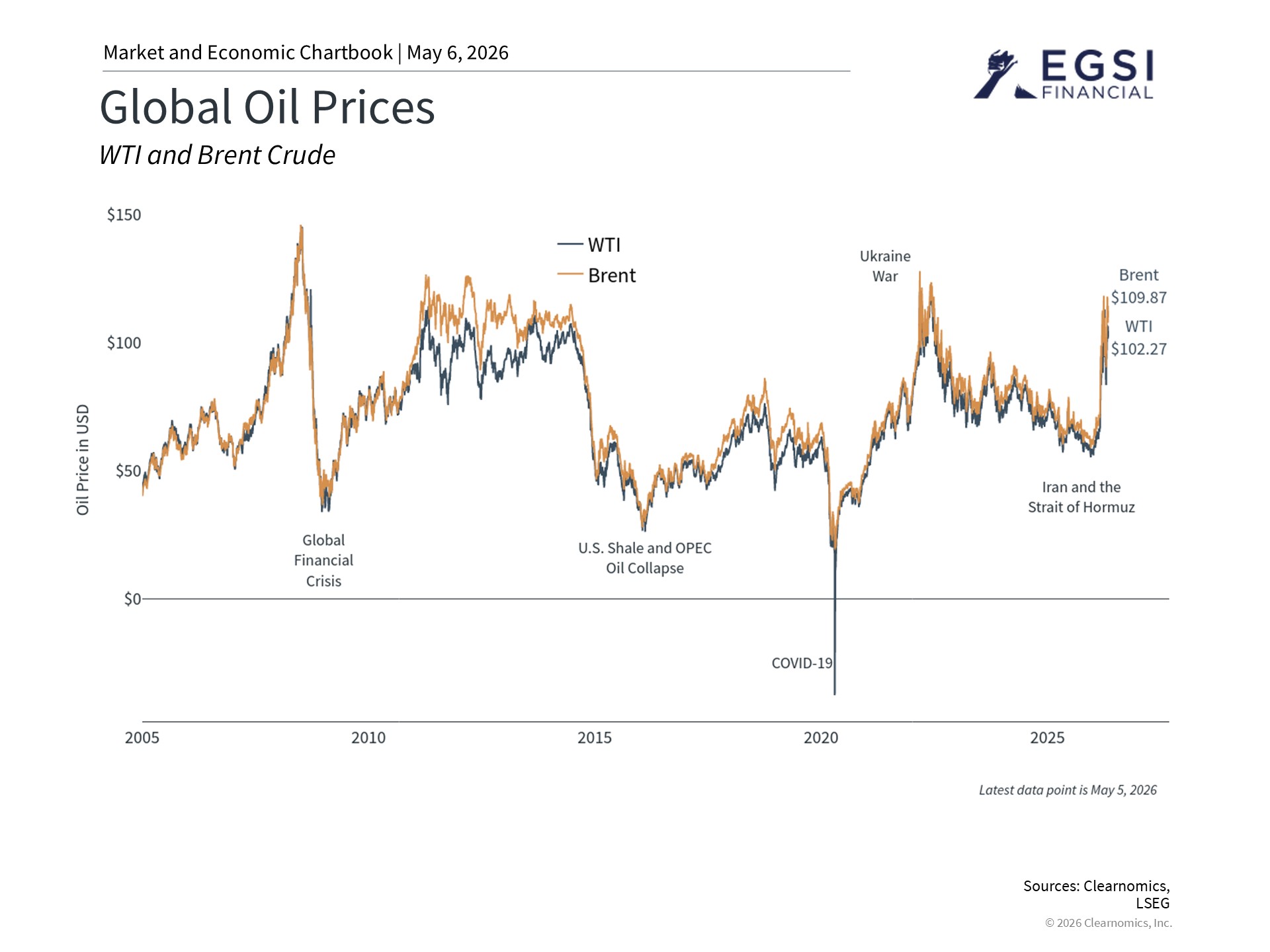
Oil prices are one of the most direct ways that the conflict in Iran affects everyday investors and consumers. Both Brent crude and WTI (two major benchmarks used to price oil) climbed back toward recent highs in April as the Strait of Hormuz — a critical waterway for global oil shipments — remained effectively closed. Several potential ceasefire and peace deal announcements over the past month created sharp market swings in both directions.
Despite higher oil prices, the stock market has held up well. The bigger concern for investors is whether rising energy costs will start to spread more broadly through the economy. This “second-order effect” would happen if oil and gasoline prices stay elevated for a long time, raising the cost of transportation and energy for businesses, which could then lead to higher prices for goods and services that consumers pay.
Still, some perspective is useful here. History suggests that the impact of oil price spikes on inflation tends to fade once the underlying situation stabilizes. For example, the surge in U.S. gasoline prices above $5 per gallon in 2022 turned out to be short-lived as supply conditions improved, even though it was a real strain on household budgets at the time. It is also worth noting that the United States remains the world’s largest producer of oil and natural gas, which offers some protection from global supply disruptions compared to earlier decades.
For investors, this year also highlights the value of holding a balanced portfolio that includes a variety of assets. Technology-driven sectors performed well over the past month, and the energy sector has contributed positively this year. Having exposure to different parts of the market continues to be an important way to manage risk and capture opportunities.
The bottom line? April’s market rebound shows that strong gains can happen even during difficult and uncertain times. A well-constructed portfolio, built around your long-term financial goals, is designed precisely to help you navigate these kinds of periods.
We are an independent financial services firm helping individuals create retirement strategies using a variety of investment and insurance products to custom suit their needs and objectives.
Advisory services offered through EGSI Investment Management, Inc., a Registered Investment Advisor with the State of Ohio. Insurance services offered through EGSI Financial, Inc.
Investing involves risk, including the potential loss of principal. No investment strategy can guarantee a profit or protect against loss in periods of declining values. None of the information contained on this website shall constitute an offer to sell or solicit any offer to buy a security or any insurance product.
Any references to protection benefits, safety, security, or steady and lifetime income streams on this website refer only to fixed insurance products. They do not refer, in any way, to securities or investment advisory products. Annuity guarantees are backed by the financial strength and claimspaying ability of the issuing insurance company. Annuities are insurance products that may be subject to fees, surrender charges and holding periods which vary by insurance company. Annuities are not FDIC insured.
The information and opinions contained in any of the material requested from this website are provided by third parties and have been obtained from sources believed to be reliable, but accuracy and completeness cannot be guaranteed. They are given for informational purposes only and are not a solicitation to buy or sell any of the products mentioned. The information is not intended to be used as the sole basis for financial decisions, nor should it be construed as advice designed to meet the particular needs of an individual’s situation.