
It has now been more than three-and-a-half years since the current bull market started in October 2022. A bull market is when stock prices are rising over a sustained period. Back then, inflation — the rate at which prices for goods and services rise — was climbing at its fastest pace in fifty years, the Federal Reserve (the U.S. central bank) was raising interest rates, and ChatGPT had not yet been released to the public. Since that time, the S&P 500 — a widely followed index that tracks 500 large U.S. companies — has more than doubled in value, and the Bloomberg U.S. Aggregate Bond index, which tracks the performance of the U.S. bond market, has fully recovered.
Although a lot has changed since then, one thing that has not changed is that there are always concerns making headlines. Every market cycle brings new challenges and raises questions about whether the tried-and-true rules of investing are still relevant. The reality is that each cycle is unique, with different events, innovations, and sources of uncertainty. And yet, the core principles of investing and financial planning have remained consistent across decades, and have continued to point investors in the right direction this year.
Bull markets climb a wall of worry
Even though global events continue to affect markets, perhaps the more important thing for long-term investors to focus on is the overall market cycle. With the market near all-time highs, it is natural to worry about sudden drops in stock prices. These short-term drops, known as pullbacks or corrections, happen often. In fact, the S&P 500 has historically seen four or five drops of 5% or more each year, on average.1 While these events are never enjoyable, long-term investing is more about historical patterns over years and decades. This is one reason why overreacting to short-term market swings can actually hurt investors, since it may leave them poorly positioned to meet their long-term financial goals.
Investors often say that the market climbs a “wall of worry” on a regular basis. Over the past several years, markets have pushed through high inflation, a banking crisis in 2023, international conflicts, concerns about central bank policy mistakes, worries about the market becoming too focused on a small group of technology companies, tariff-driven volatility, and much more. None of these concerns were small, and yet through all of them, the market has performed well.
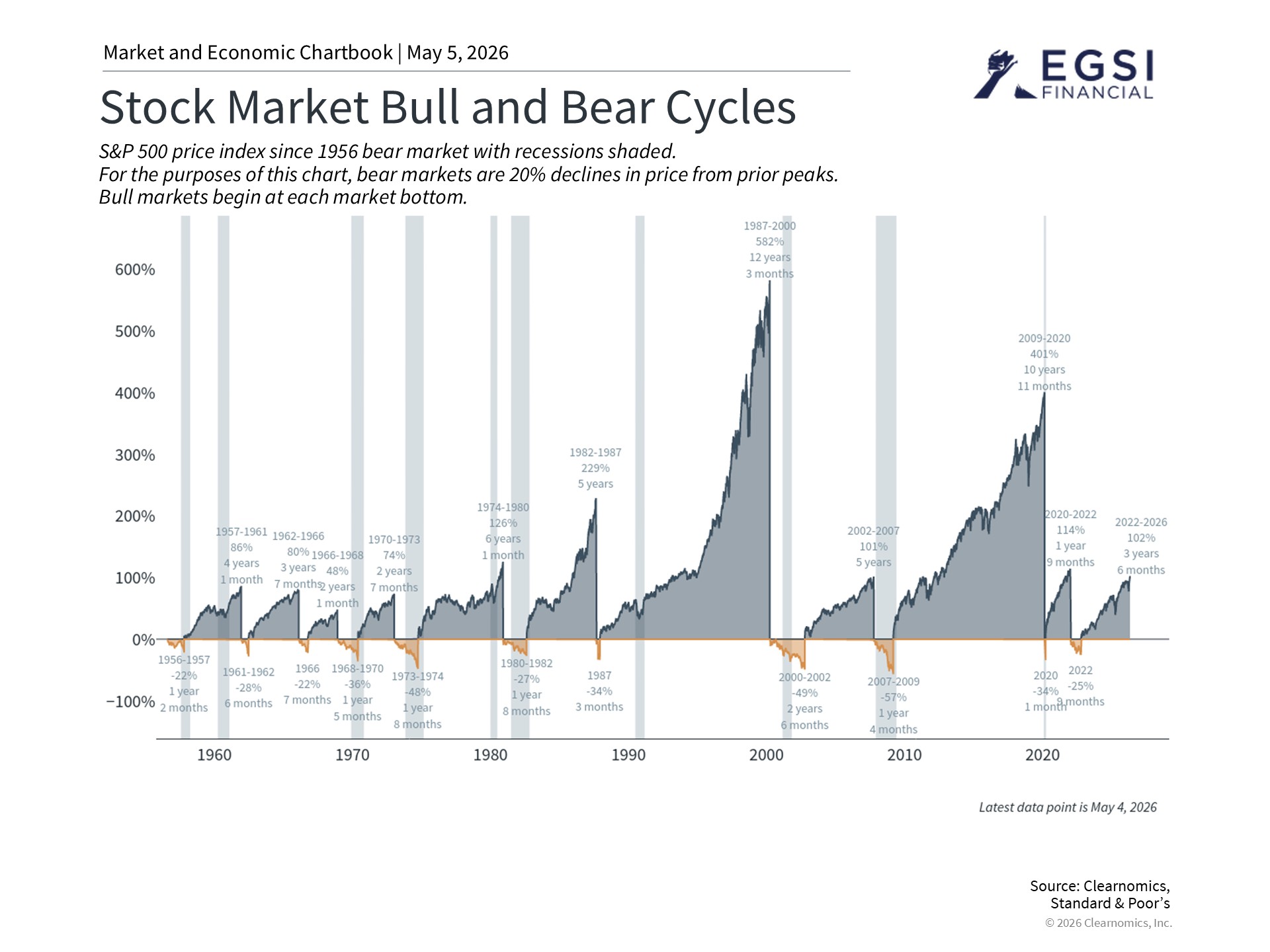
The chart above illustrates this pattern going back to World War II. Over this 70-year period, bull markets have lasted far longer and produced much larger gains than the losses seen during bear markets — periods when stock prices fall significantly. Specifically, bear markets have typically lasted one to two years on average, while recent bull markets have run as long as ten years or longer. Even when market corrections happen during bull markets, the average decline is 14%, and markets have typically recovered in just four months on average.2
For example, the bull market that followed the 2008 financial crisis lasted nearly eleven years. Despite this, it is often called “the most unloved bull market” because there was a constant stream of market and economic concerns throughout that period. Looking back, it is easy to see that even when those concerns were valid — such as worries about the pace of the economic recovery or the size of the national debt — they did not justify making major changes to long-term investment plans.
Of course, past performance is no guarantee of future results, and how quickly markets recover depends on the specific situation. But the historical record makes it clear that trying to react to every market move has, more often than not, caused investors to miss much of the gains that eventually followed.
A growing economy is the foundation for long-run returns
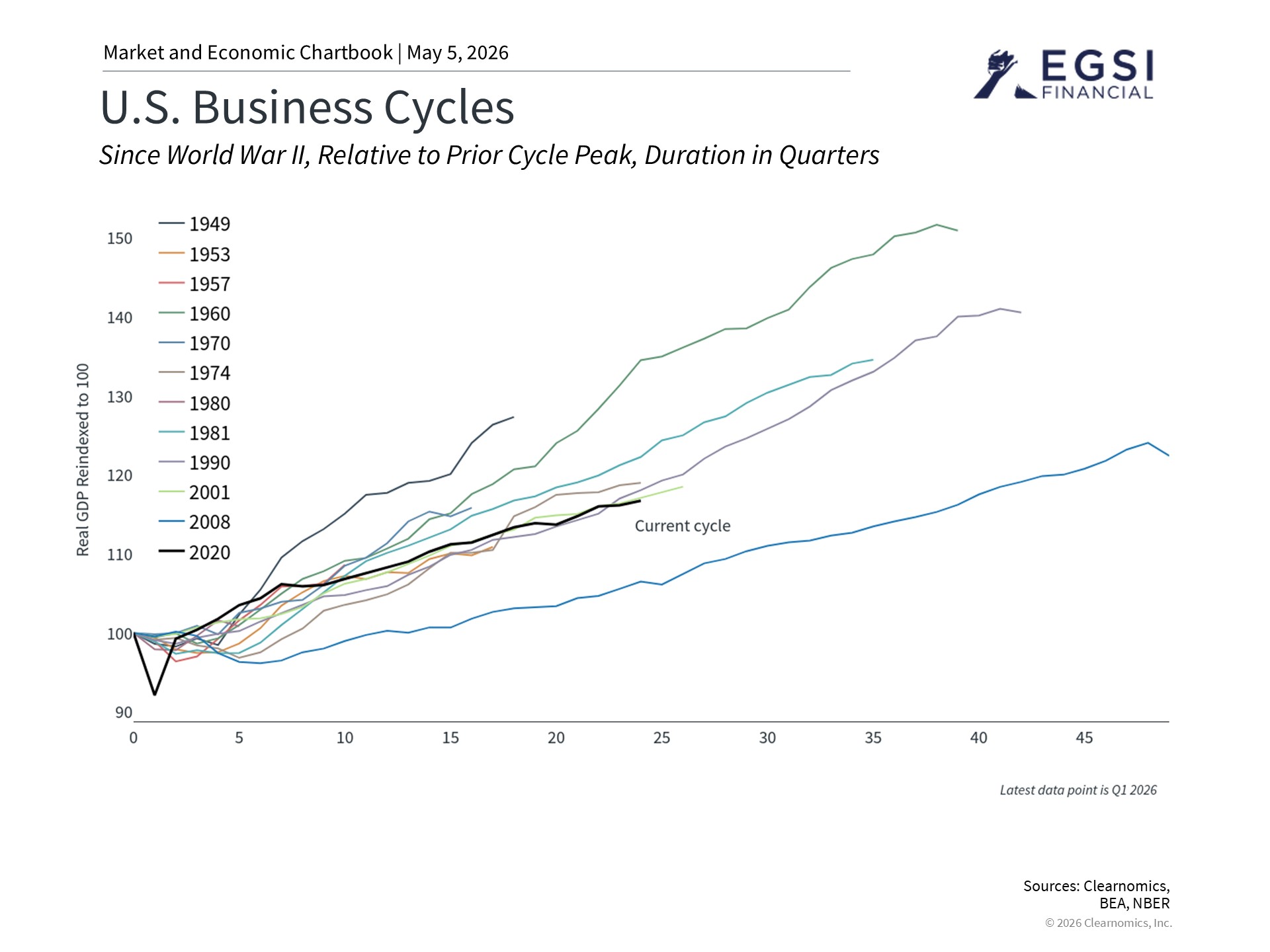
While the stock market and the broader economy are not the same thing, they are closely connected. Corporate earnings — the profits companies make — drive stock prices over the long run, and those profits ultimately depend on economic growth. This is why it is important to keep an eye on the broader economic environment, even as markets move up and down day to day for many other reasons.
The current economic expansion has technically been running two-and-a-half years longer than the current bull market. The last official recession — a period of significant economic decline — as determined by the National Bureau of Economic Research, was the brief but sharp downturn caused by the pandemic in 2020. Since then, there have been periods of slower growth and occasional predictions of a new recession, none of which have come to pass.
Today, the economy is healthy by many measures, though investors are watching three key areas closely. First, oil prices above $100 per barrel, if sustained, could reduce consumer spending and add to inflation. Second, the job market has slowed significantly, especially in areas such as technology, raising questions about whether consumers will keep spending at the strong pace seen over the past several years. Third, the large scale of investments in artificial intelligence (AI) has prompted questions about whether there is a “bubble” — a situation where prices rise far beyond what is justified by real value. This concern is understandable, given that many of today’s investors have experienced both the dot-com crash and the housing crisis.
Bubbles are notoriously difficult to spot while they are happening, and history shows that not every period of high valuations ends in a dramatic collapse. So far in this cycle, unlike in some past periods, earnings growth has supported valuations, and many companies are making large investments using their own profits. For long-term investors, the key is staying diversified — spread across different parts of the market — to benefit from growth while managing risk.
Stocks and bonds continue to complement each other
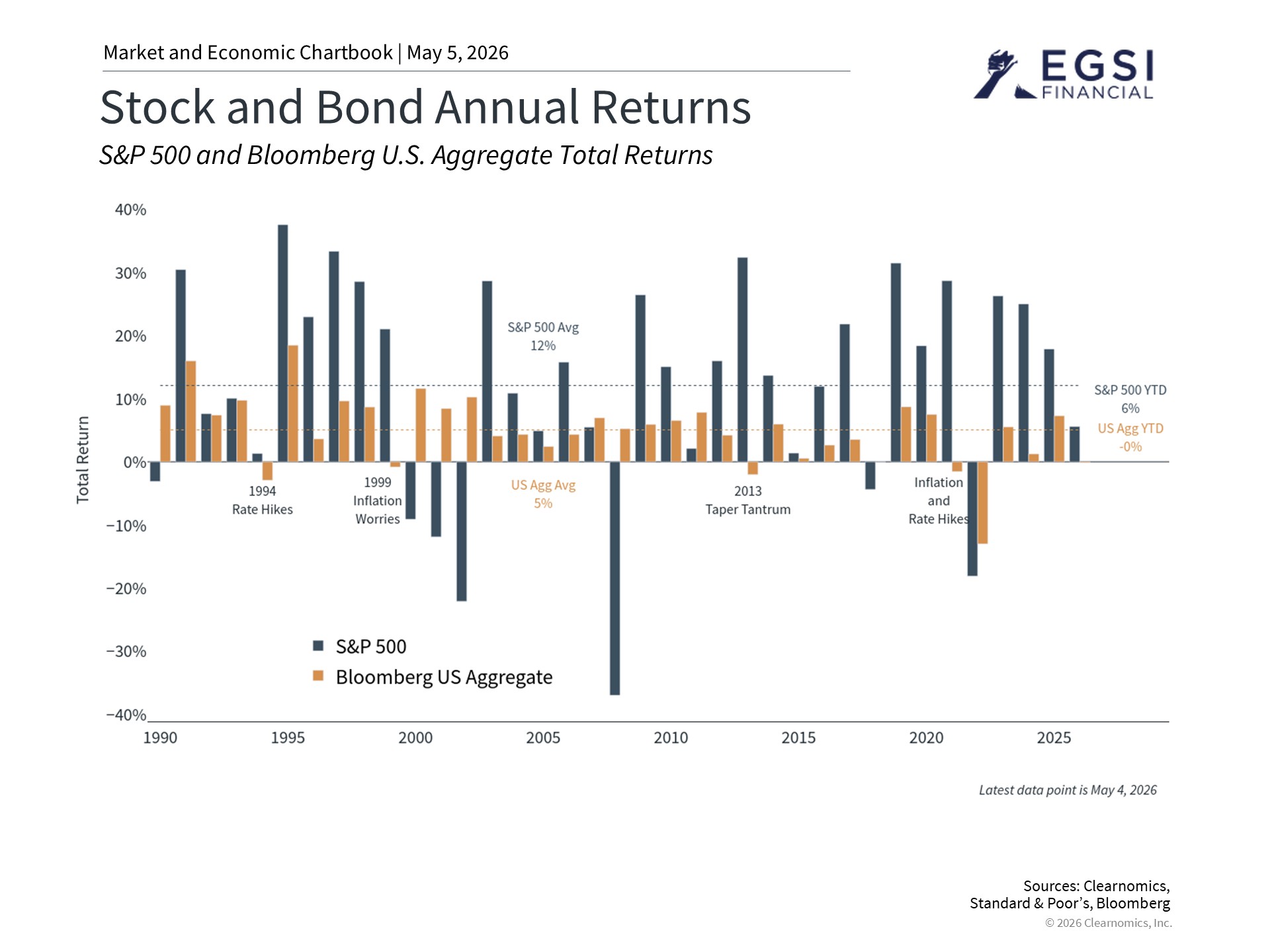
Every market cycle raises questions about whether traditional investment principles still apply. In 2022, when both stocks and bonds fell at the same time due to rapidly rising inflation and interest rates, some investors questioned whether bonds — which are essentially loans made to governments or companies in exchange for regular interest payments — still served a useful purpose in a diversified portfolio. Similar questions arose after the 2008 financial crisis, when bonds offered very little return due to historically low interest rates.
Over the past few years, bonds have not only recovered in value, but have also provided meaningful income and helped to stabilize portfolios. The Bloomberg U.S. Aggregate Bond Index has delivered positive returns in each of the past two years, helping to cushion the impact of stock market volatility. International stocks and commodities — raw materials like oil, gold, or agricultural products — have also contributed, offering additional diversification benefits.
This pattern is consistent with what history shows across market cycles. Every period seems to raise the question of whether “this time is different” when it comes to how different types of investments behave together. In the 1970s, high inflation challenged traditional portfolios. During the dot-com era, technology stocks became extremely popular despite many companies having no profits, making other sectors seem unexciting. In 2022, rising interest rates put pressure on both stocks and bonds at the same time. There are echoes of all of these challenges today.
Each time, sticking to the principles of diversification — spreading investments across different asset types — and focusing on the long term has proven to be the right approach. As uncertainty continues and new headlines cause markets to move, it is more important than ever to keep sight of the bigger picture.
The bottom line? More than three-and-a-half years into this bull market, the core principles of long-term investing remain as relevant as ever. Markets have consistently rewarded those who maintain balanced portfolios and stay focused on their long-term financial goals.
Footnotes
1. The number of pullbacks is based on S&P 500 index price returns since 1980.
2. The average size of corrections and recovery time are calculated from S&P 500 index total returns, since World War II.
We are an independent financial services firm helping individuals create retirement strategies using a variety of investment and insurance products to custom suit their needs and objectives.
Advisory services offered through EGSI Investment Management, Inc., a Registered Investment Advisor with the State of Ohio. Insurance services offered through EGSI Financial, Inc.
Investing involves risk, including the potential loss of principal. No investment strategy can guarantee a profit or protect against loss in periods of declining values. None of the information contained on this website shall constitute an offer to sell or solicit any offer to buy a security or any insurance product.
Any references to protection benefits, safety, security, or steady and lifetime income streams on this website refer only to fixed insurance products. They do not refer, in any way, to securities or investment advisory products. Annuity guarantees are backed by the financial strength and claimspaying ability of the issuing insurance company. Annuities are insurance products that may be subject to fees, surrender charges and holding periods which vary by insurance company. Annuities are not FDIC insured.
The information and opinions contained in any of the material requested from this website are provided by third parties and have been obtained from sources believed to be reliable, but accuracy and completeness cannot be guaranteed. They are given for informational purposes only and are not a solicitation to buy or sell any of the products mentioned. The information is not intended to be used as the sole basis for financial decisions, nor should it be construed as advice designed to meet the particular needs of an individual’s situation.