
For most families, a home is much more than just a place to live. It is often the biggest financial asset they own, their largest monthly bill, and their main source of debt. On a larger scale, the housing market is closely connected to how confident people feel about the economy and how much they spend. While investors have been paying close attention to global events and market swings in recent times, the fact that home prices are still near all-time highs continues to matter a great deal for personal financial planning.
Housing activity is uneven, but prices remain close to record highs
Housing market activity has been uneven across several measures in recent years. For people looking to buy a home, the biggest hurdle to affordability is mortgage rates — essentially, the interest rate on a home loan. The 30-year fixed mortgage rate (meaning a loan paid back over 30 years at a set interest rate) is currently around 6.3%. That is well above the historic lows of 3% or less seen in 2020 and 2021, and also higher than the average of 4.6% since 2008. As a result, the monthly cost of buying a home today is meaningfully higher than it was just a few years ago, even for buyers who can put down a large upfront payment.
For homeowners who locked in very low mortgage rates in recent years, selling their home means giving up those favorable rates — which can make selling feel like a difficult choice. This has kept the number of homes available for sale relatively low, making the housing market more competitive. In March, sales of existing homes dropped 3.6%, reversing gains made earlier in the year and returning to levels seen about a year ago.
In response to the limited supply of existing homes, builders have ramped up new construction. Housing starts — meaning new homes where construction has just begun — accelerated to 1.5 million units per year in January. However, it will take time before this additional supply helps ease upward pressure on prices. Even homebuilders themselves appear cautious about the outlook. The NAHB/Wells Fargo Housing Market Index, which tracks how optimistic homebuilders feel about the market, fell from 38 to 34 in April. From a stock market standpoint, homebuilding companies within the S&P 500 index have been roughly flat so far this year, posting a modest gain of just 0.4% after several years of mixed results.
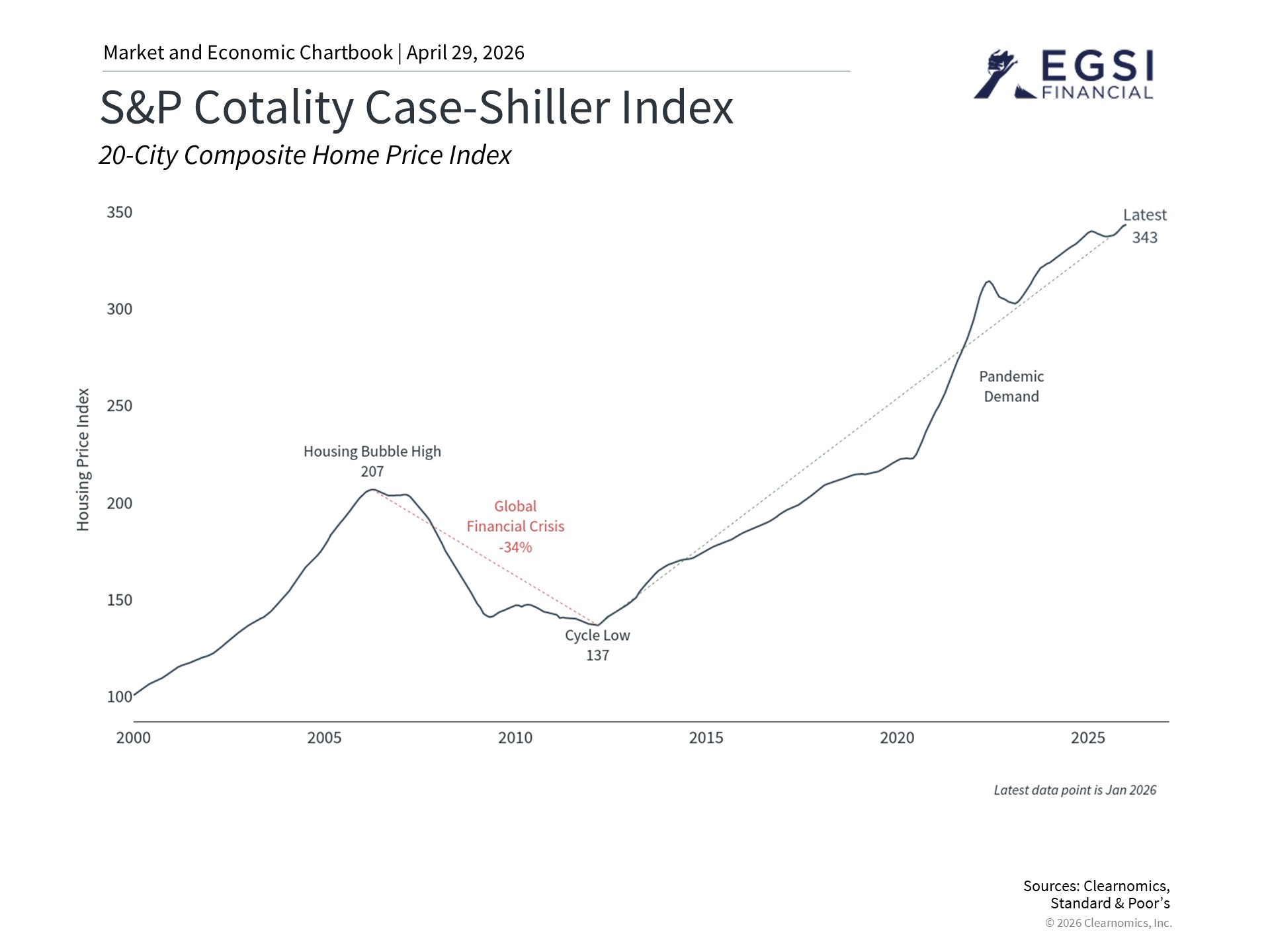
Despite these challenges, home prices across the country remain near record highs. The S&P Cotality Case-Shiller indices, which track home prices nationally and in the largest U.S. cities, have climbed steadily over time. In recent history, home prices have seen significant drops in only two periods: the 2008 housing market collapse and a brief decline that followed the sharp rise in inflation starting in 2022.
High home prices mean that, from a broad economic perspective, homeowners’ financial positions have generally stayed healthy. This has been further supported by a low unemployment rate and solid wage growth, which are key reasons why overall consumer spending has held up better than many expected. These positive factors have helped counterbalance the negative feelings many consumers have had due to inflation and job losses in some sectors, such as the technology industry.
Real estate is often a cornerstone of wealth across different generations
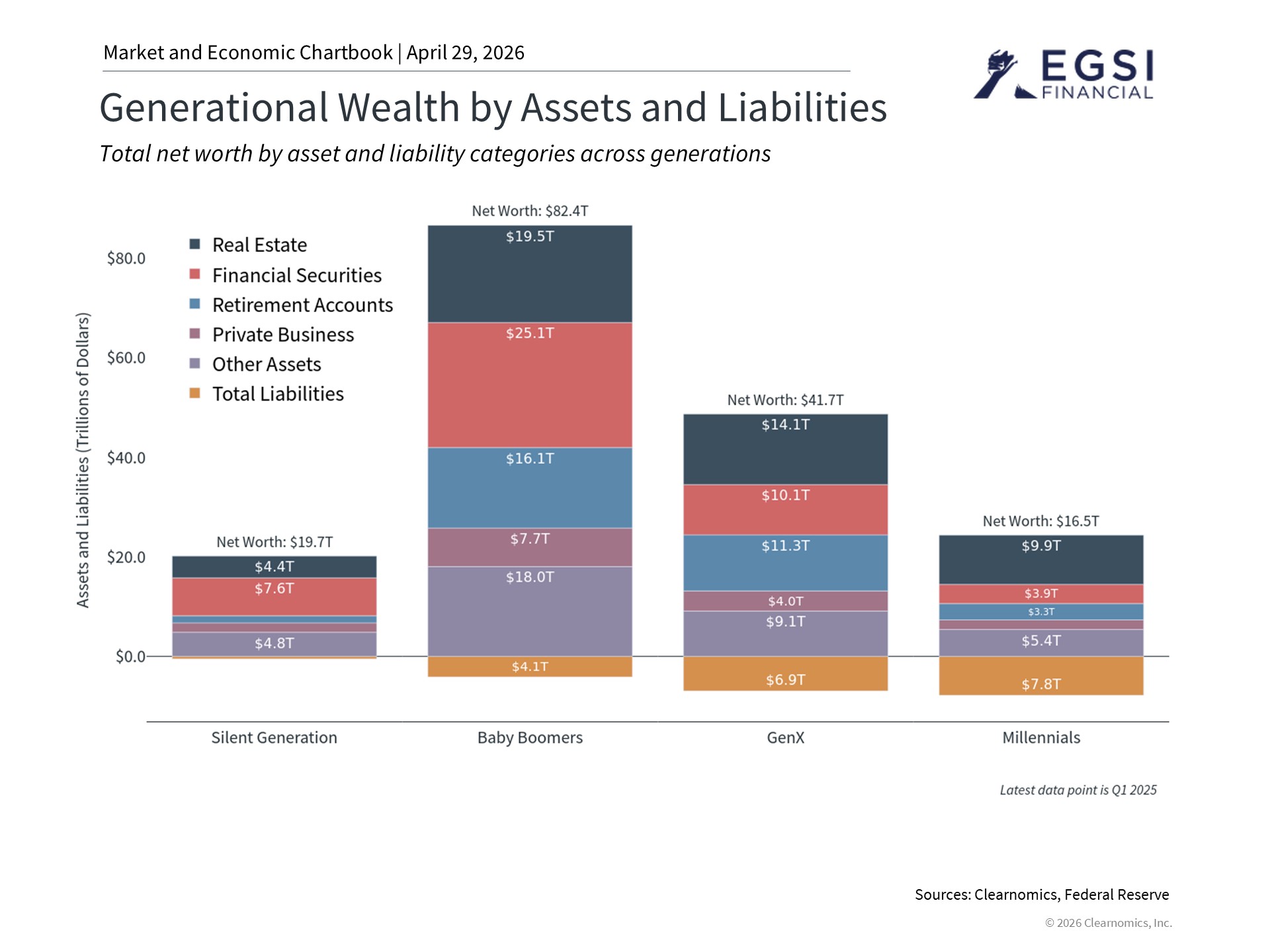
As the chart above shows, real estate plays an important role in the overall wealth of households across all age groups. For older Americans, real estate often makes up a large portion of the assets they have built over many decades. Baby Boomers, for example, hold over $19.5 trillion in real estate, which is roughly 24% of their total net worth (meaning the value of everything they own minus what they owe). For Gen X and Millennials, real estate represents an even larger share — approximately 34% and 60% of their net worth, respectively. Of course, real estate is also a major source of debt for younger households, who have not yet had enough time to pay down their mortgages or fully benefit from long-term housing market growth.
This is known as the “wealth effect,” and it matters a great deal, especially when the stock market is volatile and the world feels uncertain. When home values go up, homeowners tend to feel more financially secure and may be more willing to spend money on goods and services, which in turn supports broader economic growth. Importantly, this feeling of security can exist even if homeowners do not actually tap into their home equity — for example, through tools like a reverse mortgage (which allows older homeowners to borrow against the value of their home) or a home equity line of credit (a flexible loan tied to the value of a home).
This also highlights why it is important to look at the full picture when it comes to financial planning. Short-term swings in the stock market, while never enjoyable, may have less impact on an investor’s overall financial situation than they might think, since a large portion of their wealth is often tied up in other assets like real estate. In fact, depending on someone’s personal situation, paying down a mortgage or other forms of debt may be more beneficial than focusing heavily on the stock market.
These psychological and financial effects make the housing market important both as a sign of economic health and as a factor in financial planning. Housing costs also directly affect inflation — the general rise in prices over time — since they are the main driver of the “shelter” category within the Consumer Price Index (a widely used measure of inflation). Even before energy prices pushed headline inflation higher, elevated housing costs were a key reason inflation has been slow to return to the Federal Reserve’s 2% target.
Household debt reflects both mortgage borrowing and everyday consumer loans
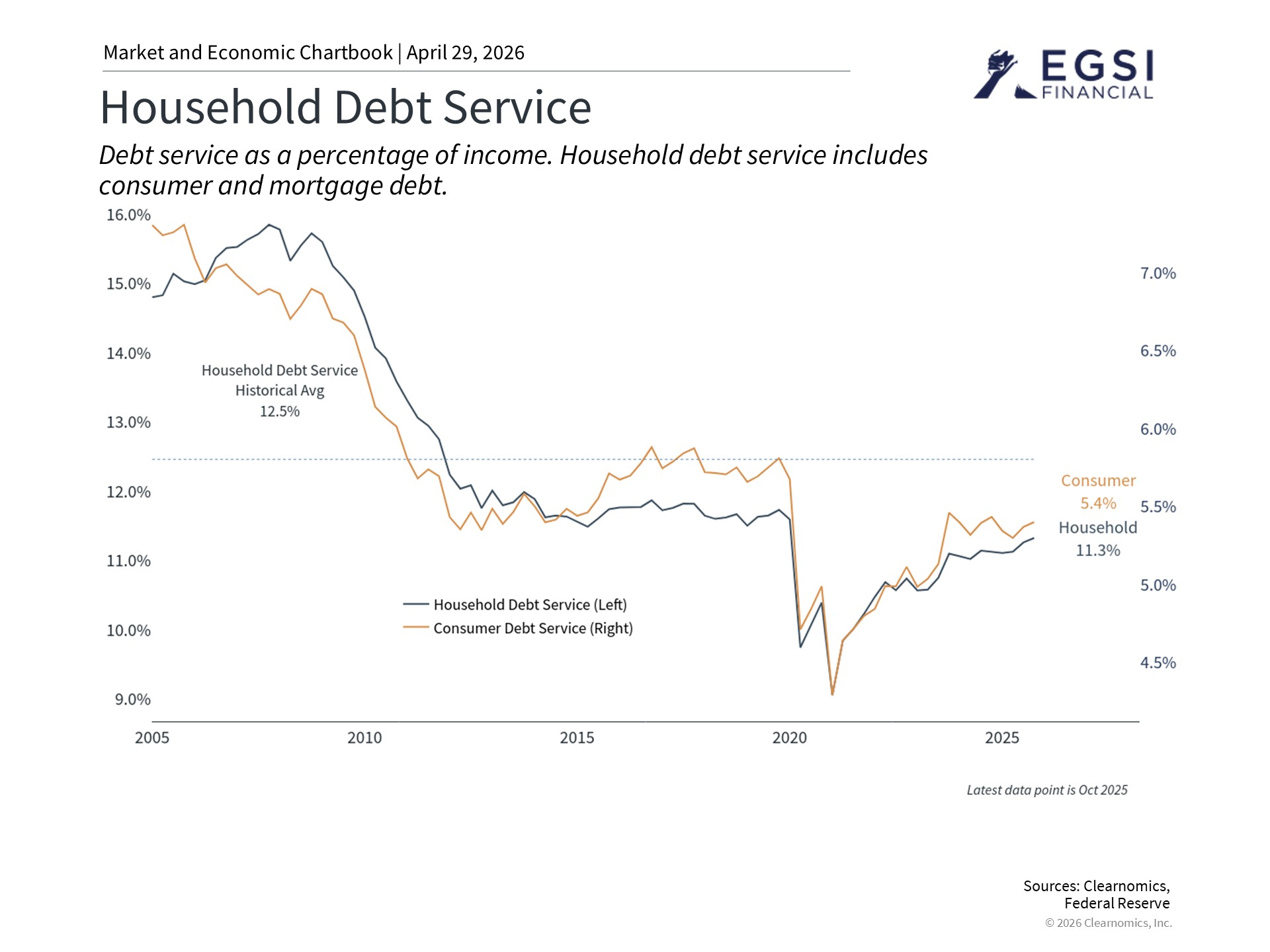
Housing is not only the largest asset on most households’ financial balance sheets — it is also the largest source of debt. The accompanying chart shows both total household debt, which includes mortgages (home loans), and consumer debt, which does not include mortgages. Even as other forms of borrowing rise, such as credit card balances and student loans, mortgage debt remains by far the biggest component of what households owe overall.
One positive sign in today’s environment is that debt service levels — meaning the size of debt payments relative to household income — remain relatively manageable compared to historical levels. Mortgage lending standards have also been significantly more cautious since the 2008 financial crisis, a period when household debt levels were much higher. That said, debt payments are still a real burden for many households, particularly those who bought homes more recently at higher prices and higher interest rates.
From an economic standpoint, healthy home prices could continue to support consumers’ financial health and the broader economy, even amid uneven housing activity. From a financial planning standpoint, it is important for investors to have a clear picture of their entire financial situation. While news headlines have focused on stock market volatility and global conflicts, the reality is that paying attention to the financial factors closer to home — like housing, mortgage debt, and overall household wealth — may play a much bigger role in reaching long-term goals.
The bottom line? The housing market remains a central part of both household finances and the wider economy. With ongoing market volatility, understanding what drives household wealth can help investors keep perspective and stay on track with their long-term financial plans.
We are an independent financial services firm helping individuals create retirement strategies using a variety of investment and insurance products to custom suit their needs and objectives.
Advisory services offered through EGSI Investment Management, Inc., a Registered Investment Advisor with the State of Ohio. Insurance services offered through EGSI Financial, Inc.
Investing involves risk, including the potential loss of principal. No investment strategy can guarantee a profit or protect against loss in periods of declining values. None of the information contained on this website shall constitute an offer to sell or solicit any offer to buy a security or any insurance product.
Any references to protection benefits, safety, security, or steady and lifetime income streams on this website refer only to fixed insurance products. They do not refer, in any way, to securities or investment advisory products. Annuity guarantees are backed by the financial strength and claimspaying ability of the issuing insurance company. Annuities are insurance products that may be subject to fees, surrender charges and holding periods which vary by insurance company. Annuities are not FDIC insured.
The information and opinions contained in any of the material requested from this website are provided by third parties and have been obtained from sources believed to be reliable, but accuracy and completeness cannot be guaranteed. They are given for informational purposes only and are not a solicitation to buy or sell any of the products mentioned. The information is not intended to be used as the sole basis for financial decisions, nor should it be construed as advice designed to meet the particular needs of an individual’s situation.