
The ongoing conflict between the United States and Iran continues to shift, and financial markets have been reacting to each new development. When a ceasefire was announced, it initially calmed things down and pushed oil prices lower — Brent crude (a common benchmark for global oil prices) fell into the $90 range. But when peace talks broke down, prices climbed back above $100 per barrel, showing just how quickly the situation can change. For investors thinking about the long term, the most important question is how these events affect the broader economy, businesses, and everyday consumers.
Geopolitical conflicts (meaning tensions or wars between countries) often affect financial markets mainly through energy prices. When oil and gas prices rise, that can push up the cost of fuel and many other things, which can ripple through the entire economy. How much damage is done depends on how long energy prices stay high. Keeping an eye on inflation (the general rise in prices), the job market, and company profits can help investors stay grounded during uncertain times.
Rising energy costs are pushing overall inflation higher
Energy costs are feeding into broader price increases
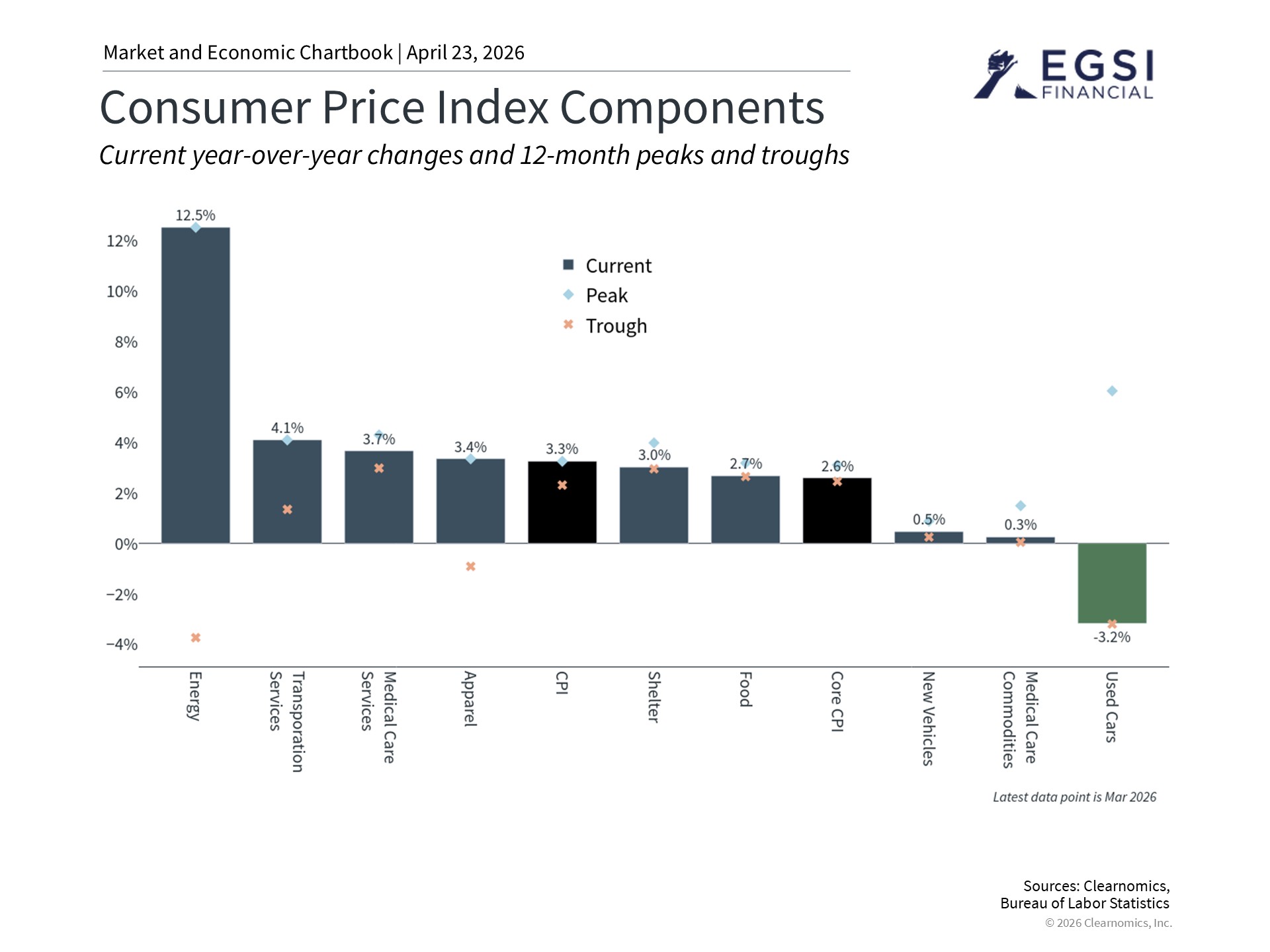
The most direct way the Iran conflict is hitting consumers is through higher energy prices. The latest Consumer Price Index (CPI) report — a widely used measure of how much everyday goods and services cost — for March showed that energy costs jumped 12.5% compared to a year earlier. Gasoline prices surged 18.9%, and fuel oil rose 44.2%. These increases pushed headline CPI (the overall measure including food and energy) to 3.3%, a sharp rise that has raised concerns about a return to the high inflation seen in 2022. Much of this increase was anticipated since the conflict in Iran began at the end of February.
However, the CPI report also shows that higher energy costs have not yet spread to most other consumer categories. Core CPI — which removes the more unpredictable food and energy costs to give a clearer view of underlying inflation — rose only 2.6% year-over-year. This came in below what analysts expected and was only slightly above the prior month’s 2.5%. An even narrower measure that also strips out housing costs, sometimes called “supercore” inflation, rose only 2.3%.
These figures suggest that while energy costs are hitting consumer wallets — with gasoline averaging $4.12 per gallon nationally, and much higher in many areas — the pressure has not yet spread broadly across the economy. This distinction matters because the bigger concern is that if oil prices stay high for a long time, the rising costs of energy, transportation, and manufacturing could start pushing up the prices of many other goods and services.
While higher gasoline prices are a real burden for households, economists often view these kinds of supply-side shocks (sudden price increases caused by outside events rather than strong demand) as temporary. The fact that core inflation has stayed relatively stable supports the hope that once the Middle East situation settles, inflation may return to pre-conflict levels. The fact that oil prices dropped after the initial ceasefire announcement adds to that hope. Still, how quickly that happens depends on how the conflict unfolds, which remains hard to predict.
The job market has softened, but demographic shifts complicate the picture
Aging population trends are reshaping what a healthy job market looks like
The health of the job market is another key factor for investors to watch. The latest employment report showed a better-than-expected 178,000 new jobs added in March, beating forecasts of just 65,000. However, the prior month was revised sharply lower to a loss of 133,000 jobs — a reminder that these monthly figures can be inconsistent and subject to big revisions.
Zooming out, the broader trend has been slowing job creation. Since the start of 2025, the economy has added an average of only about 21,000 new jobs per month, a major slowdown compared to the 122,000 monthly average in 2024. Interestingly, the unemployment rate (the share of people actively looking for work who cannot find it) has not risen much. It edged down slightly to 4.3% in March, but this reflects fewer people looking for work rather than strong hiring activity.
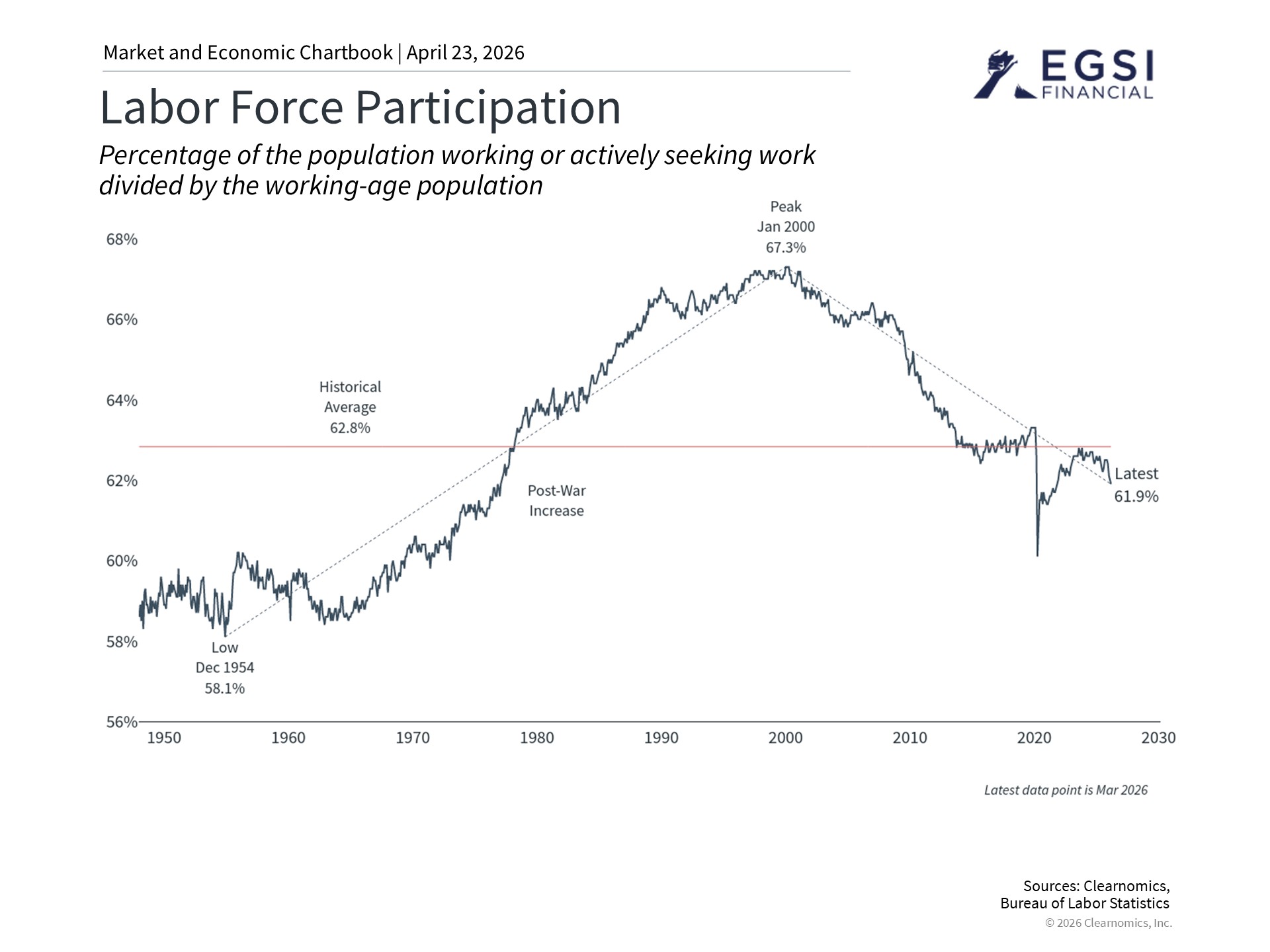
One helpful way to understand this is through the labor force participation rate — the share of working-age Americans who are either employed or actively seeking work. As the accompanying chart shows, this rate has fallen to just 61.9%, its lowest level since the pandemic. This is not a new trend; participation has been gradually declining since the early 2000s, largely because the population is aging. For example, over 11,000 baby boomers (those born between 1946 and 1964) are reaching retirement age every single day.
These demographic shifts, combined with lower levels of immigration, mean that fewer working-age Americans are in the labor force. As a result, the economy needs fewer new jobs each month to keep unemployment low, which can make the headline job numbers harder to interpret.
Looking inside the monthly jobs report, the picture is also uneven. Most recent job growth has been concentrated in the “Education and Health Services” sector, while the “Information” sector has seen job losses, consistent with layoff announcements from large technology companies. Wage growth has slowed to 3.4% year-over-year, though this pace is still faster than the overall inflation rate for many workers, providing some support for consumer spending.
What does this mean for investors? Consumers are facing higher costs at a time when job growth is slowing. That said, unemployment remains relatively stable, meaning that people who want to work are generally finding jobs. The key change is that a smaller share of the overall population is actively working today compared to the past.
Company profits continue to grow at a strong pace
Strong earnings growth has provided a bright spot for investors amid uncertainty
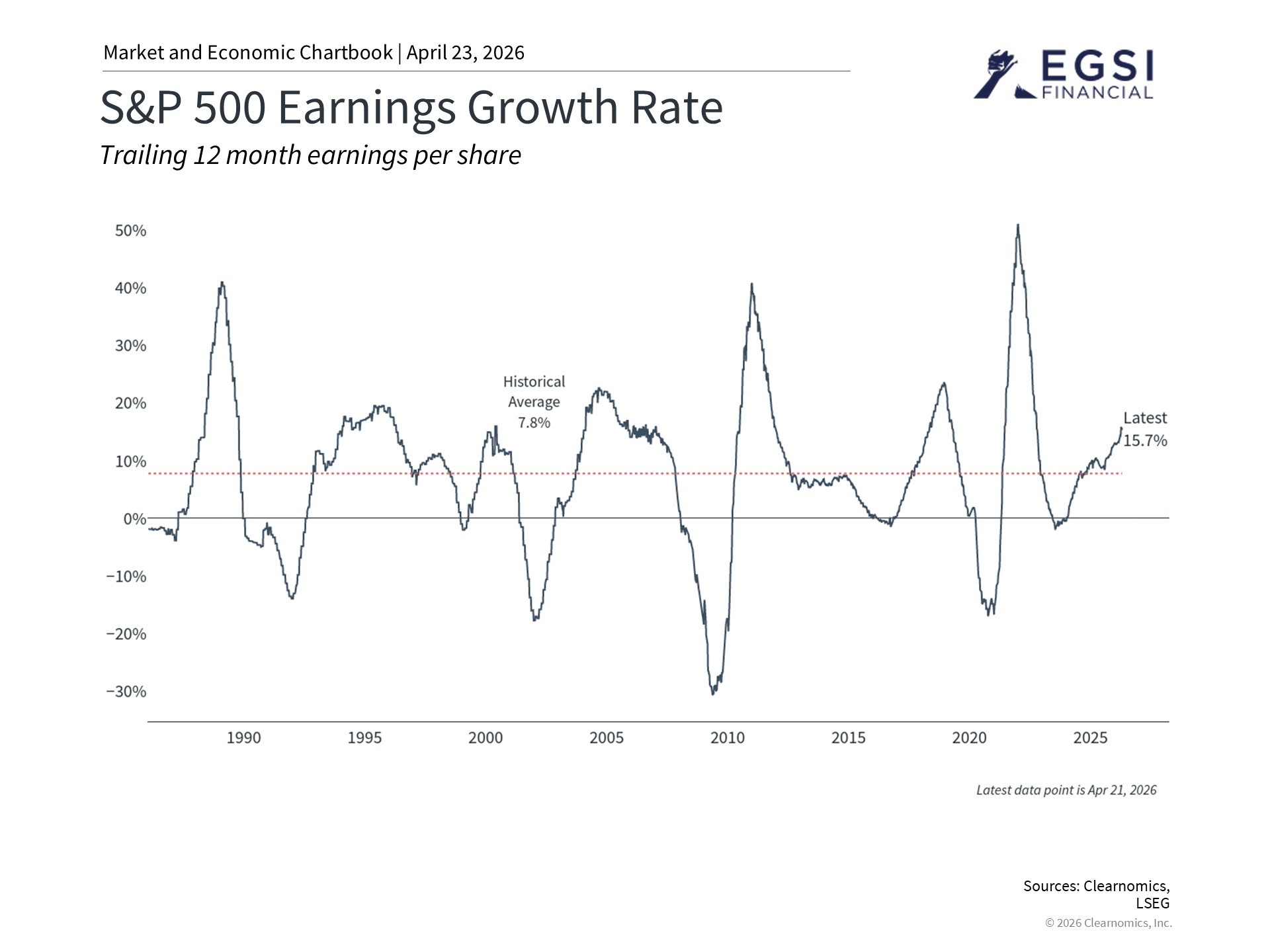
Despite the uncertainty around geopolitics, inflation, and employment, one bright spot for investors has been strong company earnings (profits). Even with the challenges described above, consumers have continued to spend, and many companies have maintained healthy profit margins (the percentage of revenue left over after expenses). Current Wall Street estimates suggest that S&P 500 earnings-per-share — a measure of how much profit large U.S. companies generate per share of stock — have grown approximately 16% over the past twelve months. Analysts expect an additional 18% growth over the coming year. These are historically strong numbers, well above the long-term average growth rate of 7.7%.
Of course, earnings estimates should always be viewed with some caution, as they are based on analyst projections that can change as economic conditions shift. Tariff policies, higher energy costs, and a slowing job market could all weigh on company profits in the months ahead. However, the current strength in earnings growth is one reason stock market valuations (a measure of how expensive stocks are relative to company profits) have improved recently, alongside the market pullback.
This is a reminder that periods of uncertainty, while they can feel uncomfortable, can also be when opportunities are most attractive for long-term investors. When markets become volatile (meaning prices swing up and down sharply) due to geopolitical events, earnings expectations often don’t change as dramatically as stock prices do. While this doesn’t guarantee a quick market rebound, it does suggest that investors who stay focused on the long term and hold well-diversified portfolios (meaning investments spread across different types of assets) are often rewarded for their patience.
The bottom line? Higher energy prices are weighing on the economy at a time when consumers are already facing other challenges. However, strong earnings growth and more attractive valuations have also created opportunities for investors. Maintaining a balanced portfolio and staying focused on long-term financial goals remains the best approach to navigating today’s environment.
We are an independent financial services firm helping individuals create retirement strategies using a variety of investment and insurance products to custom suit their needs and objectives.
Advisory services offered through EGSI Investment Management, Inc., a Registered Investment Advisor with the State of Ohio. Insurance services offered through EGSI Financial, Inc.
Investing involves risk, including the potential loss of principal. No investment strategy can guarantee a profit or protect against loss in periods of declining values. None of the information contained on this website shall constitute an offer to sell or solicit any offer to buy a security or any insurance product.
Any references to protection benefits, safety, security, or steady and lifetime income streams on this website refer only to fixed insurance products. They do not refer, in any way, to securities or investment advisory products. Annuity guarantees are backed by the financial strength and claimspaying ability of the issuing insurance company. Annuities are insurance products that may be subject to fees, surrender charges and holding periods which vary by insurance company. Annuities are not FDIC insured.
The information and opinions contained in any of the material requested from this website are provided by third parties and have been obtained from sources believed to be reliable, but accuracy and completeness cannot be guaranteed. They are given for informational purposes only and are not a solicitation to buy or sell any of the products mentioned. The information is not intended to be used as the sole basis for financial decisions, nor should it be construed as advice designed to meet the particular needs of an individual’s situation.