

Stock markets reached new record highs in August, and bonds also helped investment portfolios grow. This happened even though there was ongoing worry about tariffs (fees on imported goods), Federal Reserve independence, and technology company stocks. The month started with the U.S. putting tariffs on most major trading partners after a 90-day waiting period ended. A federal appeals court later said these “reciprocal tariffs” (tariffs that match what other countries charge) are not legal, which might lead to the case going to the Supreme Court.
Markets also dropped in the middle of the month because investors worried the Federal Reserve (the Fed) might keep interest rates high longer to fight rising prices. Recent reports on rising prices, like the Producer Price Index (which measures what companies pay for goods), show that companies are starting to charge customers more to cover tariff costs. But investor feelings quickly improved because companies reported better profits than expected and there was more confidence that the Fed will lower interest rates at their September meeting.
Economic numbers were mixed. GDP growth (which measures how much the economy grew) for the second quarter was updated higher from 3.0% to 3.3%, a big improvement from the first quarter’s 0.5% decline. However, the jobs report at the start of the month showed fewer new jobs were created, and previous months’ job numbers were lowered significantly. This led the White House to fire the Commissioner of the Bureau of Labor Statistics, adding to the uncertain environment.
Despite these challenges, market ups and downs remain low compared to history. August’s solid performance across stocks and bonds shows why investors should stay balanced and focus on long-term goals.
Key Market and Economic Numbers
- The S&P 500 (a measure of 500 large U.S. companies) rose 1.9% in August, the Dow Jones Industrial Average 3.2%, and the Nasdaq 1.6%. So far this year, the S&P 500 is up 9.8%, the Dow is up 7.1%, and the Nasdaq is up 11.1%.
- The Bloomberg U.S. Aggregate Bond Index (a measure of U.S. bonds) gained 1.2% in August. The 10-year Treasury yield (the interest rate on government bonds) ended the month lower at 4.2%.
- International developed markets jumped 4.1% in U.S. dollar terms using the MSCI EAFE index, while emerging markets gained 1.2% based on the MSCI EM index. So far this year, the MSCI EAFE index has gained 20.4% and the MSCI EM index 17.0%.
- The U.S. dollar index ended the month lower at 97.8.
- Bitcoin fell in August, ending the month at 109,127 after experiencing a “flash crash” on August 24.
- Gold prices ended the month at a new all-time high of $3,487.
- The Consumer Price Index (which measures how much prices rise for everyday goods) rose 2.7% compared to last year in July, matching what economists expected.
- The jobs report showed that the economy added only 73,000 jobs in July. Big downward changes to the May and June numbers mean that the job market was much weaker than first reported. The unemployment rate stayed low at 4.2%.
Stock markets rose on strong company profits
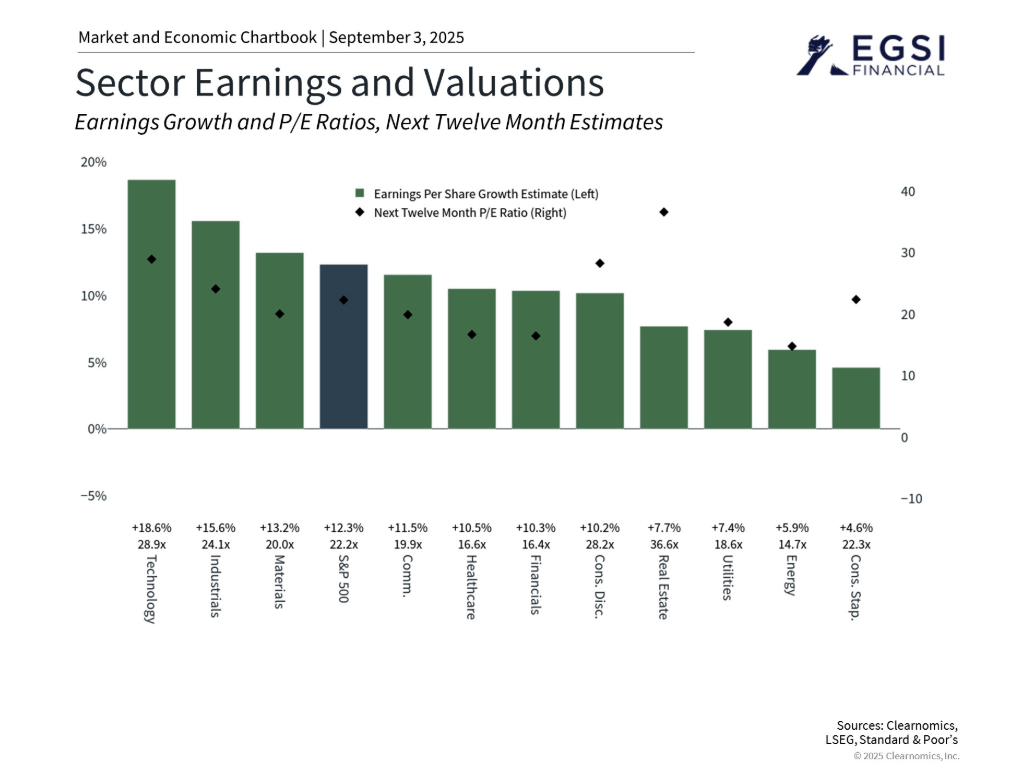
While daily news and headlines can move markets in the short term, basics like company profits and stock prices compared to earnings are what affect investment returns over the long term. Although stock market prices are quite high compared to history, this is supported by companies that continue to grow their profits at a healthy rate.
The latest earnings season numbers show that 81% of S&P 500 companies did better than expected, according to FactSet. This is the highest percentage since the third quarter of 2023, showing that the economy and company basics have been stronger than many expected.1 This also shows how well companies can adapt as they deal with tariffs, absorb higher costs, and find ways to grow despite policy uncertainty.
Many investors focus on the earnings and returns of the Magnificent Seven, a group of very large companies, including some worth multiple trillions of dollars. This group now makes up over one-third of the S&P 500, so how they perform can greatly affect the broader market. The earnings results were mixed for this group overall, but some of these “hyperscalers” (companies that can grow very quickly) did better than expected. Despite concerns about an “AI bubble” (worry that artificial intelligence company stocks are overpriced), these results helped drive a market rally in the second half of August.
The Federal Reserve is expected to cut interest rates
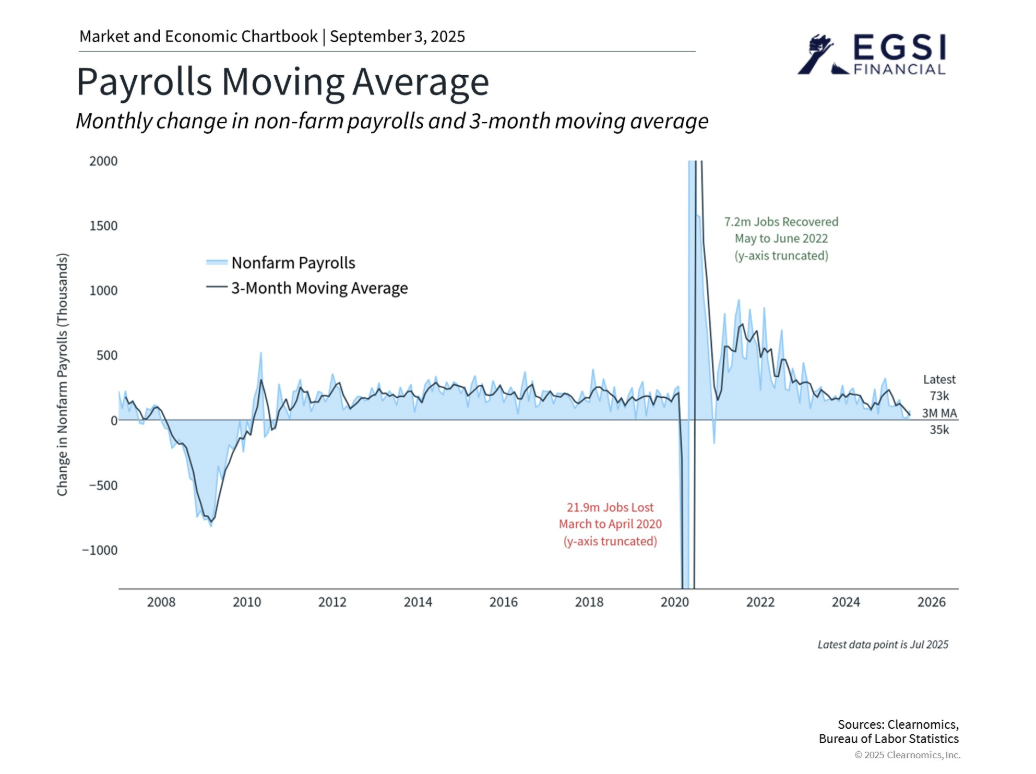
In contrast, consumer-facing businesses (companies that sell directly to people) reported mixed results due to changing household spending patterns. This gets worse because of tariffs, as companies pass on more tariff costs to consumers. Combined with weaker-than-expected jobs data, markets began expecting bigger rate cuts starting in September.
Fed Chair Jerome Powell, in a speech at their yearly conference in Jackson Hole, Wyoming, gave the clearest sign yet that the central bank is ready to start cutting interest rates again after pausing this year. The Fed has a “dual mandate” (two main jobs) to keep inflation (rising prices) steady and unemployment low. Recently, they have kept interest rates relatively high because of stubborn inflation and a strong job market. So, early signs of job market weakness could tip the Fed’s decision-making toward careful rate cuts.
Fed rate cuts can create opportunities across different types of investments
The possibility of more Fed rate cuts could create opportunities across different types of investments. In addition to supporting broad economic growth, lower interest rates can improve borrowing costs for companies, reduce barriers for new projects, and increase the current value of future cash flows (money companies expect to receive). For bonds, lower interest rates boost the prices of existing bonds that were issued when rates were higher.
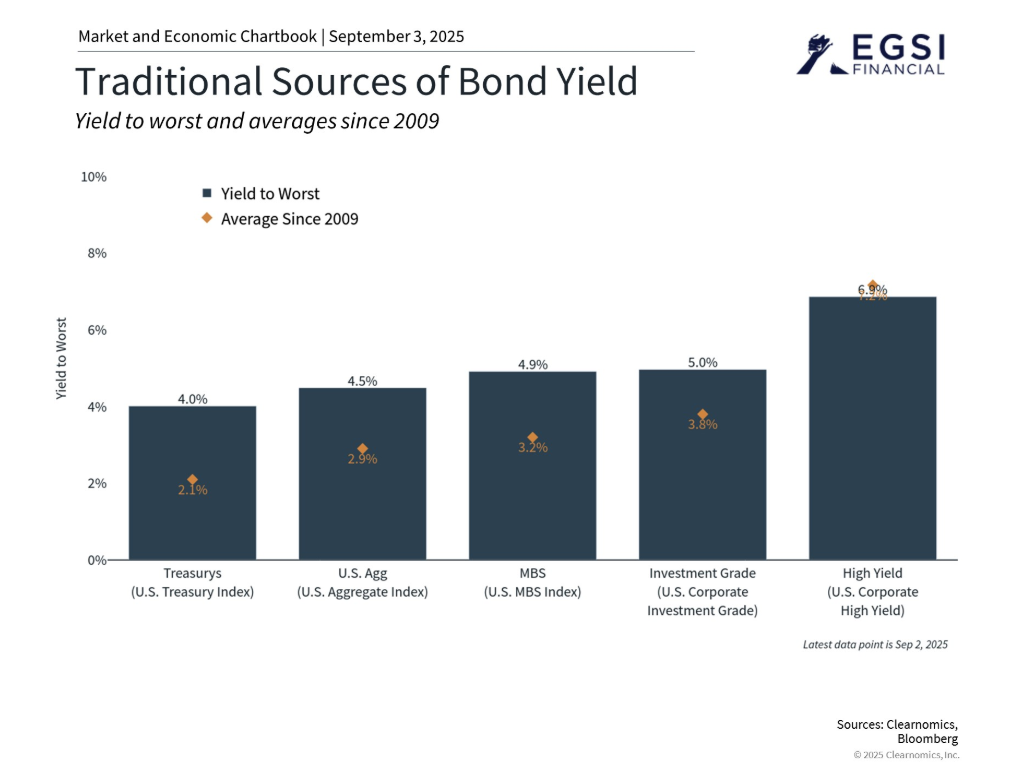
Bond yields (the interest rates bonds pay) have stayed in a narrow range this year, with the 10-year Treasury yield generally moving between 4.0% and 4.5%. Even if short-term yields go down as the Fed cuts rates, many bond types are providing healthy levels of income. The U.S. aggregate bond index is yielding 4.4%, investment-grade corporate bonds 4.9%, and high-yield bonds 6.7%. These levels are well above historical averages and support balanced portfolios.
For overall investment portfolios, investors should continue to focus on managing different risk and return drivers. Topics like tariffs, Fed policy, and the risk of a government shutdown in Washington are only some of the issues that investors will face in the months ahead. Rather than reacting to each event, holding a portfolio that can withstand these swings while providing both income and long-term growth is the best way to achieve financial goals.
The bottom line? Markets reached new all-time highs in August despite many policy concerns. Healthy company earnings and economic growth continue to support investment portfolios despite ongoing uncertainty.
We are an independent financial services firm helping individuals create retirement strategies using a variety of investment and insurance products to custom suit their needs and objectives.
Advisory services offered through EGSI Investment Management, Inc., a Registered Investment Advisor with the State of Ohio. Insurance services offered through EGSI Financial, Inc.
Investing involves risk, including the potential loss of principal. No investment strategy can guarantee a profit or protect against loss in periods of declining values. None of the information contained on this website shall constitute an offer to sell or solicit any offer to buy a security or any insurance product.
Any references to protection benefits, safety, security, or steady and lifetime income streams on this website refer only to fixed insurance products. They do not refer, in any way, to securities or investment advisory products. Annuity guarantees are backed by the financial strength and claimspaying ability of the issuing insurance company. Annuities are insurance products that may be subject to fees, surrender charges and holding periods which vary by insurance company. Annuities are not FDIC insured.
The information and opinions contained in any of the material requested from this website are provided by third parties and have been obtained from sources believed to be reliable, but accuracy and completeness cannot be guaranteed. They are given for informational purposes only and are not a solicitation to buy or sell any of the products mentioned. The information is not intended to be used as the sole basis for financial decisions, nor should it be construed as advice designed to meet the particular needs of an individual’s situation.
Investing involves risk, including the potential loss of principal. No investment strategy can guarantee a profit or protect against loss in periods of declining values. None of the information contained on this website shall constitute an offer to sell or solicit any offer to buy a security or any insurance product.
Any references to protection benefits or steady and reliable income streams on this website refer only to fixed insurance products. They do not refer, in any way, to securities or investment advisory products. Annuity guarantees are backed by the financial strength and claims-paying ability of the issuing insurance company. Annuities are insurance products that may be subject to fees, surrender charges and holding periods which vary by insurance company. Annuities are not FDIC insured.
The information and opinions contained in any of the material requested from this website are provided by third parties and have been obtained from sources believed to be reliable, but accuracy and completeness cannot be guaranteed. They are given for informational purposes only and are not a solicitation to buy or sell any of the products mentioned.