
A famous investor named Jack Bogle once said that “successful investing is about owning businesses and reaping the huge rewards provided by the dividends and earnings growth of our nation’s—and, for that matter, the world’s—corporations.” This idea matters today because owning stocks isn\’t just about watching their prices go up. It\’s also about getting dividend payments from companies as they make more money.
Right now, stock prices are near their highest levels ever, but dividend yields (the percentage of money companies pay back to shareholders) are very low. The S&P 500 is expected to pay only about 1.3% in dividends over the next year. The last time dividends were this low was in 2000 during the internet stock bubble. The Federal Reserve is also cutting interest rates, which changes how investors can earn income from their investments.
Many people think dividends are boring, especially when compared to exciting tech stocks that get lots of attention. But dividend payments shouldn\’t be ignored. They add up over time and give investors a steady stream of money, especially when stock prices go up and down a lot. Companies that both pay dividends and see their stock prices rise over many years can offer investors two benefits: regular cash payments and long-term wealth growth.
Today\’s market shows how companies and investors have changed their thinking over many decades. How can investors balance both stock price growth and dividend income in their portfolios today?
Investor attitudes toward dividends have changed over 100 years
Dividends have played different roles in investing over the past century. For most of the 1900s, dividends were a main way people made money from stocks. Dividend yields (the percentage return from dividends) were often 5% to 7% or higher. People bought stocks much like they buy bonds today – mainly for the regular income payments. Companies were expected to pay and increase their dividends to show they were financially healthy. Stock price increases were often less important than dividend income.
This started changing as investors became more interested in technology companies and fast-growing businesses. The dot-com boom of the 1990s reduced focus on dividends even more. High-growth tech companies not only put their money back into growing their businesses, but investors actually expected them to not pay dividends. Stock buybacks (when companies buy back their own shares) also became more popular as a way to return money to shareholders that was more tax-friendly than dividends.
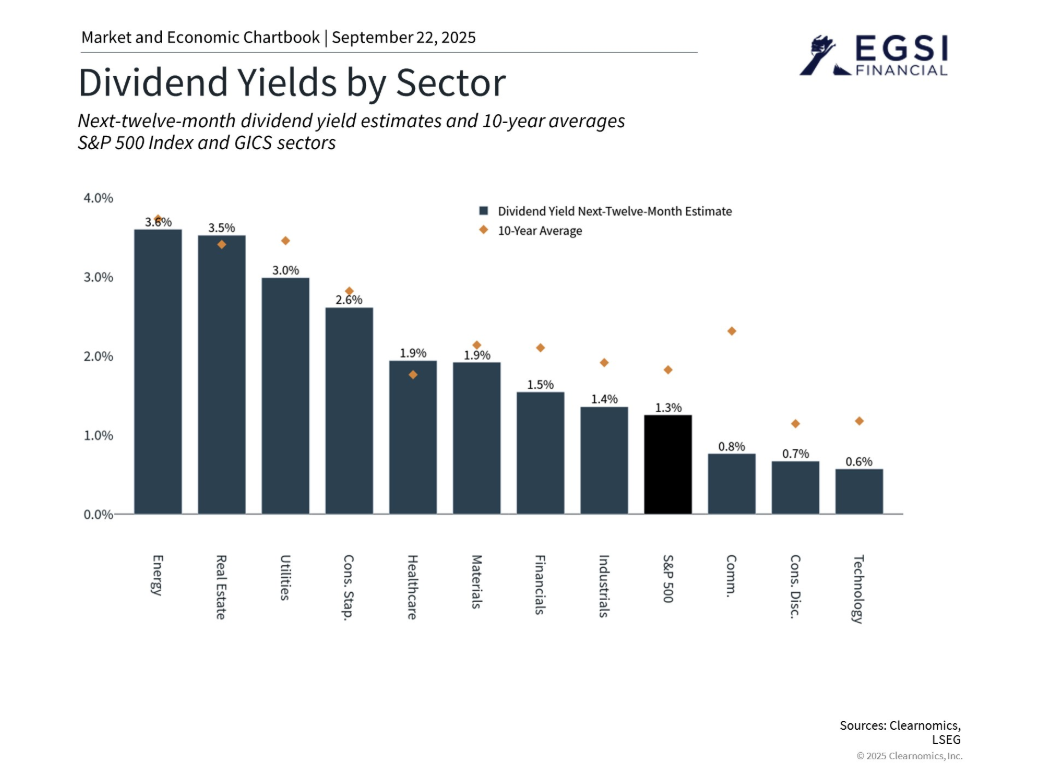
Today\’s low dividend yields show this change. As the chart shows, technology-related sectors like Information Technology, Consumer Discretionary, and Communication Services have the lowest dividend yields at 0.6%, 0.7%, and 0.8%. These sectors include the Magnificent 7 stocks, which generally pay low dividends or no dividends at all.
On the other hand, sectors like Real Estate, Energy, and Utilities that have traditionally focused on providing income offer yields above 3%. This shows that higher dividends are still available by looking at different parts of the market.
Lower dividend yields for the overall market isn\’t necessarily bad since it reflects different business strategies that can help investors in various ways. However, it does show why it\’s important to understand what role dividends play for companies, investors, and portfolios.
Company decisions and interest rates affect how attractive dividends are
From a company\’s point of view, profits can be used in two ways: put the money back into growing the business or give cash back to shareholders through dividends. In theory, companies should return cash to investors when they already have enough money for good growth opportunities or when their business is specifically designed to generate income for shareholders, like REITs (companies that own and rent out real estate).
But dividends do more than just return extra cash. Many companies pay steady dividends to attract investors and show they are financially stable, especially when they can show consistent growth in these payments over time. Growing dividend payments signal that the company is healthy and management is confident about future profits, not just providing income.
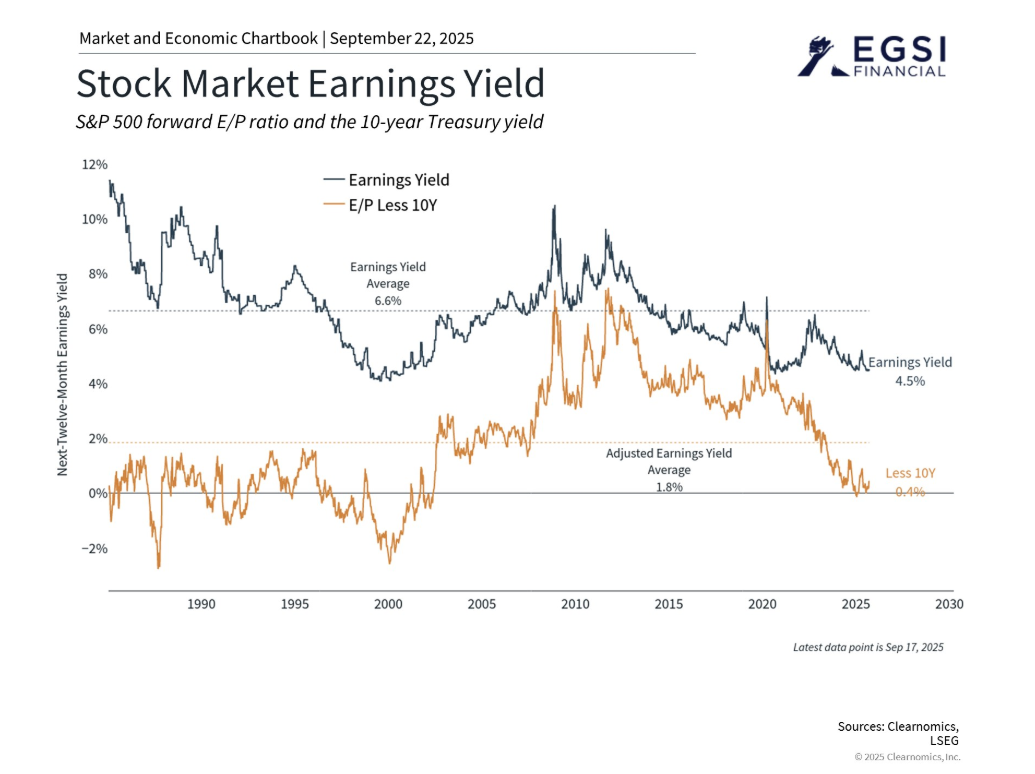
Interest rates and Federal Reserve policy also affect how attractive dividend-paying stocks are. When government bond yields are higher than dividend yields, bonds become more attractive than dividend stocks. Right now, 10-year Treasury bonds pay around 4.1%, which is much higher than what the overall stock market pays in dividends. As the Fed continues cutting interest rates, this comparison could change.
The chart shows something called the “earnings yield” or “equity risk premium.” This measures how attractive stocks are compared to Treasury bonds. The downward trend in recent years happened because stock prices climbed to new highs while interest rates also rose. The fact that interest rates have stayed in a range recently is why this measure has been more stable this year.
Dividends are important for investors to consider
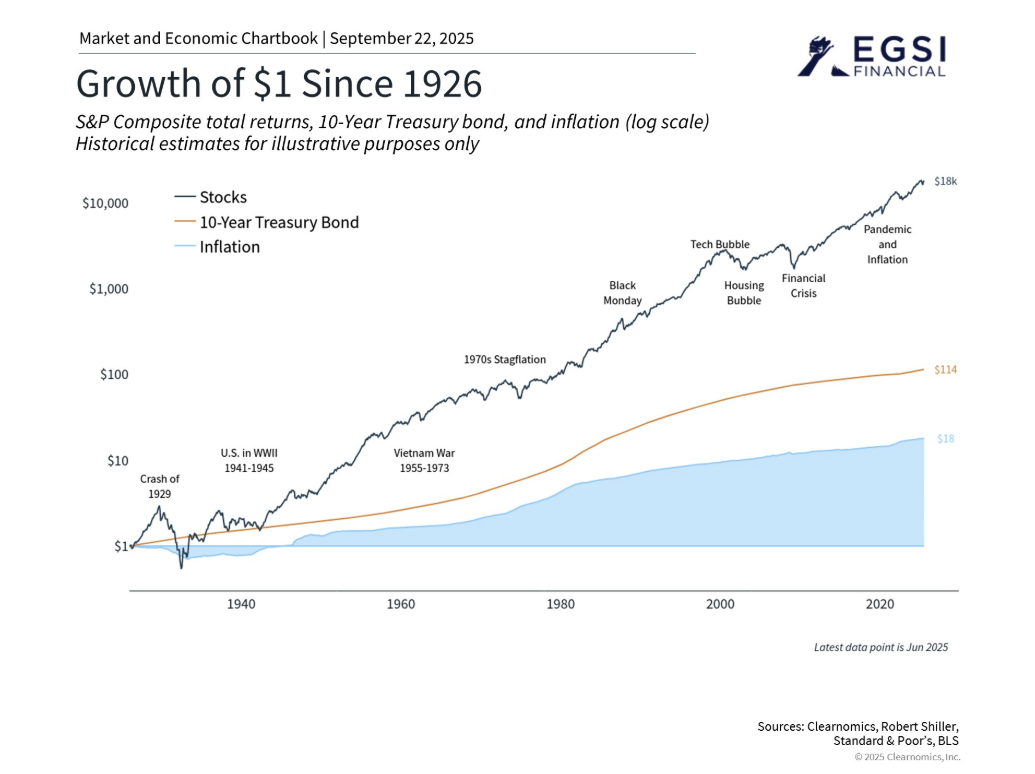
For investors, dividends are a key part of total returns from a portfolio. According to Standard and Poor\’s, dividends have provided 31% of the total return for the S&P 500 since 1926, while stock price increases provided 69%.1 Today, most everyday investors seem to focus mainly on stock prices, except when they need portfolio income, such as people nearing or already in retirement.
The chart shows that $1 invested in stocks in 1926 grew to about $18,000 by 2025, showing the power of compound growth over long periods. This growth came from both dividends and price increases, but the mix was different in different decades. During some periods, dividends provided most of the return. In others, stock price increases were more important. What stayed the same was the importance of staying invested through various market cycles, no matter what drove returns.
For investors approaching or already in retirement, the focus naturally shifts toward generating current income. However, this doesn\’t necessarily mean focusing only on high-dividend stocks. The risk of “yield chasing” – focusing only on the highest-paying investments – is that it can lead to poor diversification, concentration in companies and industries that can\’t sustain their payments, and reduced growth for today\’s longer retirements.
Therefore, investors should find the right balance of dividends and growth for their financial goals. This “total return” approach helps ensure that portfolios can generate appropriate returns in various market conditions, whether through dividends, stock price increases, or both.
The bottom line? While dividend yields are near historic lows, they continue to play an important role in portfolios. Investors should focus on both price appreciation and dividends as they work toward their financial goals.
1. https://www.spglobal.com/spdji/en/documents/research/research-sp500-dividend-aristocrats.pdf
We are an independent financial services firm helping individuals create retirement strategies using a variety of investment and insurance products to custom suit their needs and objectives.
Advisory services offered through EGSI Investment Management, Inc., a Registered Investment Advisor with the State of Ohio. Insurance services offered through EGSI Financial, Inc.
Investing involves risk, including the potential loss of principal. No investment strategy can guarantee a profit or protect against loss in periods of declining values. None of the information contained on this website shall constitute an offer to sell or solicit any offer to buy a security or any insurance product.
Any references to protection benefits, safety, security, or steady and lifetime income streams on this website refer only to fixed insurance products. They do not refer, in any way, to securities or investment advisory products. Annuity guarantees are backed by the financial strength and claimspaying ability of the issuing insurance company. Annuities are insurance products that may be subject to fees, surrender charges and holding periods which vary by insurance company. Annuities are not FDIC insured.
The information and opinions contained in any of the material requested from this website are provided by third parties and have been obtained from sources believed to be reliable, but accuracy and completeness cannot be guaranteed. They are given for informational purposes only and are not a solicitation to buy or sell any of the products mentioned. The information is not intended to be used as the sole basis for financial decisions, nor should it be construed as advice designed to meet the particular needs of an individual’s situation.
Investing involves risk, including the potential loss of principal. No investment strategy can guarantee a profit or protect against loss in periods of declining values. None of the information contained on this website shall constitute an offer to sell or solicit any offer to buy a security or any insurance product.
Any references to protection benefits or steady and reliable income streams on this website refer only to fixed insurance products. They do not refer, in any way, to securities or investment advisory products. Annuity guarantees are backed by the financial strength and claims-paying ability of the issuing insurance company. Annuities are insurance products that may be subject to fees, surrender charges and holding periods which vary by insurance company. Annuities are not FDIC insured.
The information and opinions contained in any of the material requested from this website are provided by third parties and have been obtained from sources believed to be reliable, but accuracy and completeness cannot be guaranteed. They are given for informational purposes only and are not a solicitation to buy or sell any of the products mentioned.