

Each year, the Social Security Administration announces a cost-of-living adjustment, or COLA. This is one of the most closely watched updates for retirees and everyday consumers. The COLA directly affects how much money Social Security recipients receive, and it also reflects how prices across the economy are changing. This matters for everyone, not just retirees, because rising prices put pressure on household budgets.
The Social Security Administration recently announced a 3.6% COLA for 2027, which is one of the largest increases seen in recent decades. While this sounds like good news, it is just one piece of a larger puzzle when it comes to keeping up with rising prices. For long-term investors, understanding what is driving inflation, how it affects savings, and what it means for investment portfolios is essential.
Higher energy prices are behind the 2027 COLA increase
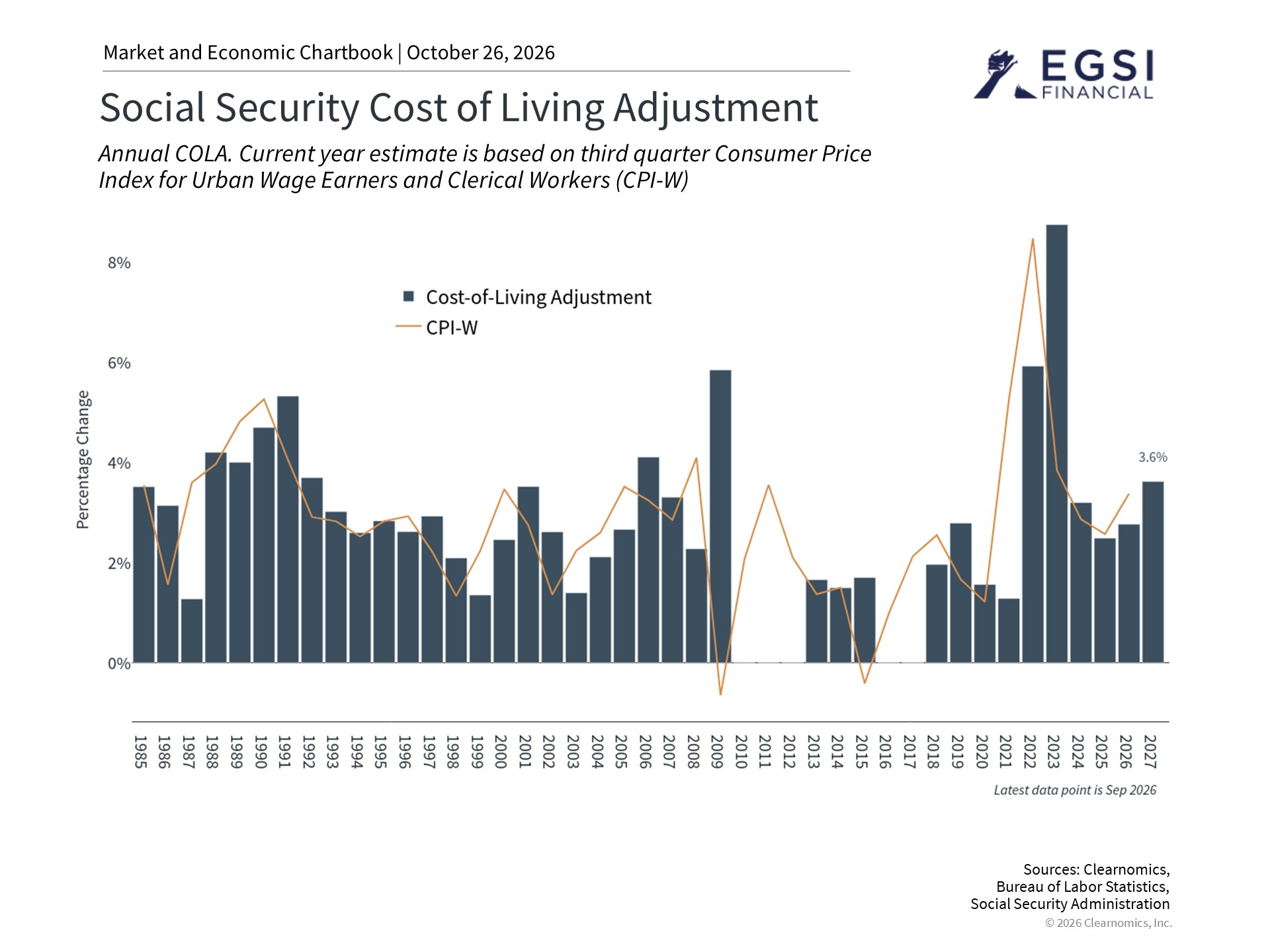
Over the past year, inflation has been pulled in two directions. On one hand, the broad inflationary pressures that built up during the pandemic have been easing. The Consumer Price Index, which is a common measure of how much everyday goods and services cost, slowed from a peak of 9.1% year-over-year in 2022 down to 2.7% at the start of 2026. On the other hand, rising energy prices tied to the war in Iran have pushed inflation back up in recent months. The most recent data shows that prices have risen 3.7% over the past year.1 So while the overall direction of inflation has been improving, energy costs have added new pressure on consumers.
This is why the 3.6% COLA for 2027 stands out. It is the fifth-largest increase in over 35 years, and the highest since the 8.7% adjustment that took effect in 2023. To put it in perspective, the average COLA over the past decade has been 3.1%.2
The COLA is calculated using a version of the Consumer Price Index called the CPI-W, which stands for “urban wage earners and clerical workers.” This index compares prices in the third quarter of the current year to the same period a year earlier. However, one number cannot perfectly reflect the financial situation of every retiree. For example, the 2027 COLA means the average Social Security recipient will receive about $75 more per month starting in January 2027.3 While that is a welcome boost, it may not be enough to fully cover rising costs for healthcare, prescription drugs, and other necessities that many retirees depend on.
There is also an experimental measure called CPI-E, or the Consumer Price Index for the Elderly. It is designed to track spending by households headed by adults aged 62 and older. Because seniors tend to spend more of their income on things like healthcare and housing, which tend to rise in price faster, CPI-E generally grows more quickly than CPI-W. From January 1985 to January 2025, CPI-E rose 221%, while CPI-W increased 197%.4 Still, no single index can capture every household’s experience perfectly.
For retirees enrolled in Medicare, it is also worth noting that the monthly Part B premium, which covers outpatient care, is projected to rise by $6.60 to $209.50.5 Because this amount is typically deducted directly from Social Security checks, it can partially offset the COLA increase for those affected. Part D prescription drug plan costs are also going up, and while lower-cost options are still available, these increases make the actual benefit gain smaller than the headline percentage might suggest.
Consumer spending continues to support overall economic growth
Looking at the broader economy, inflation is still affecting many areas. Overall prices, as measured by headline CPI, rose 3.7% year-over-year in September, with gasoline prices accounting for more than half of the monthly increase, surging 9.1%. When food and energy prices are removed from the calculation, what is known as core CPI rose a much smaller 2.6%.6
These numbers suggest that energy is the main driver of today’s inflation, rather than prices rising broadly across the entire economy. An even narrower measure, sometimes called “supercore” inflation because it excludes food, shelter, and energy, rose only 2.0%.7 Other inflation measures tell a similar story.
It is natural for higher inflation to weigh on how people feel about the economy, and consumer confidence has dropped to historic lows. Despite this, many measures of actual consumer spending remain strong. Retail sales, for instance, grew at a significant rate of 6.3% over the past year in September.8 It is worth noting, though, that part of this increase reflects higher prices rather than more purchases, since gasoline accounted for approximately 71% of the monthly increase.
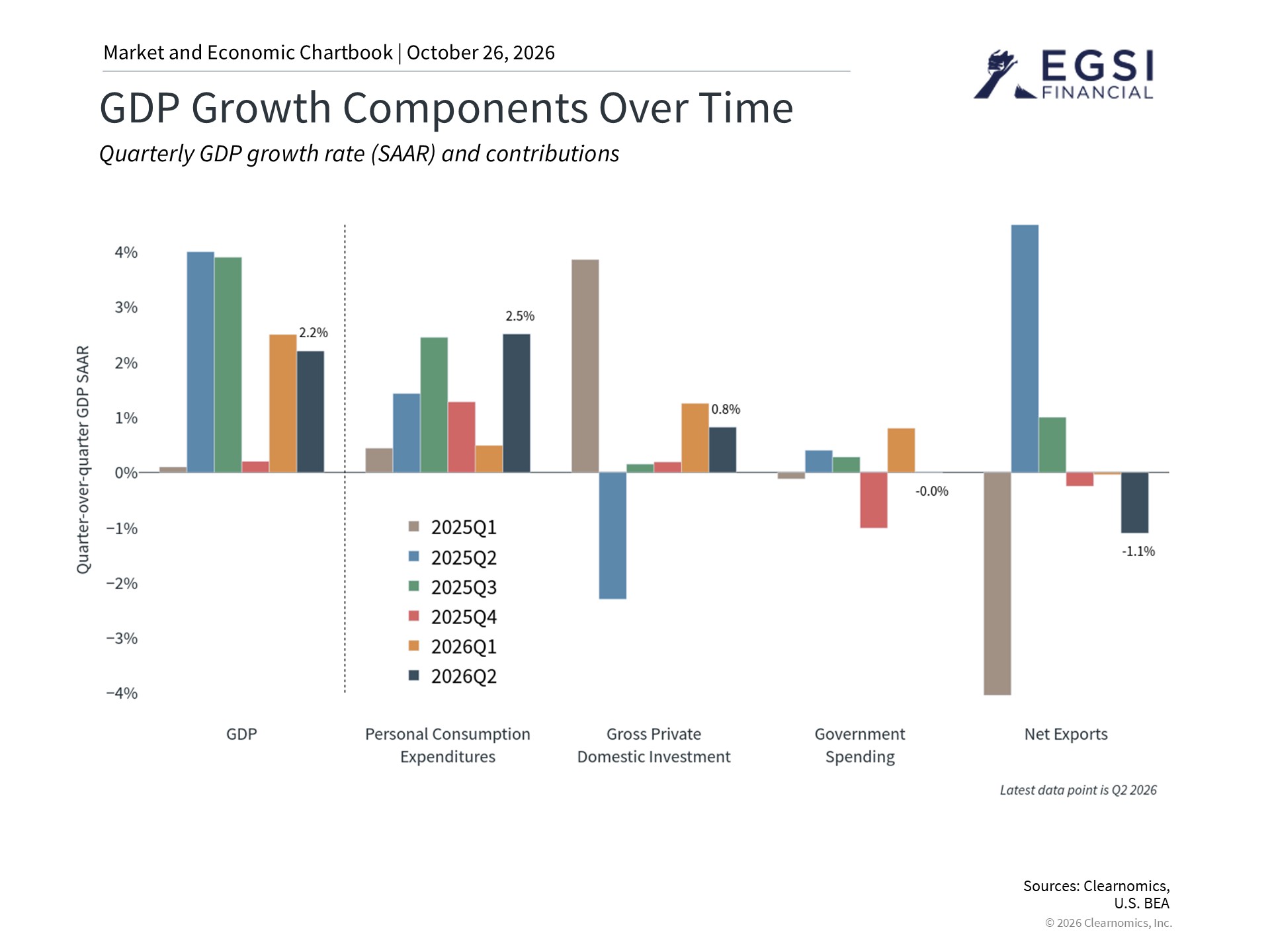
All of these factors feed into real Gross Domestic Product (GDP) growth, which measures the size of the economy after stripping out the effects of inflation. Despite higher inflation and some uncertainty in the job market, consumer spending has remained solid, as shown in the chart above.9 Business investment has also stayed steady, partly driven by continued spending on artificial intelligence infrastructure like data centers. Together, these forces have helped support economic growth, corporate profits, and financial markets, even amid ongoing challenges.
Cash savings are still not keeping up with inflation
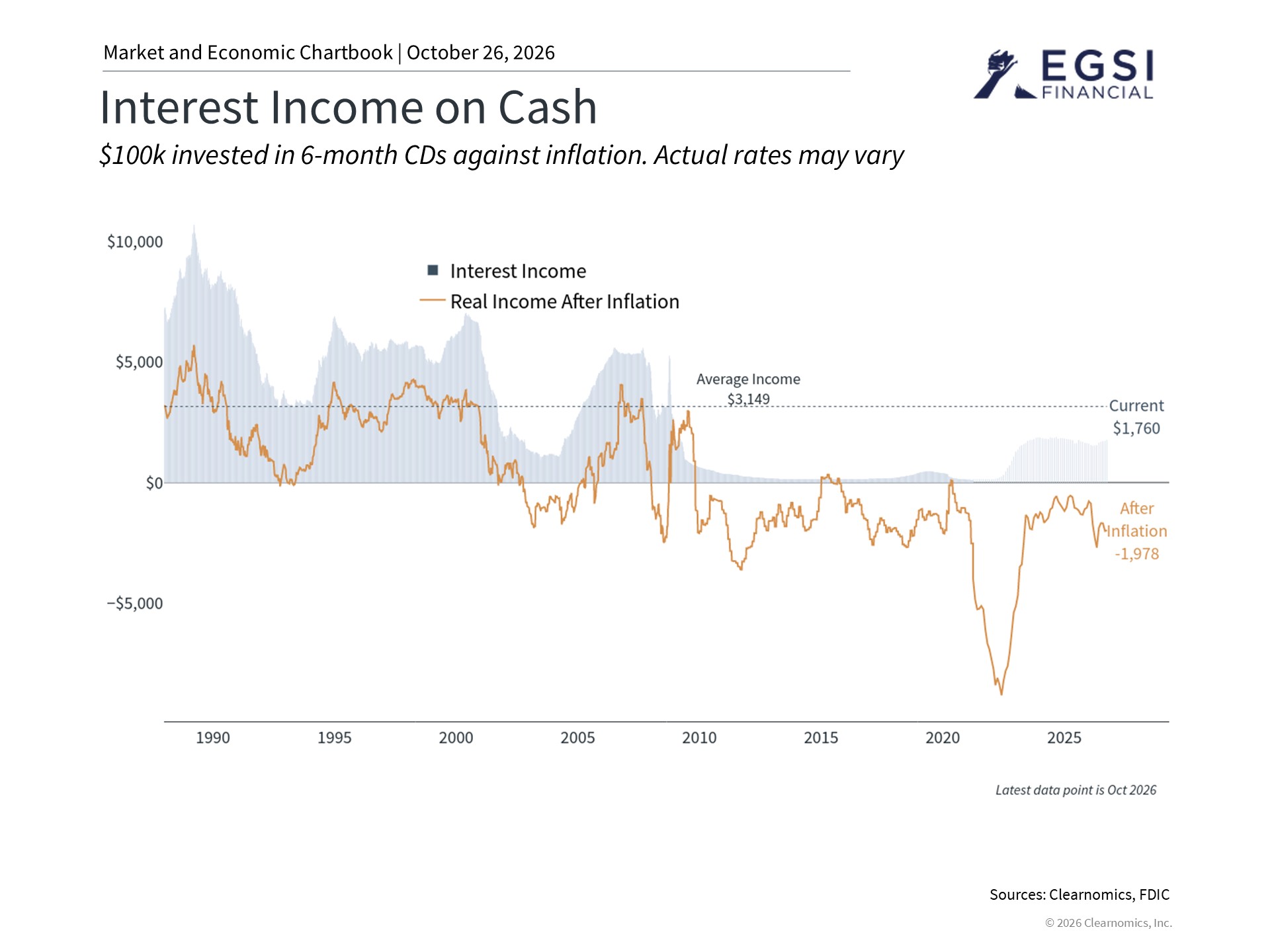
Even though the economy continues to grow, the combination of inflation and higher interest rates creates real challenges for long-term investors. Interest rates are higher today than they have been for much of the past decade, but when you account for inflation, the actual purchasing power gained from holding cash in a savings account or similar product is still lower than many people might expect.
The chart above shows the interest income earned on cash, based on average yields on six-month certificates of deposit (CDs), according to the FDIC. A CD is a type of savings product where you deposit money for a set period in exchange for a fixed interest rate. While these rates are higher than in the past, they are still not keeping pace with inflation. Some specific products may offer better rates, but managing them, making sure they are renewed at the right time, and keeping track of the rate environment all require attention. The takeaway is that simply keeping money in cash remains a challenge for maintaining purchasing power, which is why sticking to a long-term financial plan and holding a diversified portfolio is so important.
For many investors, this is why looking beyond cash and annual benefit adjustments is so important for staying ahead of inflation. A balanced portfolio that includes stocks and bonds, when built thoughtfully, has the potential to deliver stronger inflation-adjusted returns than cash alone. Investment-grade corporate bonds, for example, currently offer yields that are well above their long-run historical averages, making them worth considering as part of a broader strategy.
The bottom line? The 2027 Social Security COLA of 3.6% is a reminder that inflation remains a real challenge due to higher energy prices. Maintaining a balanced portfolio that doesn’t only rely on cash or benefit adjustments alone continues to be the best way to maintain and grow purchasing power.
1. https://www.bls.gov/news.release/cpi.htm
2. Clearnomics research using Social Security Administration data, as of October 18, 2026
3. https://www.ssa.gov/news/en/press/releases/2026-10-14.html
4. https://www.congress.gov/crs-product/IF12675
5. https://www.cms.gov/oact/tr/2026
6. https://www.bls.gov/news.release/cpi.htm
7. https://www.bls.gov/news.release/cpi.htm
8. Clearnomics research using U.S. Census Bureau data, as of October 18, 2026
9. Clearnomics research using BEA data, as of October 18, 2026
We are an independent financial services firm helping individuals create retirement strategies using a variety of investment and insurance products to custom suit their needs and objectives.
Advisory services offered through EGSI Investment Management, Inc., a Registered Investment Advisor with the State of Ohio. Insurance services offered through EGSI Financial, Inc.
Investing involves risk, including the potential loss of principal. No investment strategy can guarantee a profit or protect against loss in periods of declining values. None of the information contained on this website shall constitute an offer to sell or solicit any offer to buy a security or any insurance product.
Any references to protection benefits, safety, security, or steady and lifetime income streams on this website refer only to fixed insurance products. They do not refer, in any way, to securities or investment advisory products. Annuity guarantees are backed by the financial strength and claims-paying ability of the issuing insurance company. Annuities are insurance products that may be subject to fees, surrender charges and holding periods which vary by insurance company. Annuities are not FDIC insured.
The information and opinions contained in any of the material requested from this website are provided by third parties and have been obtained from sources believed to be reliable, but accuracy and completeness cannot be guaranteed. They are given for informational purposes only and are not a solicitation to buy or sell any of the products mentioned. The information is not intended to be used as the sole basis for financial decisions, nor should it be construed as advice designed to meet the particular needs of an individual’s situation.