
Treasury yields have climbed to their highest points in recent years, driven by worries about inflation, oil prices, the national debt, and the Federal Reserve (often called “the Fed,” which is the central bank of the United States). The 10-year Treasury yield (the interest rate on a U.S. government bond that matures in 10 years) has moved back above 4.6%, and the 30-year Treasury has stayed above 5% for the longest stretch since 2007.1 In general, this is good news for long-term investors, since higher yields help support portfolio goals such as earning income and maintaining stability.
Equally important is the rise in real yields, which are bond yields after adjusting for inflation. Understanding these moves matters for investors because they affect many parts of investing and financial planning. Portfolios and financial plans should account for these changing interest rates and economic conditions, particularly because they have shifted considerably over the past decade.
The distinction between nominal and real interest rates is straightforward. A nominal yield is simply the stated interest rate on a bond, such as a corporate bond or a U.S. Treasury note. A real yield takes things a step further by showing what an investor actually earns once inflation is factored in. Real yields represent the true return for savers and serve as an important reference point for comparing all other types of investments. So, with real yields on the rise, what should investors keep in mind?
Long-term real yields are near multi-year highs
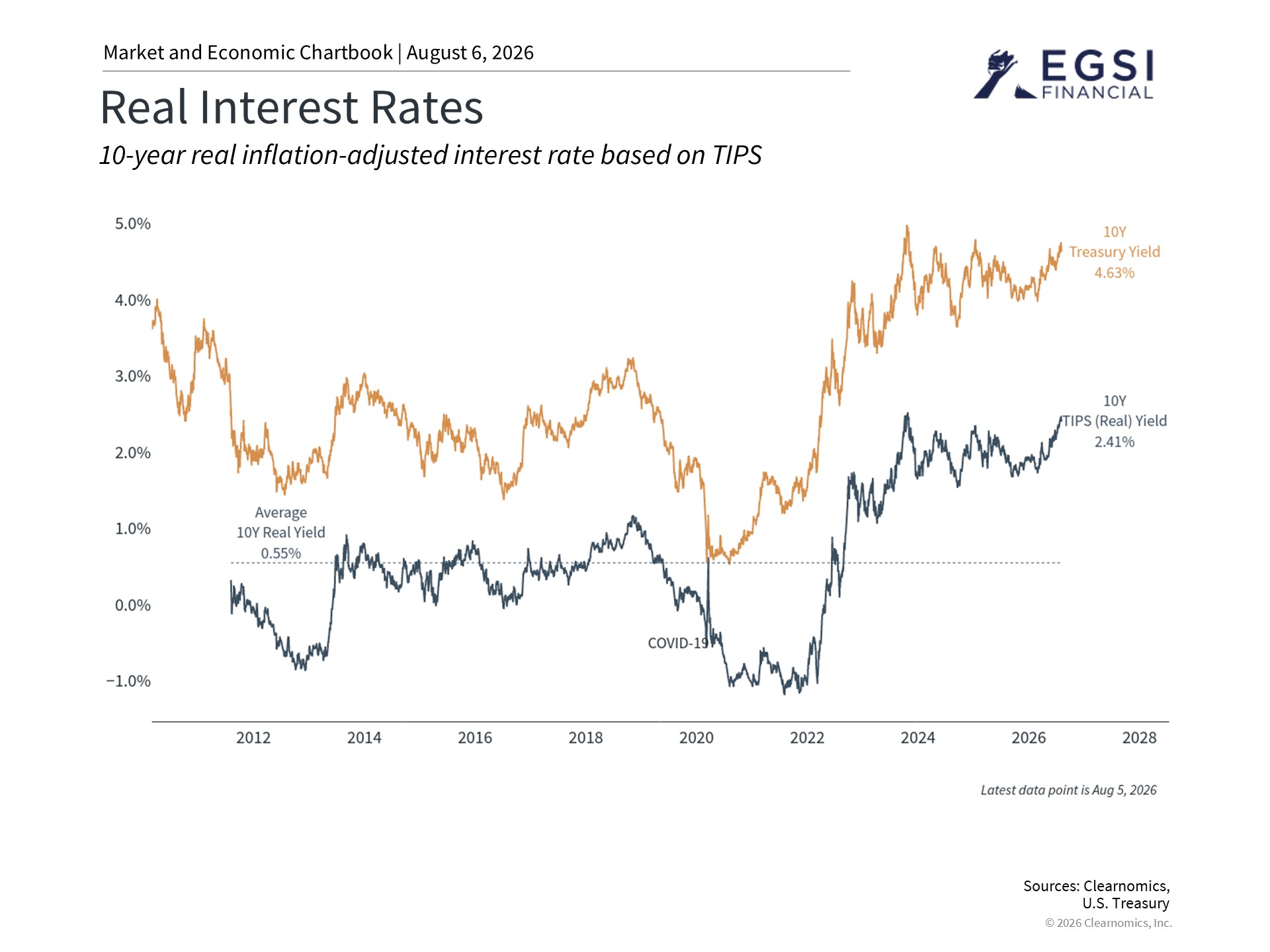
The chart above shows how real yields have changed over the past fifteen years or so. Back in 2020, real yields on government bonds actually turned negative. This meant that investors were either expecting very little inflation in the years ahead, or they were willing to accept a guaranteed loss in purchasing power in exchange for the safety of U.S. Treasury securities. The Fed played a big role in this by cutting interest rates to support the economy and encourage investors to put money into stocks, real estate, and other assets with higher potential returns.
Things changed in 2022 when inflation rose sharply, prompting the Fed to reverse course and raise its key interest rate at the fastest pace in decades. Both nominal and real yields jumped as a result. Today, the 10-year nominal Treasury yield sits at around 4.7%, while the real yield for that same bond is approximately 2.4%, well above the levels seen since the global financial crisis. These figures reflect expectations for inflation over the next ten years, not just the most recent data.
Several factors are keeping long-term yields elevated. Oil prices have climbed back above $90 per barrel for Brent crude amid the ongoing war in Iran, and gasoline prices have risen above $4 per gallon nationally.2 Higher energy costs can push broader inflation higher, which in turn lifts nominal yields. Interestingly, inflation expectations have not risen much according to market measures and surveys, largely because many expect the Fed may raise rates over the coming months to keep rising prices in check.
Additionally, the growing national debt and federal budget deficit continue to create uncertainty around government bond yields. This affects what economists call the “term premium,” which is the extra yield investors want in order to hold longer-term bonds rather than shorter-term ones. With the total national debt now exceeding $39 trillion, higher interest payments naturally increase the government’s borrowing costs, pushing U.S. Treasury yields up.3
Higher yields affect all parts of the market
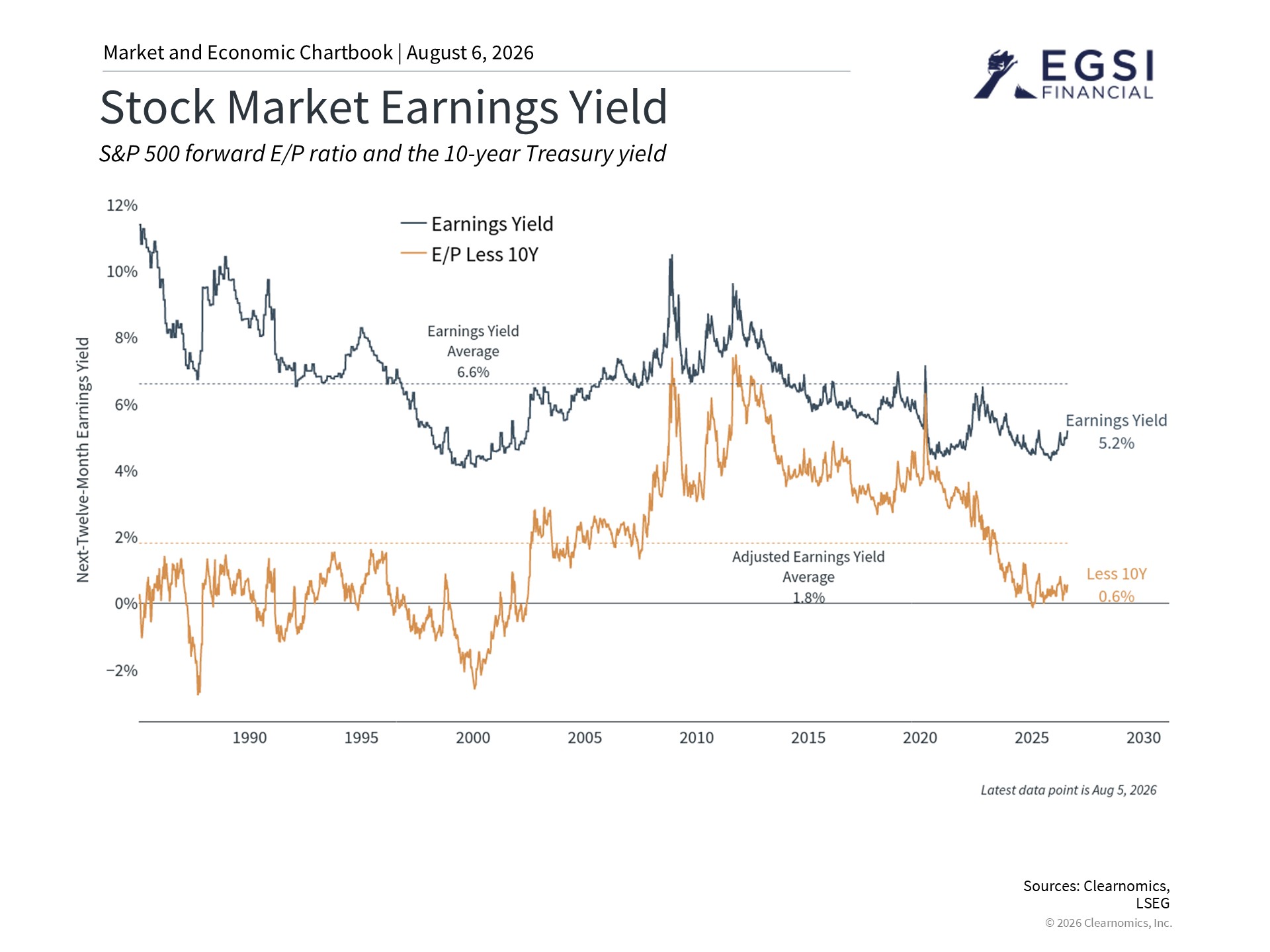
Interest rates do not just matter for bonds. They also affect how appealing different types of investments look compared to one another. This is especially relevant for long-term investors, since it shapes the relative attractiveness of different assets in a balanced portfolio. For example, the chart above shows the S&P 500 earnings yield, which is calculated by dividing the earnings per share of the index by its price. This is a useful way to compare the stock market against bond yields.
This comparison is often called the “equity risk premium,” because it measures how much extra benefit investors get for taking on the greater risk of owning stocks instead of bonds. When real bond yields were near zero or negative, as they were for much of the period after 2008, stocks faced little competition. Investors were willing to accept lower earnings yields from stocks because there were few other options for earning income and growth. This situation was often referred to as TINA, or “there is no alternative.”
At today’s levels, the 10-year real yield of 2.4% means investors can earn a solid, inflation-adjusted return from government bonds. The S&P 500 earnings yield is around 4.9%, which corresponds to a forward price-to-earnings ratio of roughly 20x (meaning investors are paying about $20 for every $1 of expected earnings). As a result, carefully thinking about the right mix of stocks and bonds in a portfolio has become potentially more important than it used to be.4
The Fed balance sheet and what it means for yields
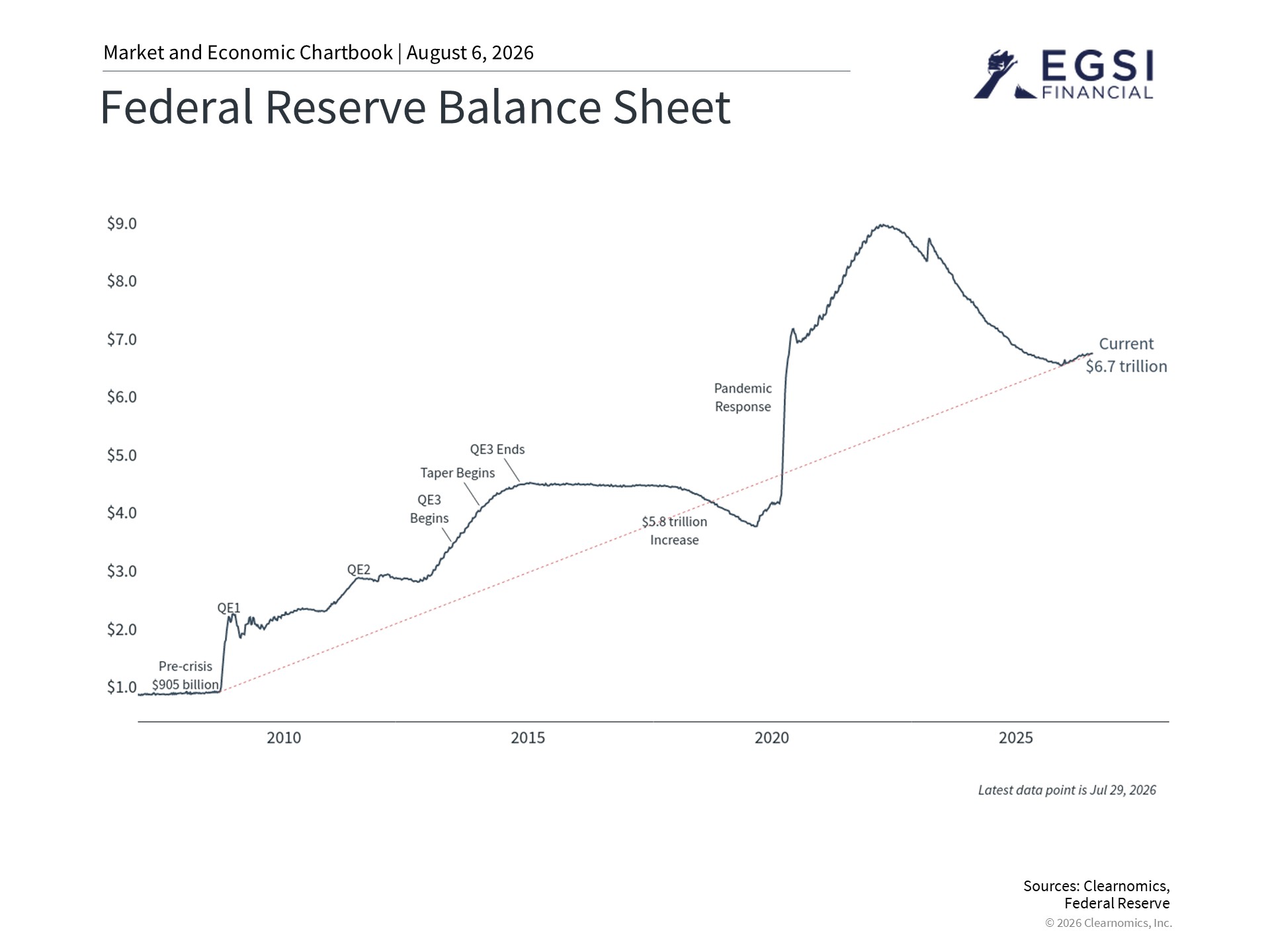
Another factor influencing bond yields is uncertainty around Fed policy under its new leadership, Kevin Warsh. One task force he has launched is focused on addressing the central bank’s $6.7 trillion balance sheet (the collection of assets, mainly bonds, that the Fed holds). As the chart above illustrates, the Fed’s holdings have grown with each economic crisis over the years. Although the balance sheet has decreased somewhat in recent years as assets have matured and been paid off, it remains far larger than it was before 2008.
Warsh has long believed that the Fed should reduce its balance sheet when the economy is in good shape. Doing so would mean selling Treasury securities and mortgage-backed securities (bonds backed by home loans). Selling these bonds pushes their yields higher, which raises borrowing costs for businesses and homebuyers alike. Combined with the expectation that the Fed may raise its key interest rate in the months ahead, these actions could keep both short-term and long-term interest rates higher for an extended period.
For long-term investors, this means it is more important than ever to hold a well-considered mix of stocks, bonds, and other assets designed to help meet financial goals.
The bottom line? Real yields are at their highest levels in years, driven by inflation concerns, fiscal uncertainty, and a shrinking Fed balance sheet. A thoughtfully constructed and well-balanced portfolio aligned with financial plans is more important than ever.
References
1. https://home.treasury.gov/policy-issues/financing-the-government/interest-rate-statistics
2. https://gasprices.aaa.com/
3. https://www.jec.senate.gov/public/index.cfm/republicans/debt-dashboard
4. Clearnomics research and LSEG data as of July 27, 2026
5. https://www.federalreserve.gov/monetarypolicy/task-forces.htm
Index Descriptions
S&P 500
The Standard & Poor’s 500 Index is a capitalization-weighted index of 500 stocks designed to measure performance of the broad domestic economy through changes in the aggregate market value of 500 stocks representing all major industries.
We are an independent financial services firm helping individuals create retirement strategies using a variety of investment and insurance products to custom suit their needs and objectives.
Advisory services offered through EGSI Investment Management, Inc., a Registered Investment Advisor with the State of Ohio. Insurance services offered through EGSI Financial, Inc.
Investing involves risk, including the potential loss of principal. No investment strategy can guarantee a profit or protect against loss in periods of declining values. None of the information contained on this website shall constitute an offer to sell or solicit any offer to buy a security or any insurance product.
Any references to protection benefits, safety, security, or steady and lifetime income streams on this website refer only to fixed insurance products. They do not refer, in any way, to securities or investment advisory products. Annuity guarantees are backed by the financial strength and claims-paying ability of the issuing insurance company. Annuities are insurance products that may be subject to fees, surrender charges and holding periods which vary by insurance company. Annuities are not FDIC insured.
The information and opinions contained in any of the material requested from this website are provided by third parties and have been obtained from sources believed to be reliable, but accuracy and completeness cannot be guaranteed. They are given for informational purposes only and are not a solicitation to buy or sell any of the products mentioned. The information is not intended to be used as the sole basis for financial decisions, nor should it be construed as advice designed to meet the particular needs of an individual’s situation.
Investing involves risk, including the potential loss of principal. No investment strategy can guarantee a profit or protect against loss in periods of declining values. None of the information contained on this website shall constitute an offer to sell or solicit any offer to buy a security or any insurance product.
Any references to protection benefits or steady and reliable income streams on this website refer only to fixed insurance products. They do not refer, in any way, to securities or investment advisory products. Annuity guarantees are backed by the financial strength and claims-paying ability of the issuing insurance company. Annuities are insurance products that may be subject to fees, surrender charges and holding periods which vary by insurance company. Annuities are not FDIC insured.
The information and opinions contained in any of the material requested from this website are provided by third parties and have been obtained from sources believed to be reliable, but accuracy and completeness cannot be guaranteed. They are given for informational purposes only and are not a solicitation to buy or sell any of the products mentioned. The information is not intended to be used as the sole basis for financial decisions, nor should it be construed as advice designed to meet the particular needs of an individual’s situation.