The United States and Iran have announced a preliminary agreement aimed at ending a four-month conflict that has put pressure on the global economy. Financial markets responded with optimism: stock prices rose, oil prices dropped, and interest rates moved lower. So what does this agreement actually mean, and how should everyday investors think about it?
The agreement, referred to as a “memorandum of understanding,” includes a plan to reopen the Strait of Hormuz, which is a critical waterway for global oil shipments. A final deal is expected to be worked out over the next 60 days. While the news is encouraging, particularly from a humanitarian standpoint, many details are still unclear. The full text of the agreement has not yet been made public, and thorny issues like Iran’s nuclear program and economic sanctions remain unresolved.
It is also worth keeping in mind that since the conflict began, there have been several temporary ceasefires and failed negotiations. Each of those events caused short-term swings in financial markets as investors reacted to the latest headlines. So while the current news is a positive step, it comes at a time when markets have already been trending upward and the broader economy has remained solid.
Oil prices and inflation: possible relief at the pump
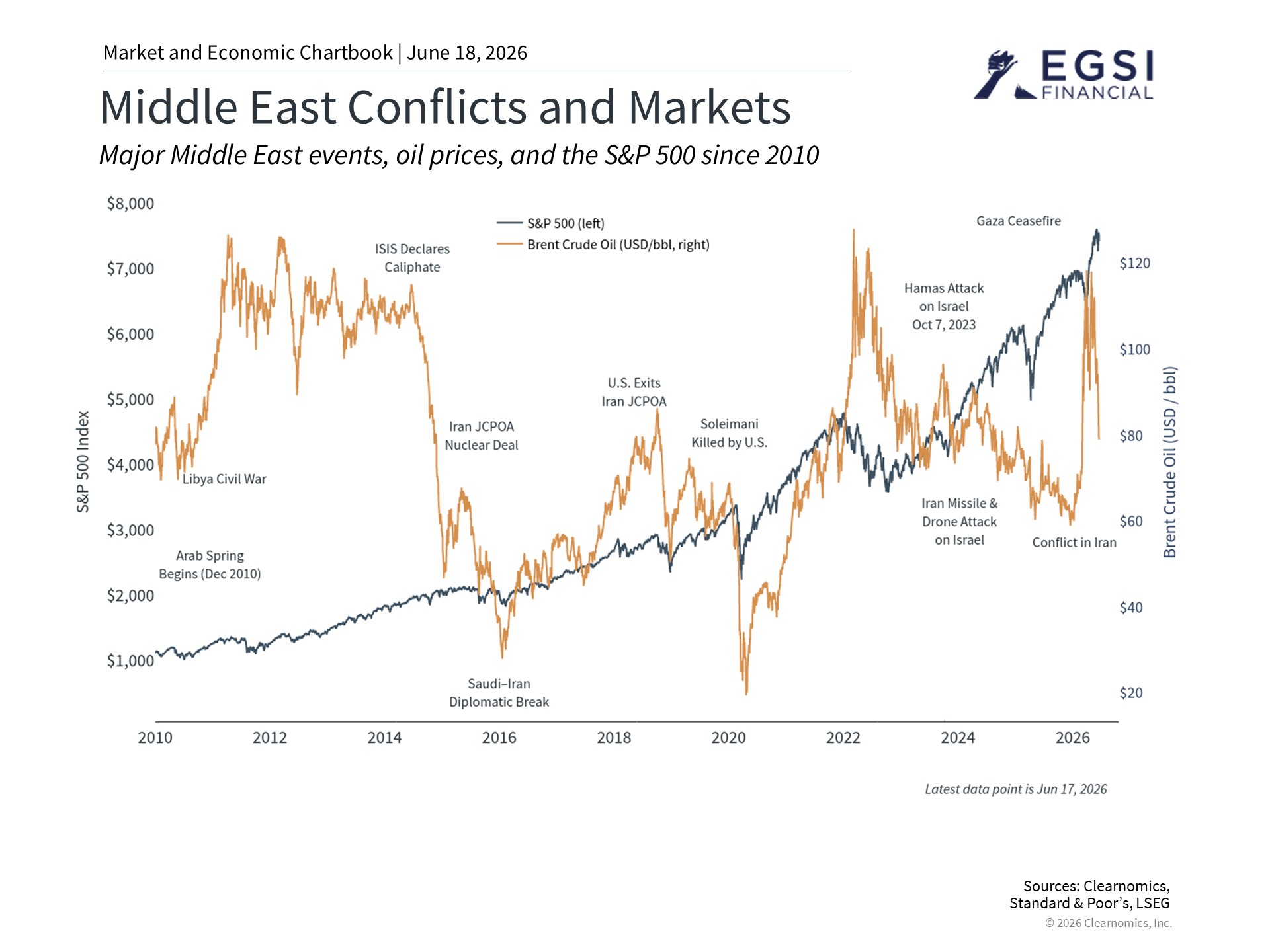
Energy prices are the main way that geopolitical conflicts ripple through the broader economy. The effective closure of the Strait of Hormuz forced major oil-producing countries in the Middle East to cut back output as storage facilities filled up. That said, oil prices had already started moving lower in recent weeks, falling more than 25% from a peak of $118 per barrel in April to around $85 before the preliminary peace deal was announced.1
History shows that while conflicts in the Middle East can cause oil prices to spike, those spikes tend to be temporary. Over the long run, oil prices are shaped by broader supply and demand forces, such as how much oil the United States is producing. This is why economists often call supply-driven price increases “transitory,” meaning the inflationary effects tend to fade once the disruption is resolved. A reopening of the Strait of Hormuz would be a meaningful step in that direction, even if it takes some time for fuel prices at the pump to fully return to more normal levels.
Gasoline prices followed a similar pattern. The average price of regular unleaded gasoline climbed above $4.50 per gallon at its peak in late May before pulling back to around $4.00 per gallon more recently. The latest Consumer Price Index (CPI) report, which measures how much prices have changed over time, shows that energy prices rose 23.5% compared to a year ago, with gasoline up 40.5%. This surge in energy costs was the main reason overall inflation reached 4.2% in May, the highest level in several years.2
While higher energy prices have been a burden for consumers, the situation has not turned into a repeat of the broad inflation seen after the pandemic. Importantly, “core” inflation, which strips out food and energy prices to give a clearer picture of underlying price trends, rose only 2.9% over the past year in May. This suggests that higher oil prices have not yet spread widely across the rest of the economy. If oil prices continue to fall, inflation pressures may ease as well, which could help the Federal Reserve as it works to balance inflation management with a still-healthy jobs market.
Markets have posted healthy gains across asset classes so far this year3
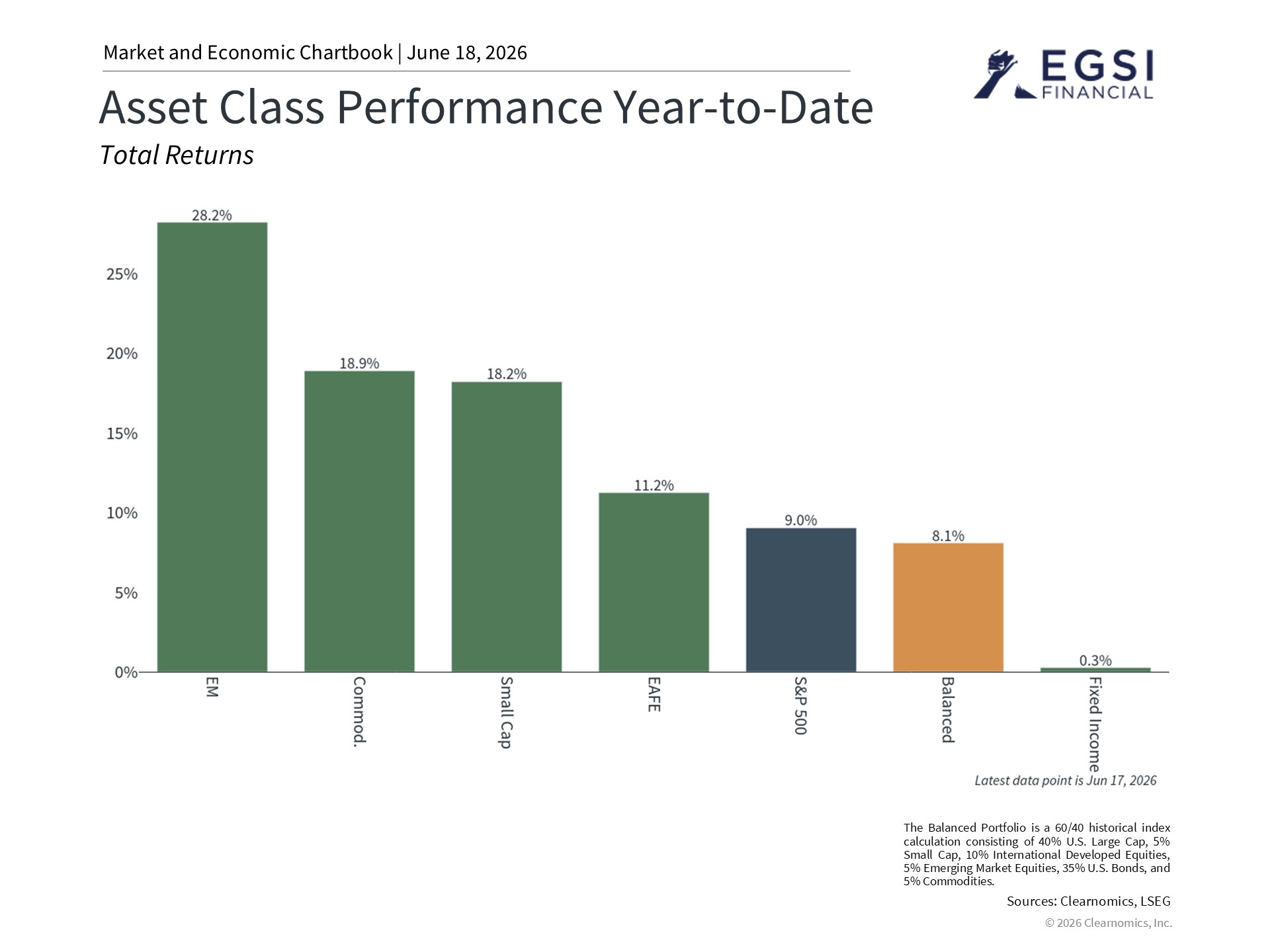
Beyond energy, many types of investments have held up well this year. The U.S. stock market has delivered strong results, with the S&P 500 (a broad index that tracks 500 large U.S. companies) up about 10% for the year, supported by strong company earnings and a healthy economy.4 Bonds, which are essentially loans investors make to governments or companies in exchange for regular interest payments, have also helped steady portfolios during volatile periods, even though the Bloomberg U.S. Aggregate Bond Index is roughly flat on the year.5 The 10-year Treasury yield is below 4.5% and the 30-year yield is under 5%, as both inflation and uncertainty have shown some improvement. Stocks in international markets have also performed well, continuing a trend seen over the past two years.6
Gains have been broad-based, with eight of the eleven major S&P 500 sectors finishing in positive territory. The energy sector has been the standout performer, up roughly 27% year to date, as higher oil prices boosted revenues for energy producers. Sectors with more defensive qualities, meaning they tend to hold up better when the economy faces stress, such as Utilities and Consumer Staples, also performed relatively well as investors looked for stability. Information Technology experienced some turbulence due to swings in interest rates, but still delivered a return of about 17.5% year to date.
This is a good reminder of why spreading investments across different parts of the market matters. Geopolitical events, inflation, and interest rates are hard to predict in advance. Holding a variety of investments that can support a portfolio through different conditions is one of the most reliable ways to manage risk while still pursuing growth over time.
Keeping a long-term view on geopolitics and economic cycles
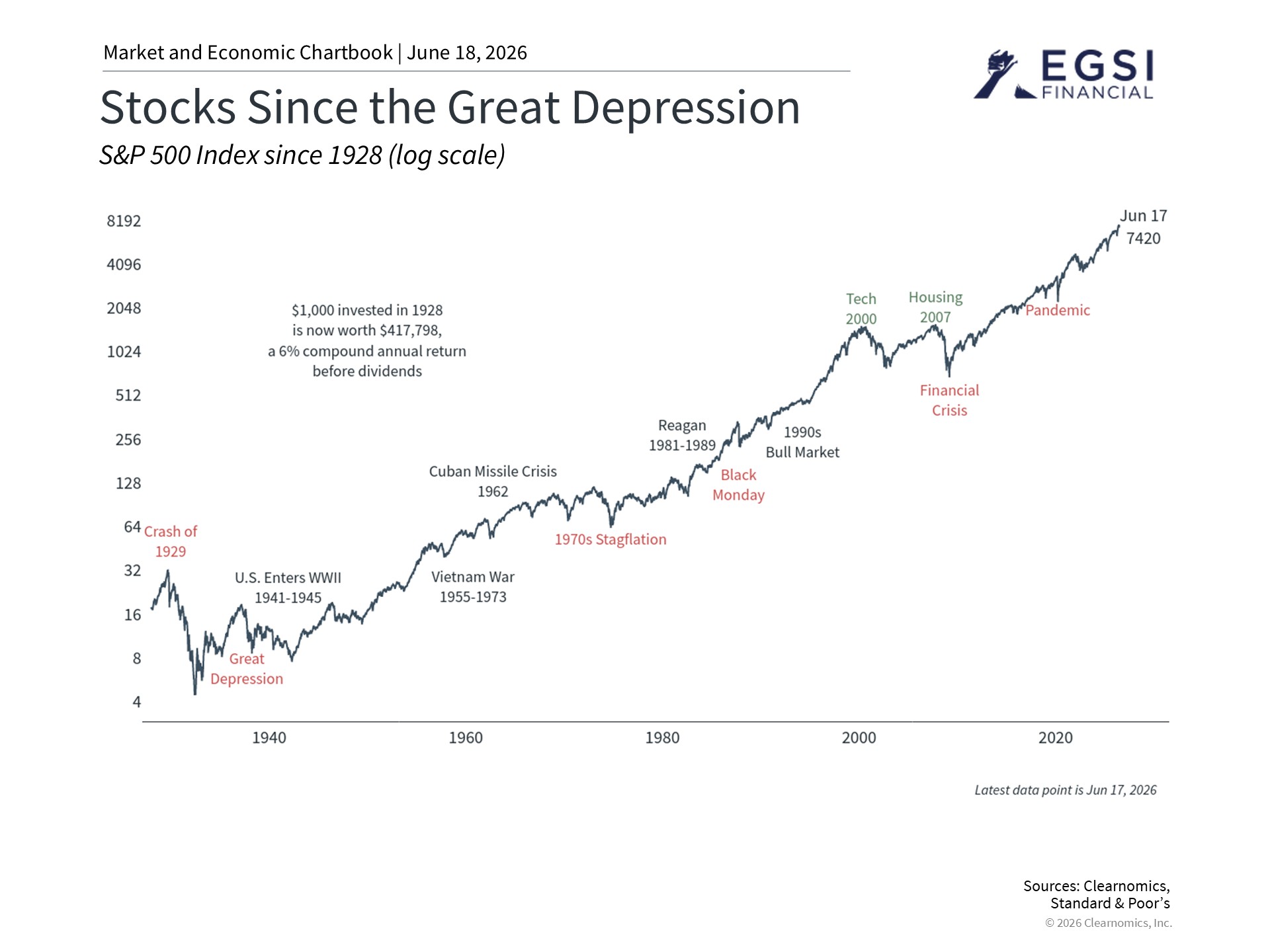
Over the past hundred years, geopolitical events such as wars, oil embargoes, and regional crises have repeatedly tested financial markets. While these events often caused short-term market swings, markets typically recovered and moved higher over time, even when the underlying situations were not fully resolved. As the chart above illustrates, what drove long-term investment returns was not any single event, but rather the broader economic and market cycles playing out over time.
The announcement of a preliminary peace deal is undoubtedly a positive development. That said, well-constructed portfolios do not depend on any single event to perform well over time. Lower energy prices should ease inflation, give households more purchasing power, and reduce the cost burden on businesses that rely on transportation. All of these factors support the broader economy. This moment also serves as a timely reminder of the value of staying invested and keeping a focus on long-term financial goals rather than reacting to short-term news.
The bottom line? A preliminary U.S.-Iran peace agreement has lifted markets and pushed oil prices lower. For investors, history shows that the best way to navigate geopolitical events is to focus on long-term trends and financial goals.
References
1. Clearnomics research, CME Group data as of June 12, 2026
2. https://www.bls.gov/news.release/cpi.nr0.htm
3. Asset classes included are MSCI Emerging Markets Index (EM), MSCI Developed Markets Index (EAFE), MSCI World Small Cap Index (Small Cap), S&P 500, balanced portfolio, fixed income, and MSCI World Commodity Producers Index (Commod.). The balanced portfolio is a historical 60/40 portfolio consisting of 40% U.S. large cap, 5% small cap, 10% international developed equities, 5% emerging market equities, 35% U.S. bonds, and 5% commodities.
4. Clearnomics research, Standard & Poor’s data through June 12, 2026
5. Clearnomics research, Bloomberg index data through June 12, 2026
6. Clearnomics research, MSCI index data through June 12, 2026
Index Descriptions
S&P 500
The Standard & Poor’s 500 Index is a capitalization-weighted index of 500 stocks designed to measure performance of the broad domestic economy through changes in the aggregate market value of 500 stocks representing all major industries.
The modern design of the S&P 500 stock index was first launched in 1957. Performance prior to 1957 incorporates the performance of the predecessor index, the S&P 90.
MSCI Emerging Markets Index
The MSCI EM (Emerging Markets) Index is a free float-adjusted market capitalization weighted index that is designed to measure the equity market performance of the emerging market countries of the Americas, Europe, the Middle East, Africa and Asia. The MSCI EM Index consists of the following emerging market country indices: Brazil, Chile, Colombia, Mexico, Peru, Czech Republic, Egypt, Greece, Hungary, Poland, Qatar, Russia, South Africa, Turkey, United Arab Emirates, China, India, Indonesia, Korea, Malaysia, Philippines, Taiwan, and Thailand.
MSCI EAFE Index
The MSCI EAFE Index is a free float-adjusted market capitalization index that is designed to measure the equity market performance of developed markets, excluding the US & Canada. The MSCI EAFE Index consists of the following developed country indices: Australia, Austria, Belgium, Denmark, Finland, France, Germany, Hong Kong, Ireland, Israel, Italy, Japan, the Netherlands, New Zealand, Norway, Portugal, Singapore, Spain, Sweden, Switzerland and the UK.
Bloomberg US Aggregate Bond Index
The Bloomberg U.S. Aggregate Bond Index is an index of the U.S. investment-grade fixed-rate bond market, including both government and corporate bonds.
We are an independent financial services firm helping individuals create retirement strategies using a variety of investment and insurance products to custom suit their needs and objectives.
Advisory services offered through EGSI Investment Management, Inc., a Registered Investment Advisor with the State of Ohio. Insurance services offered through EGSI Financial, Inc.
Investing involves risk, including the potential loss of principal. No investment strategy can guarantee a profit or protect against loss in periods of declining values. None of the information contained on this website shall constitute an offer to sell or solicit any offer to buy a security or any insurance product.
Any references to protection benefits, safety, security, or steady and lifetime income streams on this website refer only to fixed insurance products. They do not refer, in any way, to securities or investment advisory products. Annuity guarantees are backed by the financial strength and claimspaying ability of the issuing insurance company. Annuities are insurance products that may be subject to fees, surrender charges and holding periods which vary by insurance company. Annuities are not FDIC insured.
The information and opinions contained in any of the material requested from this website are provided by third parties and have been obtained from sources believed to be reliable, but accuracy and completeness cannot be guaranteed. They are given for informational purposes only and are not a solicitation to buy or sell any of the products mentioned. The information is not intended to be used as the sole basis for financial decisions, nor should it be construed as advice designed to meet the particular needs of an individual’s situation.