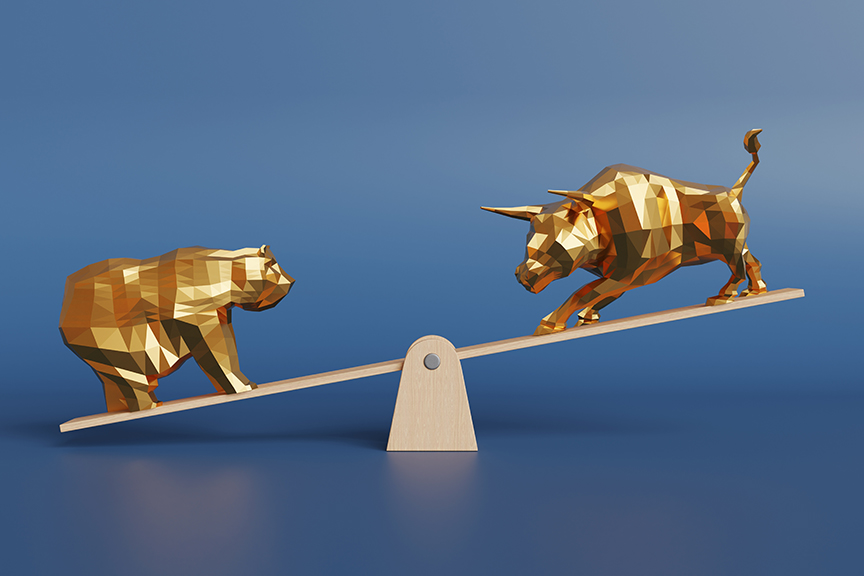

May 2026 was a rewarding month for investors. Major stock market indexes climbed to new all-time highs, even as the bond market dealt with pressure from rising inflation concerns. The S&P 500 (a widely followed measure of U.S. stock market performance) rose above 7,500 for the first time ever, driven largely by strong performance from technology companies. Meanwhile, long-term interest rates (the cost of borrowing money over many years) climbed to levels not seen in nearly two decades, before easing later in the month as oil prices pulled back. Hopes for a peace agreement in Iran also gave markets a lift, though the situation there remains fluid.
May also brought a notable change in leadership at the Federal Reserve (the U.S. central bank that manages interest rates and monetary policy) for the first time since 2018. Kevin Warsh was sworn in as the new Fed Chair, replacing Jerome Powell. Leadership changes at the Fed naturally prompt questions about what comes next for interest rates and the broader economy. However, history shows that markets and the economy have generally performed well under a wide range of Fed leaders. For long-term investors, the recent stock market strength is a positive sign, though keeping a well-balanced portfolio remains important for navigating all phases of the market cycle.
Key Market and Economic Highlights for May
• The S&P 500, Nasdaq, and Dow Jones Industrial Average gained 5.1%, 8.4%, and 2.8%, respectively, during the month. All three major U.S. indexes finished May at new all-time highs.
• Market volatility (a measure of how much prices are swinging up and down) fell over the month, as tracked by the CBOE VIX index, which ended May at 15.32.
• International developed markets (stocks from wealthy countries outside the U.S.) returned 2.6% based on the MSCI EAFE Index in U.S. dollar terms, while emerging markets (stocks from developing countries) returned 9.5% based on the MSCI EM Index.
• The 30-year Treasury yield (the interest rate on long-term U.S. government bonds) reached 5.18%, its highest level in nearly two decades, before finishing the month below 5%. The 10-year Treasury yield rose to 4.4%. The Bloomberg U.S. Aggregate Bond Index returned 0.3% for the month.
• Oil prices declined, with Brent crude closing at approximately $92 per barrel and WTI at $88.
• Gold ended the month slightly lower at $4,539 per ounce. The U.S. Dollar Index stood at 98.94, also down only slightly.
• First quarter real GDP (a measure of economic growth after adjusting for inflation) was revised lower from 2.0% quarter-over-quarter to 1.6%. April inflation showed headline CPI at 3.8% year-over-year and core CPI at 2.8%.
Long-term interest rates climbed before pulling back
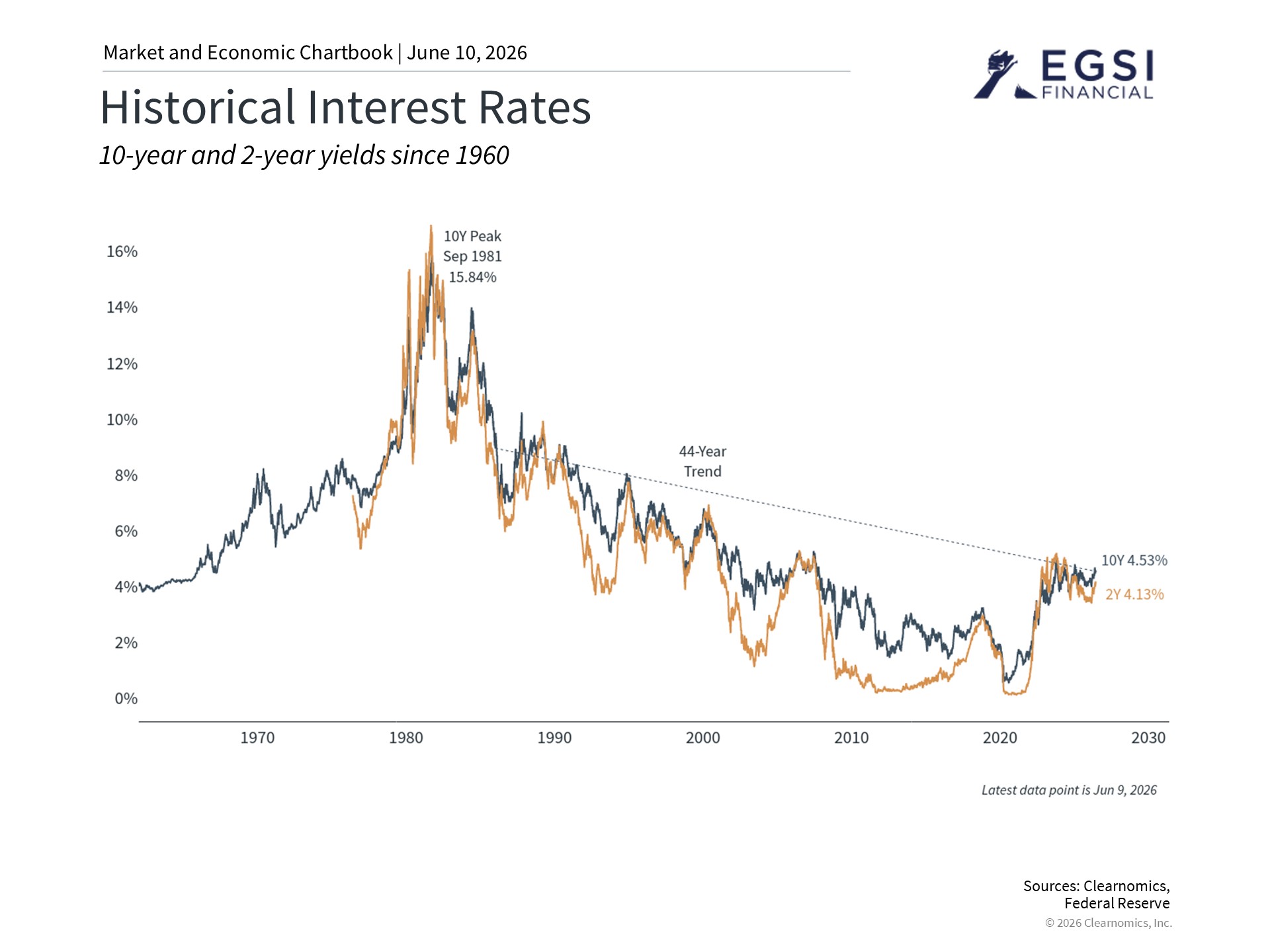
One of the biggest stories in May was the sharp movement in interest rates. The 30-year U.S. Treasury yield (the rate the government pays to borrow money for 30 years) hit its highest point in nearly two decades during the month, before settling back below 5%.1 Both the 10-year and 2-year yields also moved higher, as more investors came to believe that interest rates would remain elevated for a longer period. Markets are now pricing in at least one rate increase by the Fed by mid-2027, driven by ongoing inflation concerns.
This rate move was triggered by inflation reports that came in higher than expected. Both the Consumer Price Index (CPI, which tracks what everyday consumers pay for goods and services) and the Producer Price Index (PPI, which tracks costs for businesses) rose more than anticipated, largely due to higher energy prices. When inflation rises, interest rates tend to follow, because investors want more compensation when the purchasing power of money is declining. Some economists worry that if fuel prices stay elevated for a long time, higher costs could spread across a wide range of goods and services. Gasoline prices have eased slightly to around $4.30 per gallon on average nationwide, but this is still about $1.50 higher than before the conflict in Iran began.2
Higher interest rates touch nearly every part of the economy. For everyday consumers, they translate directly into higher borrowing costs, including higher rates on personal loans and mortgages. Businesses also feel the impact, since it becomes more expensive to finance day-to-day operations or borrow money to expand.
In financial markets, rising interest rates reduce the present-day value of future earnings and cash flows, which can put pressure on asset prices. On the other hand, higher yields also mean that bonds are now offering more meaningful income than they have in years, which can actually be a benefit for investors who hold a diversified mix of assets.
It is worth keeping some perspective here. Markets have moved significantly in both directions this year as news about a potential peace deal has shifted back and forth. Interest rates have also proven very hard to forecast over recent years. While rates remain elevated today, they are still well below the levels many had feared when inflation was running much hotter and the Fed was actively raising rates.
The stock market hit new record highs in May
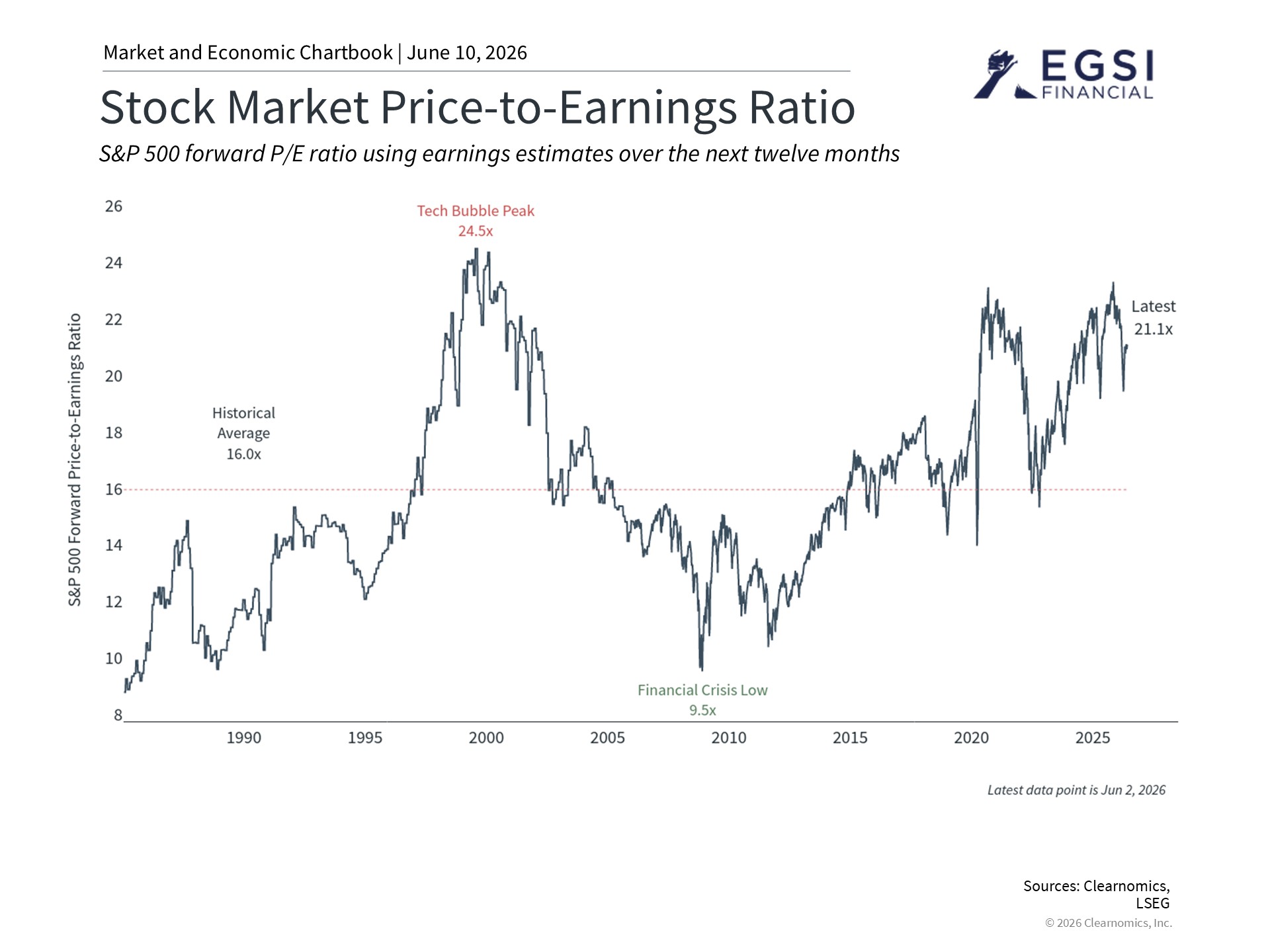
Despite the headwinds from higher interest rates, the stock market continued to set new records. The S&P 500 surpassed 7,500 in May for the first time, and there have been 22 all-time highs recorded this year through the end of May.3 While the Magnificent 7 and other large technology companies have continued to be key drivers of market performance, the overall rally has been broader than in some previous years, with more sectors and company sizes participating.
This favorable market environment has sparked growing interest in upcoming IPOs (initial public offerings, which is when a private company sells shares to the public for the first time) from companies such as SpaceX, Anthropic, OpenAI, and others. These companies have grown mainly through private funding. Over the past two decades, there has been a clear trend of companies waiting longer before going public. While a lot of attention tends to focus on what happens to a stock price right after an IPO, the bigger long-term benefit is that IPOs give all investors access to a wider range of companies. Looking at today’s large technology companies as an example, what has mattered most is not their IPO day price, but how they have grown and performed over the decades since.
It is not unusual for major indexes to reach new all-time highs during a bull market (a period of rising stock prices). Historically, markets have trended upward over long periods of time, which means they naturally spend a lot of time near record levels. What matters more than whether the market is at a new high is whether the underlying economy and businesses remain on solid footing. Corporate earnings (the profits companies make) have continued to grow at a healthy pace, with analysts expecting further growth in the year ahead.4
Strong earnings growth has helped keep valuations (a way of measuring whether stocks are expensive or cheap relative to company earnings) relatively stable even as the market has climbed. The S&P 500 price-to-earnings ratio, which compares stock prices to company profits, is hovering around 20.9x, which is within the range seen over the past several years. That said, this level is still well above long-term historical averages. High valuations do not tell us exactly what the market will do in the short term, but they are an important factor to consider when building a long-term portfolio. Spreading investments across different sectors, company sizes, and investment styles can help manage risk while still allowing investors to benefit from broader market trends.
Kevin Warsh takes over as the new Fed Chair
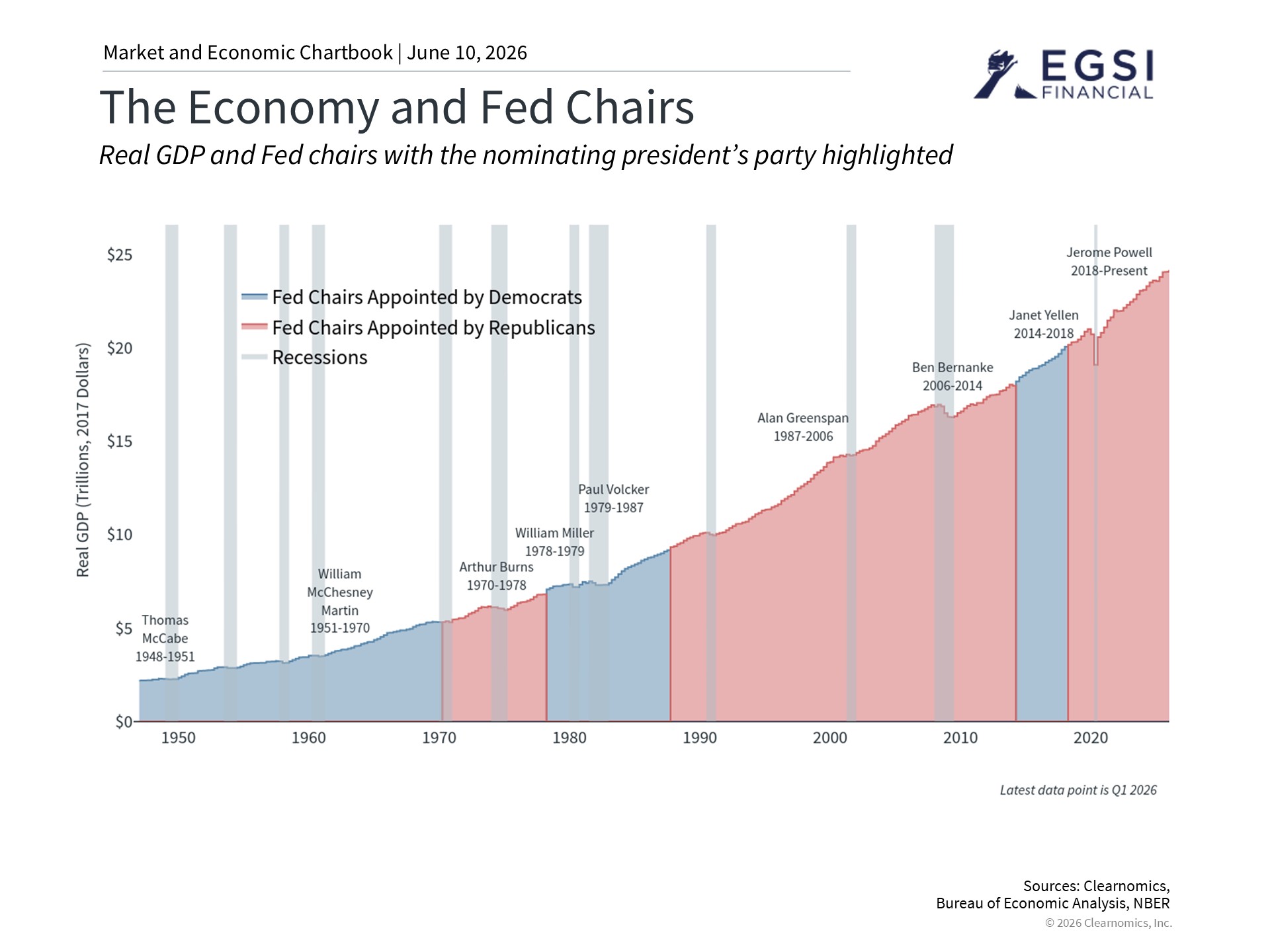
Kevin Warsh was sworn in as the new Chair of the Federal Reserve in May, taking over from Jerome Powell. Warsh is not new to the Fed, having previously served on its Board of Governors during the 2008 global financial crisis. Because of this background, markets view him as a familiar figure who understands monetary policy and financial markets well.
Changes in Fed leadership do not happen often, so they tend to raise questions about what direction policy might take in the years ahead. Warsh is seen as someone who wants to reform the way the Fed operates, which can create some additional uncertainty about future decisions. In his recent Senate testimony, Warsh stressed that the Fed must remain independent from political influence and act in the best interests of the country. He has also indicated a preference for a more narrowly focused central bank, and his past views have leaned toward being cautious about inflation risks.
Regardless of any reforms Warsh may pursue, the Fed faces a genuinely difficult economic environment right now. The overall economy is still in reasonably good shape, but inflation has been picking up in recent months while the job market has sent mixed signals. Normally, a weaker job market would call for lower interest rates to encourage hiring, while rising inflation would suggest keeping rates higher. This creates a challenging balancing act, and markets have shifted from expecting further rate cuts to now anticipating at least one rate increase.
For investors, the historical record offers some reassurance. The economy has grown through the terms of many different Fed chairs, across different political environments and policy approaches. Over the long run, what drives investment returns most is corporate earnings growth, productivity improvements, population trends, and technological innovation. A change in Fed leadership can create short-term uncertainty, but it rarely changes these deeper, longer-term forces.
The bottom line? May brought new milestones for the stock market, extending a strong run for investors. While headlines around inflation, the new Fed Chair, and geopolitics will likely continue to generate uncertainty, the best approach for investors is still to focus on their long-term financial goals.
References
1. https://home.treasury.gov/policy-issues/financing-the-government/interest-rate-statistics
2. https://gasprices.aaa.com/
3. Clearnomics research based on Standard & Poor’s index data
4. Clearnomics research based on LSEG earnings data
5. https://www.cmegroup.com/markets/interest-rates/cme-fedwatch-tool.html
Index Descriptions
S&P 500
The Standard & Poor’s 500 Index is a capitalization-weighted index of 500 stocks designed to measure performance of the broad domestic economy through changes in the aggregate market value of 500 stocks representing all major industries.
Dow Jones
The Dow Jones Industrial Average is comprised of 30 stocks that are major factors in their industries and widely held by individuals and institutional investors.
NASDAQ
The NASDAQ Composite Index measures all NASDAQ domestic and non-U.S. based common stocks listed on The NASDAQ Stock Market. The market value, the last sale price multiplied by total shares outstanding, is calculated throughout the trading day, and is related to the total value of the Index.
MSCI Emerging Markets Index
The MSCI EM (Emerging Markets) Index is a free float-adjusted market capitalization weighted index that is designed to measure the equity market performance of the emerging market countries of the Americas, Europe, the Middle East, Africa and Asia. The MSCI EM Index consists of the following emerging market country indices: Brazil, Chile, Colombia, Mexico, Peru, Czech Republic, Egypt, Greece, Hungary, Poland, Qatar, Russia, South Africa, Turkey, United Arab Emirates, China, India, Indonesia, Korea, Malaysia, Philippines, Taiwan, and Thailand.
MSCI EAFE Index
The MSCI EAFE Index is a free float-adjusted market capitalization index that is designed to measure the equity market performance of developed markets, excluding the US & Canada. The MSCI EAFE Index consists of the following developed country indices: Australia, Austria, Belgium, Denmark, Finland, France, Germany, Hong Kong, Ireland, Israel, Italy, Japan, the Netherlands, New Zealand, Norway, Portugal, Singapore, Spain, Sweden, Switzerland and the UK.
Bloomberg US Aggregate Bond Index
The Bloomberg U.S. Aggregate Bond Index is an index of the U.S. investment-grade fixed-rate bond market, including both government and corporate bonds.
We are an independent financial services firm helping individuals create retirement strategies using a variety of investment and insurance products to custom suit their needs and objectives.
Advisory services offered through EGSI Investment Management, Inc., a Registered Investment Advisor with the State of Ohio. Insurance services offered through EGSI Financial, Inc.
Investing involves risk, including the potential loss of principal. No investment strategy can guarantee a profit or protect against loss in periods of declining values. None of the information contained on this website shall constitute an offer to sell or solicit any offer to buy a security or any insurance product.
Any references to protection benefits, safety, security, or steady and lifetime income streams on this website refer only to fixed insurance products. They do not refer, in any way, to securities or investment advisory products. Annuity guarantees are backed by the financial strength and claimspaying ability of the issuing insurance company. Annuities are insurance products that may be subject to fees, surrender charges and holding periods which vary by insurance company. Annuities are not FDIC insured.
The information and opinions contained in any of the material requested from this website are provided by third parties and have been obtained from sources believed to be reliable, but accuracy and completeness cannot be guaranteed. They are given for informational purposes only and are not a solicitation to buy or sell any of the products mentioned. The information is not intended to be used as the sole basis for financial decisions, nor should it be construed as advice designed to meet the particular needs of an individual’s situation.