

Investors often look at past data even though they know the future matters most. Recent reports show backward-looking information that worries some investors and government officials about the economy. Some people wonder if we’ll have a recession. Right now, there are signs that the job market is slowing down and prices are still rising, but unemployment is still low and the overall economy is still growing. For people investing for the long term, these mixed signals make it more important than ever to keep a balanced view.
Looking at economic data is hard, and understanding market factors is never simple. During times like these, it helps to focus less on news headlines and more on the basic parts of the economy. Often, the best place to start is looking at how consumers are doing financially. This is because consumer spending makes up over two-thirds of all economic activity and directly affects company profits and the broader economy. So how are consumers doing in today’s complicated economic situation?
Jobs have become harder to find in recent months
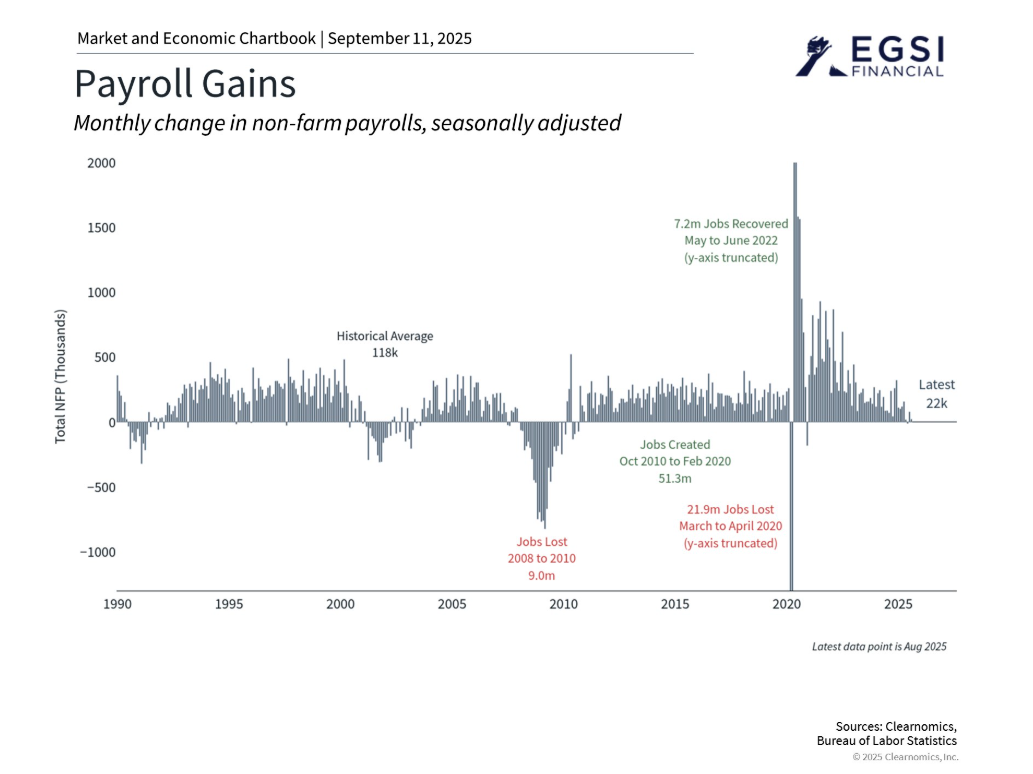
To understand how consumers are doing financially, we need to look at the job market. The latest jobs report showed more proof that the labor market is slowing down more than people expected. Only 22,000 jobs were added in August according to the Bureau of Labor Statistics. This was much lower than the 75,000 that economists thought would be added. The report also changed numbers from earlier months. June’s job numbers now show the economy actually lost 13,000 jobs that month, which was the first drop since 2020.
While these numbers are important and have been talked about a lot in financial news, economists don’t just look at the main job numbers, which can change a lot from month to month. Instead, they look at trends and consider something called “labor market slack.” This simply means whether people who are looking for work can find it.
Fed Chair Jerome Powell recently said the current job market is in “a curious kind of balance” because both the number of workers available and the demand for them have slowed down.1 The good news is that the unemployment rate is only 4.3%, which shows that many people who want to work are able to find jobs. The “under-employment” rate, which includes workers who have given up looking, is also still very low at 8.1%. Other reports show there is still about one job opening for each unemployed person across the country. While this doesn’t mean everyone will find a job, it shows that companies are still hiring.
This matters because, when we look at it along with the job numbers, it suggests the labor market is cooling down slowly rather than crashing suddenly. The important difference is that big jumps in unemployment have historically only happened because of economic shocks, like the 2008 financial crisis or the 2020 pandemic. The current situation seems to show natural changes in the economy. For the Fed (which is the central bank), this employment path makes it more likely they will cut interest rates starting in September.
Consumer money situations show strength despite problems
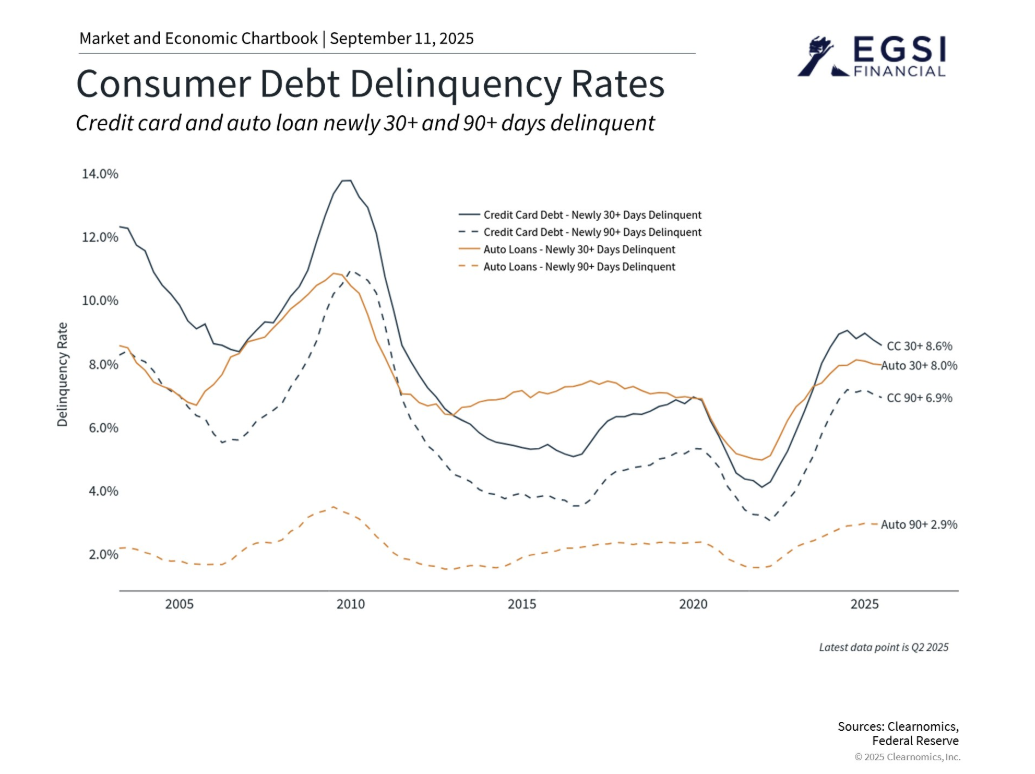
While the job market is getting softer, consumer finances overall are showing signs of a “two-speed economy.” This means financial situations are different based on things like wealth and income levels. Many investors have focused on these numbers because the total amount of debt keeps rising across credit cards, car loans, student loans, and more. When households borrow more money, it can be a problem if there’s an economic downturn. This factor helped start the financial crisis in 2008.
One way to understand if there are problems in household finances is to see if bills are being paid on time. The chart above shows that credit card and car loan late payments have gone up over the past two years. This is partly because consumers are borrowing more money and, more recently, because interest rates are higher. This rise in late payments has mostly happened among borrowers with lower credit scores, which gives more proof of a two-speed economy.
However, the chart also shows that these late payment rates have stopped rising recently and are still much lower than levels we saw before 2008. And while the total amount of debt is high across the country, the amount that households are paying on their debt has stayed flat in recent months. This suggests that while some households may feel more stretched as they pay interest and principal on their loans, these numbers are not yet at levels that have historically led to recessions.
Household wealth stays near record high levels
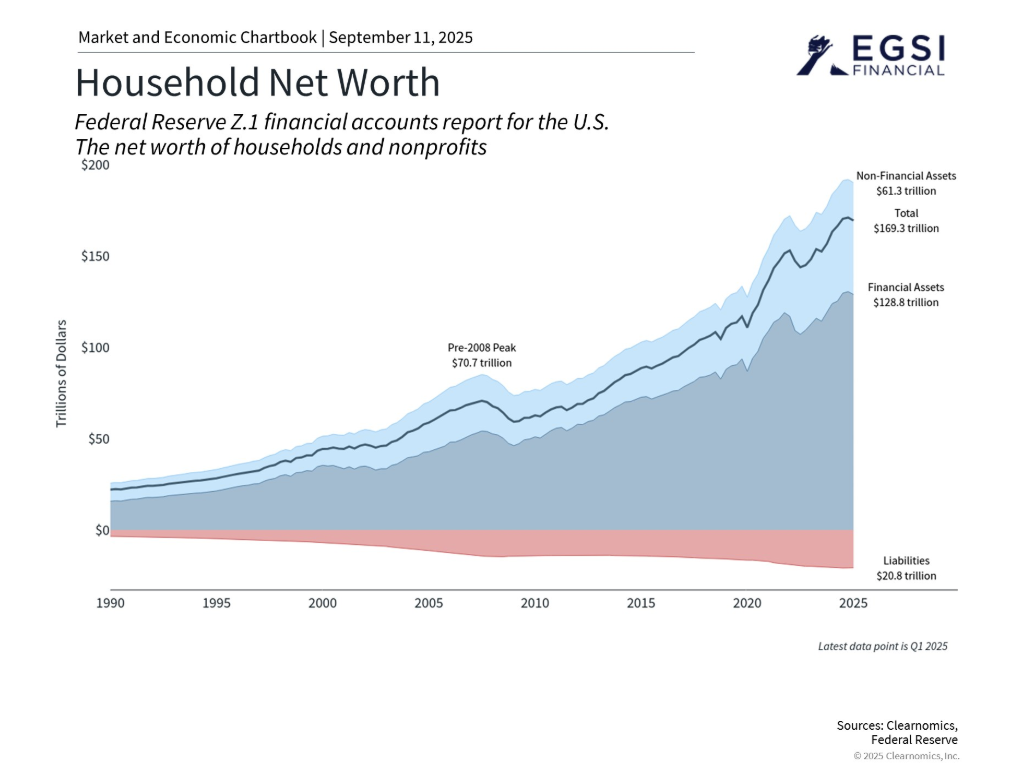
It’s easy to focus only on the debt side of consumers’ finances, since this is often where problems start. However, the asset side (what people own) is just as important, and U.S. household net worth (assets minus debts) is still near record levels today. This is shown in the chart above.
At $169 trillion, net worth has grown over the past 15 years because of steady economic growth, rising home prices, and strong stock market returns. Again, this shows a two-speed economy since the households that have borrowed more money in recent years may not be the same households that are benefiting from rising asset prices. Still, this wealth effect, where rising asset values help support consumer spending, can help provide economic stability. This is one reason why the many worries of the past few years have not always directly led to a weaker economy.
This also reminds us what creates wealth over time, and why it’s important to have a portfolio that fits your financial goals. During this period, there were many times when investors worried about recessions. While markets can react to bad news or experience drops in the short term, they often “climb the wall of worry” in the long term. For patient investors, focusing on where the long-term economy is headed is much more important than thinking about where it’s been.
The bottom line? While the job market has slowed down, making Fed rate cuts more likely starting in September, it is only one part of the overall economic picture. When the future is uncertain, investors should focus on the basic economic trends to stay balanced in their portfolios.
We are an independent financial services firm helping individuals create retirement strategies using a variety of investment and insurance products to custom suit their needs and objectives.
Advisory services offered through EGSI Investment Management, Inc., a Registered Investment Advisor with the State of Ohio. Insurance services offered through EGSI Financial, Inc.
Investing involves risk, including the potential loss of principal. No investment strategy can guarantee a profit or protect against loss in periods of declining values. None of the information contained on this website shall constitute an offer to sell or solicit any offer to buy a security or any insurance product.
Any references to protection benefits, safety, security, or steady and lifetime income streams on this website refer only to fixed insurance products. They do not refer, in any way, to securities or investment advisory products. Annuity guarantees are backed by the financial strength and claimspaying ability of the issuing insurance company. Annuities are insurance products that may be subject to fees, surrender charges and holding periods which vary by insurance company. Annuities are not FDIC insured.
The information and opinions contained in any of the material requested from this website are provided by third parties and have been obtained from sources believed to be reliable, but accuracy and completeness cannot be guaranteed. They are given for informational purposes only and are not a solicitation to buy or sell any of the products mentioned. The information is not intended to be used as the sole basis for financial decisions, nor should it be construed as advice designed to meet the particular needs of an individual’s situation.
Investing involves risk, including the potential loss of principal. No investment strategy can guarantee a profit or protect against loss in periods of declining values. None of the information contained on this website shall constitute an offer to sell or solicit any offer to buy a security or any insurance product.
Any references to protection benefits or steady and reliable income streams on this website refer only to fixed insurance products. They do not refer, in any way, to securities or investment advisory products. Annuity guarantees are backed by the financial strength and claims-paying ability of the issuing insurance company. Annuities are insurance products that may be subject to fees, surrender charges and holding periods which vary by insurance company. Annuities are not FDIC insured.
The information and opinions contained in any of the material requested from this website are provided by third parties and have been obtained from sources believed to be reliable, but accuracy and completeness cannot be guaranteed. They are given for informational purposes only and are not a solicitation to buy or sell any of the products mentioned.