

Nelson Mandela famously said that “education is the most powerful weapon which you can use to change the world.” For many families, paying for a child’s education is a major financial goal, but education costs have risen sharply over the years. Grandparents often want to help pay for their grandchildren’s education, partly because it creates a meaningful legacy that goes beyond a typical gift.
In the past, grandparents had to follow specific rules when giving money to grandchildren to avoid unexpected problems, including issues related to taxes and financial aid eligibility. Recently, however, federal financial aid rules changed so that grandparent-owned 529 accounts (special savings accounts designed for education) are no longer counted against a student when calculating financial aid. This removes a key downside that these accounts used to have. As a result, these accounts are worth a fresh look as part of a family’s overall plan for funding education.
The rising cost of a college education
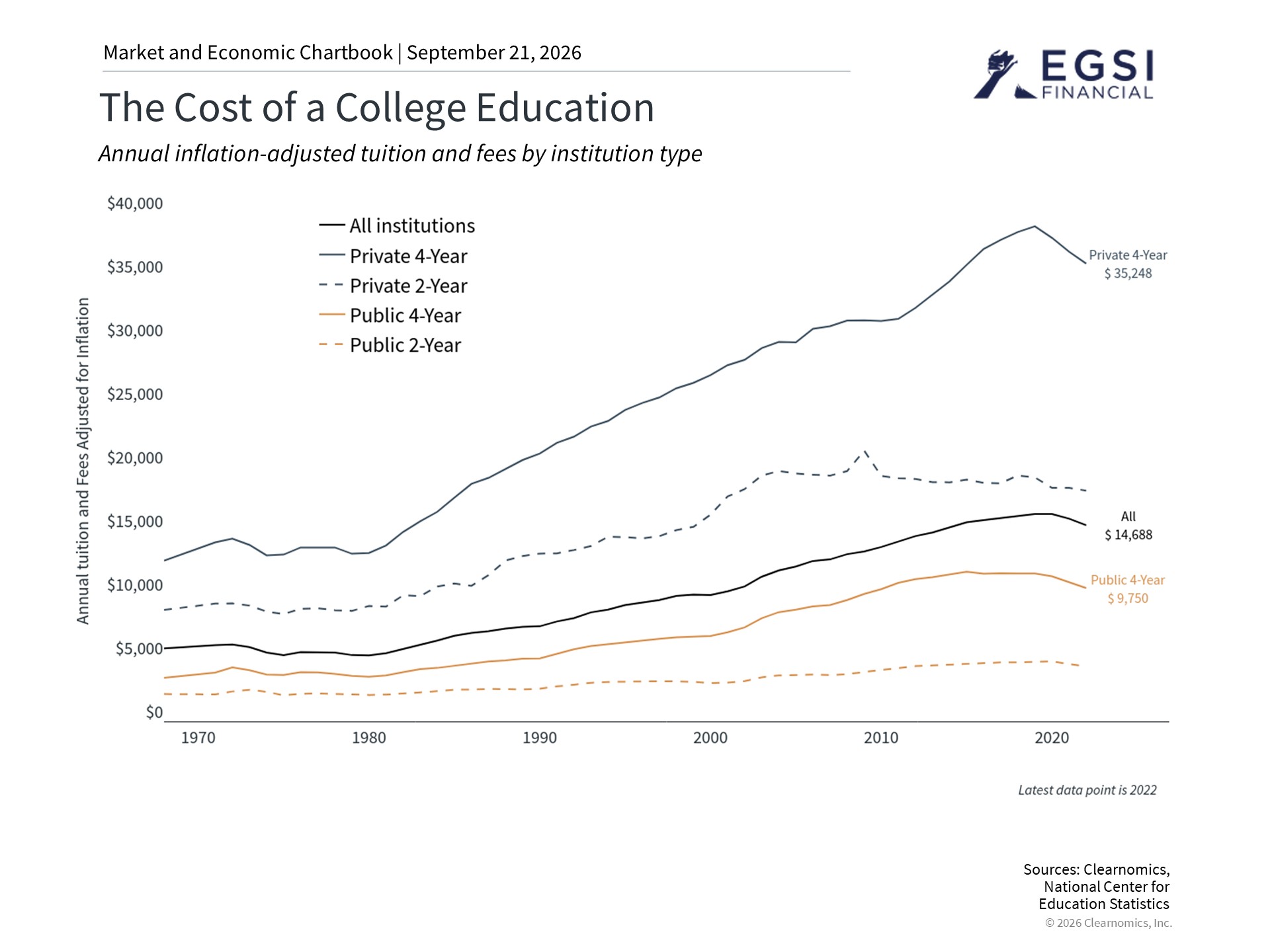
Going to college is an exciting milestone, but it is also one of the biggest financial challenges many families face. College costs have grown much faster than general inflation over the past 40 years. The chart above shows average tuition and fees after adjusting for inflation, based on data from the National Center for Education Statistics going back to 1963. The upward trend is clear, particularly for private four-year colleges and universities.
Tuition and fees are just one part of the total cost. Families also need to cover housing, food, books, transportation, and other education-related expenses, which now average more than $17,000 per year according to the College Board.1 These numbers confirm what most families already sense: starting to plan and save early is very important.
Most families pay for college using a mix of sources. These can include income and savings from parents and students, scholarships and grants, loans, and sometimes financial help from relatives and friends. This is where grandparent-owned 529 accounts can be especially useful.
Although parents often open 529 accounts for their children, grandparents can open their own 529 accounts for their grandchildren too. In the past, this approach was not always the best choice. That is because money withdrawn from a grandparent-owned 529 plan to pay for college used to be counted as student income on the FAFSA form, which is the form students fill out to apply for federal financial aid.2
A recent rule change has updated this calculation. Under the old rules, student income was counted at a rate of 50% when determining the Student Aid Index (SAI), which is the number used to figure out how much financial aid a student qualifies for. Withdrawals from grandparent-owned 529 accounts were included in this student income figure.3 Now, grandparent-owned 529 accounts are no longer treated this way, which makes them a more attractive option for families.
Higher education can support a lasting legacy
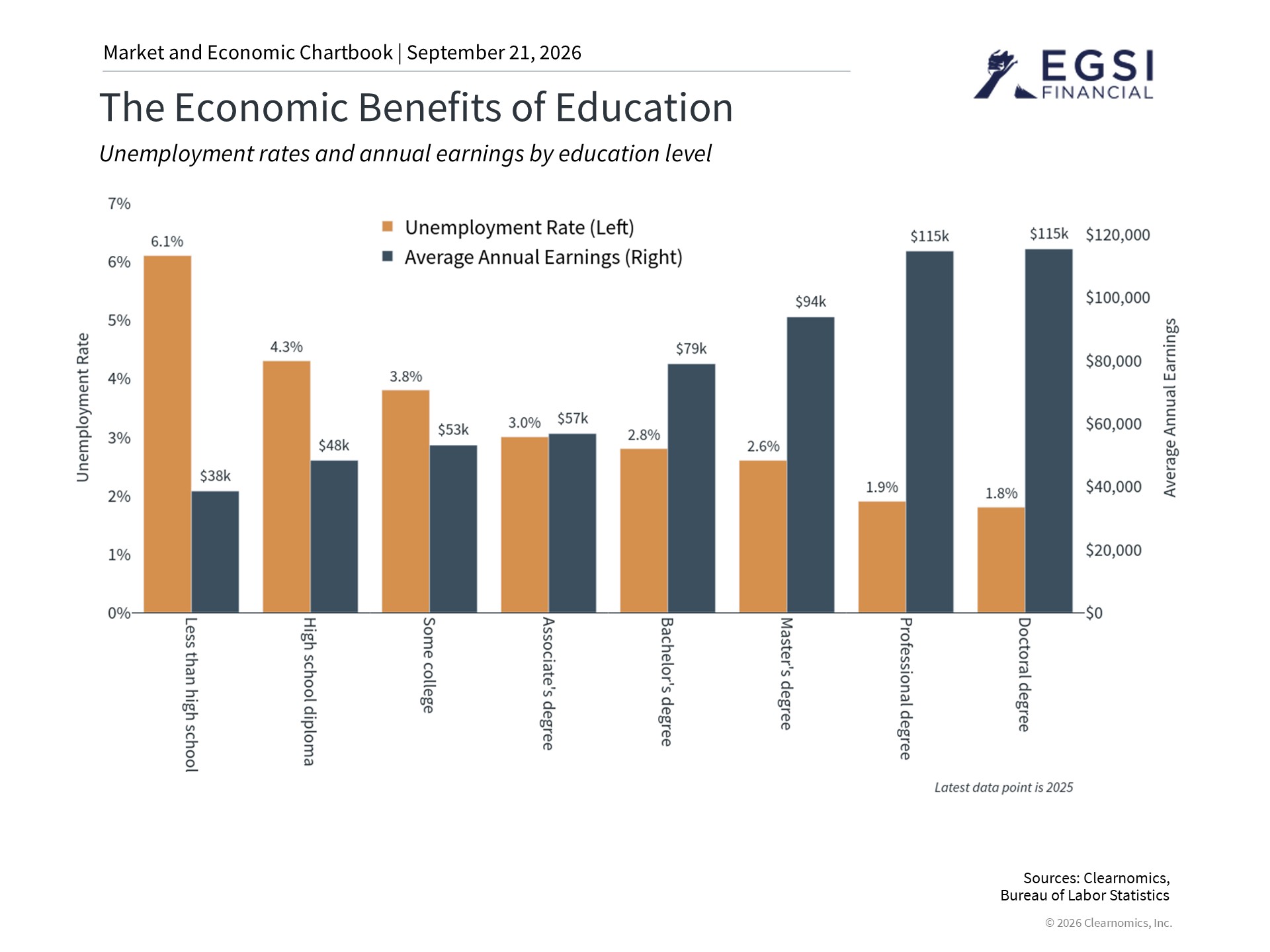
Even with rising costs, the latest data from the Bureau of Labor Statistics shows that earning a higher degree still pays off over a lifetime. People with more education tend to earn higher average wages and are less likely to be unemployed. For example, someone with only a high school diploma has an unemployment rate of 4.3%, which is close to the national average. By comparison, people with a bachelor’s degree have an average unemployment rate of 2.8%, and those with professional or doctoral degrees have rates below 2%.4 Helping grandchildren get a strong educational foundation is one powerful way to leave a lasting legacy.
One helpful feature of grandparent-owned 529 accounts is that the grandparent keeps control of the money. This includes deciding when to take money out and having the ability to change who the account is for, known as the “beneficiary,” to another qualifying family member or even to themselves. This flexibility matters because education plans can change. A grandchild might earn a scholarship, choose a less expensive school, or decide not to finish college. In any of these situations, families have several options for any unused funds.
The SECURE 2.0 Act, a recent law, allows up to $35,000 to be moved from a 529 account into the grandchild’s Roth IRA (a type of retirement savings account) over their lifetime, free from taxes and penalties, as long as certain conditions are met.5 One key condition is that the 529 account must have been open in the grandchild’s name for at least 15 years. It is also important to note that standard annual Roth IRA contribution limits and earned income requirements still apply.
Another option is using up to $10,000 from a 529 account to pay off qualified federal or private student loans. This can apply to the main account beneficiary or their siblings.6 Also, starting in 2026, grandparents can withdraw up to $20,000 per year, per grandchild, tax-free to cover K-12 (kindergarten through twelfth grade) private school tuition.
529 accounts have lifetime limits on total contributions, which vary by state. However, there is no annual cap on how much can be contributed, making them useful for estate planning and gifting purposes. For 2026, a grandparent can give up to $19,000 per year to each grandchild without having to report it as a federal gift for tax purposes.7
A grandparent who wants to contribute a larger amount can choose to “front-load” up to five years of gifts all at once, which adds up to as much as $95,000.8 A key advantage of doing this is that the money has more time to grow in a tax-free environment.
Depending on the state where a grandparent lives, there may be additional benefits.9 More than 30 states offer an income tax deduction or credit for certain 529 contributions. In most cases, this tax benefit is tied to using the grandparent’s home-state plan. However, nine states offer “tax parity,” meaning the tax benefit applies to contributions made to any state’s 529 plan.
All things considered, 529 accounts can be a powerful tool for financial planning when used thoughtfully. This is especially true as more families look for tax-efficient ways to help cover college costs and reduce reliance on student loans. Grandparents can play an important role in that effort, and 529 plans offer a tax-friendly way to do so. Of course, while helping pay for a grandchild’s education is a generous gesture, any contributions should be balanced carefully against a grandparent’s own retirement needs and long-term financial goals.
The bottom line? Grandparents can leave a lasting legacy for their grandchildren in many different ways, including grandparent-owned 529 accounts. With careful planning, they can strategically invest in their grandchildren’s future by helping with education costs using tax-efficient strategies.
References
1. https://research.collegeboard.org/media/pdf/Trends-in-College-Pricing-and-Student-Aid-2025-final_1.pdf
2. https://www.congress.gov/crs-product/R46909
3. https://www.congress.gov/crs-product/R48835
4. https://www.bls.gov/emp/
5. https://www.congress.gov/crs_external_products/R/HTML/R42807.html
6. https://www.irs.gov/taxtopics/tc313
7. https://www.irs.gov/faqs/interest-dividends-other-types-of-income/gifts-inheritances/gifts-inheritances-1
8. https://www.irs.gov/forms-pubs/about-form-709
9. https://www.irs.gov/newsroom/tax-benefits-for-education-information-center
We are an independent financial services firm helping individuals create retirement strategies using a variety of investment and insurance products to custom suit their needs and objectives.
Advisory services offered through EGSI Investment Management, Inc., a Registered Investment Advisor with the State of Ohio. Insurance services offered through EGSI Financial, Inc.
Investing involves risk, including the potential loss of principal. No investment strategy can guarantee a profit or protect against loss in periods of declining values. None of the information contained on this website shall constitute an offer to sell or solicit any offer to buy a security or any insurance product.
Any references to protection benefits, safety, security, or steady and lifetime income streams on this website refer only to fixed insurance products. They do not refer, in any way, to securities or investment advisory products. Annuity guarantees are backed by the financial strength and claims-paying ability of the issuing insurance company. Annuities are insurance products that may be subject to fees, surrender charges and holding periods which vary by insurance company. Annuities are not FDIC insured.
The information and opinions contained in any of the material requested from this website are provided by third parties and have been obtained from sources believed to be reliable, but accuracy and completeness cannot be guaranteed. They are given for informational purposes only and are not a solicitation to buy or sell any of the products mentioned. The information is not intended to be used as the sole basis for financial decisions, nor should it be construed as advice designed to meet the particular needs of an individual’s situation.
Investing involves risk, including the potential loss of principal. No investment strategy can guarantee a profit or protect against loss in periods of declining values. None of the information contained on this website shall constitute an offer to sell or solicit any offer to buy a security or any insurance product.
Any references to protection benefits or steady and reliable income streams on this website refer only to fixed insurance products. They do not refer, in any way, to securities or investment advisory products. Annuity guarantees are backed by the financial strength and claims-paying ability of the issuing insurance company. Annuities are insurance products that may be subject to fees, surrender charges and holding periods which vary by insurance company. Annuities are not FDIC insured.
The information and opinions contained in any of the material requested from this website are provided by third parties and have been obtained from sources believed to be reliable, but accuracy and completeness cannot be guaranteed. They are given for informational purposes only and are not a solicitation to buy or sell any of the products mentioned. The information is not intended to be used as the sole basis for financial decisions, nor should it be construed as advice designed to meet the particular needs of an individual’s situation.